
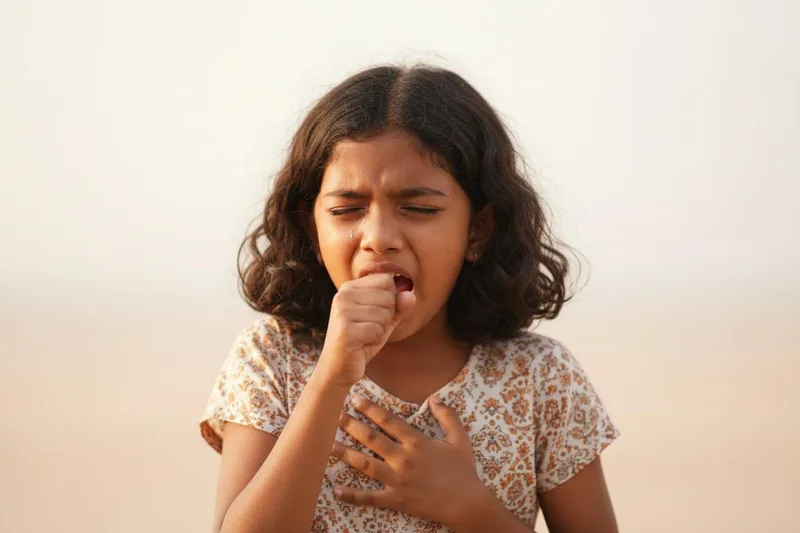
We've all had the experience of something we eat or drink "going the wrong way" and getting stuck in our throat. When that happens, we have to cough it up, with tears streaming down our eyes. Most of the time, it's not a problem when it comes out. But think about it, what happens if something that gets stuck in our throat, whether it's a piece of food, a little water, or a drop of saliva, doesn't go all the way to our stomach, but goes all the way to our lungs through the airways? That's how something that shouldn't go into the lungs gets into the lungs and causes a bacterial infection, which is what we simply call `(Aspiration Pneumonia)`.
Simply put, what is Aspiration Pneumonia?
Aspiration pneumonia is a bacterial infection of our lungs. It occurs when something other than the air we breathe - such as food, drink, saliva, stomach acid, vomit, or even a very small foreign object - enters our airways.
Imagine that there are two passages in our throat. One is the "esophagus" that takes food and drink to the stomach. The other is the "windpipe" that takes the air we breathe into the lungs. Normally, when we swallow something, this windpipe closes off with a small flap. So the food and drink go straight to the stomach. But sometimes, when this process doesn't work properly, the "wrong way" thing happens.
The scary thing is, some people don't even realize something is going into their lungs like this. We call this ``silent aspiration.'' That means it happens without any coughing or choking. Then it's days, maybe weeks, before the symptoms of pneumonia appear.
What are the symptoms of this condition?
Aspiration pneumonia may not cause symptoms right away, but you may experience these symptoms over a few days.
| Symptom | Description |
|---|---|
| Fever | The first sign of an infection in the body. It can also be accompanied by aching muscles. |
| Difficulty breathing (Dyspnea) | Breathing feels labored and suffocating. There may be a "whooshing" sound coming from the chest when breathing. |
| Cough | A cough that brings up mucus. Sometimes this mucus can be tinged with blood or pus . The mucus can be green, yellow, or brown. |
| Chest pain | You may feel a sharp pain in your chest when you take a deep breath or cough. |
| Bad breath | Bad breath can be caused by the growth of bacteria inside the lungs. |
| Excessive fatigue | You may feel extremely tired and sleepy as your body fights the infection. |
Why is this happening? Who is at higher risk?
Simply put, this condition can be caused by anything that doesn't belong in the lungs. Because bacteria can enter the lungs with those things. Some people are especially prone to this.
| Risk category | Why are they at greater risk? |
|---|---|
| People with swallowing difficulties (Dysphagia) | People with neurological diseases such as stroke, brain injury, and Parkinson's disease have impaired swallowing, which can easily cause food and drink to enter the airway. |
| Elderly people (over 65 years old) | As we age, the muscles involved in swallowing and coughing weaken. The immune system also weakens, making us more susceptible to infections. |
| Those who have undergone anesthesia or dental surgery | When you are under anesthesia, the protective reflexes in your throat are not activated, allowing saliva or stomach acid to enter your lungs. |
| People who use alcohol or drugs | These reduce consciousness and impair swallowing and coughing reflexes. |
| Young children (under 5 years old) | This risk is especially high for children who put small toys in their mouths and play while eating. |
| People with low immunity | For people with diseases or taking medications that weaken the immune system, even a small amount of bacteria entering the lungs can cause a serious infection. |
How do you find this, Doctor?
If you have symptoms of pneumonia, your doctor will first ask you about your symptoms, any other medical conditions you have, especially difficulty swallowing. Then they will listen to your chest with a stethoscope to check for any abnormal sounds in your lungs. These tests may be done to confirm the diagnosis.
- Chest X-ray: This can clearly show areas of infection in the lungs.
- CT Scan: Can produce clearer, more detailed images than X-rays.
- Blood tests: These can confirm whether there is an infection in the body.
- Sputum tests: A sample of phlegm from your lungs can be taken to find out what type of bacteria is in it.
- Bronchoscopy: In this, a thin tube with a camera attached is passed through the trachea into the lungs to observe the inside.
- Swallowing studies: A test performed by a speech pathologist to look at exactly what happens when you swallow to see if there is a problem with the swallowing process.
How is it treated? How long will it take to recover?
Since this is a bacterial infection, the main treatment is antibiotics . It is extremely important to take the antibiotics prescribed by your doctor for the full duration.
Depending on the severity of the illness, you may need to stay in the hospital for treatment.
- If there is difficulty breathing , oxygen therapy may be necessary.
- If the condition is very severe, you may be connected to a ventilator (mechanical ventilation) machine to assist with breathing.
In addition, it is essential to treat the underlying cause of the aspiration.
- Speech therapy for swallowing difficulties.
- Tube feeding is the feeding of food through a tube to those who cannot swallow.
- In some cases, medications such as ACE inhibitors are also used.
You will start to feel better about a week after starting antibiotics. However, it may take about a month for the fatigue caused by the infection to go away and for you to fully recover.
What to do in an emergency?
This is something you should keep in mind. You don't need to panic about everything, but it's important to know when to see a doctor and when to go to the emergency room.
When to see your doctor
If you often feel like food or drink is stuck in your throat, or you have difficulty swallowing, don't ignore it. Talk to your family doctor about this. He or she can refer you to a specialist if necessary.
Situations when you need to go to a hospital immediately
If you have symptoms like severe chest pain, high fever, and obvious difficulty breathing , it is an emergency. Pneumonia is a disease that can become serious very quickly. So go to a hospital's emergency room (ETU) without delay.
Can this situation be prevented?
Yes, there are several things we can do to reduce the risk of aspiration pneumonia. It is very important to be aware of these, especially if you belong to a risk group.
- Control underlying conditions: If you have conditions like difficulty swallowing or gastroesophageal reflux disease (GERD), talk to your doctor and get them treated properly.
- Eating posture: Sit up straight when eating and drinking. Do not lie down for at least 30 minutes after eating.
- Eat slowly and thoroughly: Chew your food thoroughly, eat slowly with small mouthfuls. Minimize talking and smiling while eating.
- Limit alcohol: Avoid excessive alcohol consumption.
- Avoid smoking: Smoking and tobacco products damage the protective mechanisms of the lungs.
- Oral health: Brush your teeth well and have your mouth checked regularly by a dentist. The fewer bacteria in your mouth, the less likely they are to get into your lungs and cause an infection.
A little extra knowledge: The difference between `Pneumonia` and `Pneumonitis`
Sometimes these two terms are confused. `Aspiration Pneumonia` is a bacterial infection caused by something that has entered the lungs. `Aspiration Pneumonitis` is simply an inflammation of the lung tissue caused by something like stomach acid entering the lungs, without an infection. Although the symptoms of both are similar, the treatments may be different.
Take-Home Message
- Although it is common for food and drink to "go the wrong way," sometimes it can lead to a serious lung infection like `Aspiration Pneumonia`.
- Fever, cough with mucus, difficulty breathing, and chest pain are the main symptoms.
- If you have persistent difficulty swallowing, be sure to talk to your doctor about it. Don't ignore it.
- If you develop severe symptoms such as severe chest pain, high fever, and difficulty breathing, immediately go to a hospital's Emergency Department (ETU).
- Sitting up straight, eating slowly, maintaining oral hygiene, and getting proper treatment for underlying conditions can help prevent this condition.


💬 Comments (0)
No comments yet. Be the first to share your thoughts here.
Add Your Comment