

When the doctor tells you that your little one has autism, it's normal for you, as a parent, to feel a great burden and a little fear. 'What do I do now? How can I help my child? What will his future be like?' Questions like these must have crossed your mind a hundred thousand times. Don't worry. You are not alone. Today we are talking about therapies that can help children with autism, enhance their abilities, and teach them how to live well in this world.
What really happens with these autism therapies?
First, there is something very important that we all need to understand. Autism is not a disease. It is not something that can be 'cured' or 'made away'. Simply put, autism is a difference in the way your child's brain works and processes information. We call this in medical terms ``Neurodivergence''. Just like some people are tall and some are short, some people's brains work differently.
So the goal of these treatments is not to 'make' the child, force them to change, or confine them to the same framework that exists in society. Instead, these treatments identify and develop the child's strengths and provide them with the skills they need to overcome the challenges they face. This world is not always an easy place for `(neurodivergent)` children. So, the main goal of these treatments is to prepare the child to live in that world successfully, happily, and as independently as possible.
Not every treatment you hear about online or from a friend is right or safe. There are many myths and misinformation about autism. So, always stick to evidence-based treatments recommended by your doctor.
What is the best treatment for my child?
This is a question that many parents ask. But the truth is, there is no single 'best' treatment that works for every child. Because every child is different. What works very well for one child may not be as successful for another.
Your doctor and your child's healthcare team will consider these factors when recommending treatment:
- The child's age and unique needs: A young child may not need the treatment they need.
- Other health conditions the child has: The child may have other medical conditions, which are also considered when choosing treatment.
- Your family's preferences, schedule, and financial capabilities: A plan is made to fit all of these.
There are several treatments that are mainly used for autistic children. Let's talk about them one by one.
- Behavioral therapy
- Speech-language therapy
- Occupational and physical therapy
- Social skills training
- Parent training
Let's first look at behavioral therapy.
This is one of the most common treatments for children with autism. It simply involves encouraging the child to engage in positive behaviors and reducing challenging behaviors that could be harmful to them or others. For example, encouraging good behaviors, such as talking and asking for things they need.
These treatments are based on a learning theory called Applied Behavior Analysis (ABA). Simply put, this means that when a child displays good, positive behavior and we praise (reward) them, they are more likely to repeat that behavior.
In the past, there was a bit of controversy about the use of punishment in this ``(ABA)`` method. But that is no longer the case. Today, behavioral therapy involves the following:
- Using positive reinforcement: When a child completes a goal, give them a reward. This can be anything from a favorite toy to praise. This encourages the child to learn new skills.
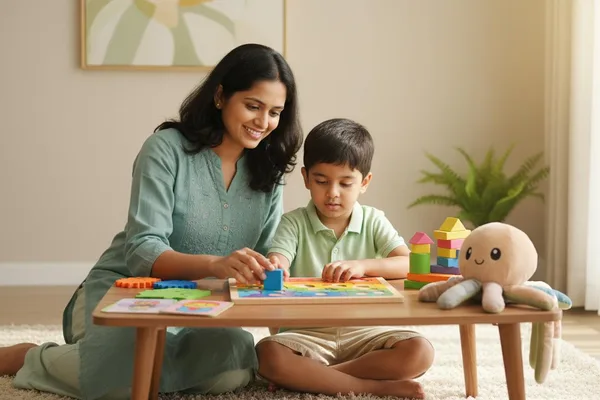
- Teaching through Play: Playing teaches children social skills and how to build relationships with others.
- Finding the cause of challenging behavior: If a child suddenly becomes upset, there is a reason for it. Perhaps it is because he is unable to communicate his needs. This way, the cause is found and an appropriate solution is provided.
- Treatment in different settings: Some treatments take place in a professional's office. Others take place in environments familiar to the child, such as home, school, or the playground.
- Short-term or long-term: Depending on the child's needs, this treatment can last for several months, a year, or longer.
What other methods belong to behavioral therapy?
Let's take a look at some of the treatments listed below that have been scientifically proven to be effective in this table.
| Intervention Name | Simply put, this is what happens... |
|---|---|
| Early Intensive Behavioral Intervention (EIBI) | This is an intensive, focused treatment that usually begins with children under 4 years of age and lasts for several years. It helps with communication, social relationships, and repetitive behaviors. |
| Early Start Denver Model (ESDM) | This is designed for toddlers . It develops the child's social, cognitive, and language skills while playing in familiar settings, such as at home. |
| Joint Attention, Symbolic Play, Engagement and Regulation (JASPER) | This is also a way to develop the social communication skills of children from 12 months to 8 years old through play. |
| Pivotal Response Treatment (PRT) | This is about encouraging children to talk and connect with others. It teaches them how to start a conversation and respond to others. |
| Treatment and Education of Autistic and Related Communication-Handicapped Children (TEACCH®) | Helps build various skills in a structured environment tailored to the child's abilities and sensory preferences. |
Help from speech and language therapy
Many children with autism have difficulty speaking and communicating. This type of therapy is specifically designed for this. A speech therapist helps the child with things like:
- Make simple requests: Learn to express your needs in short sentences like "I need water," "I need to go to the bathroom."
- Put your feelings into words: Teach them to express emotions like happiness, sadness, and anger.
- Adjust the speed and rhythm of speech: Some children speak very quickly, or speak in a monotonous rhythm. Help them adjust this.
- Use alternative communication methods: Children who have difficulty speaking can use Augmentative and Alternative Communication (AAC) methods. For example, picture cards, sign language, or speech-generating devices can be used.
Let's learn about Occupational & Physical Therapy.
Some people get a little confused when they hear these two names. Let's see what happens with these two.
Occupational Therapy (OT)
This gives the child the skills they need to do everyday tasks (we call these `Activities of Daily Living - ADLs) on their own. Think about things like brushing teeth, getting dressed, eating, and tying shoelaces. It also helps with things like difficulty writing and holding toys.
Physical Therapy (PT)
This mainly helps with problems related to the child's body movements. For example, this treatment helps to improve the child's balance, stabilize the gait, reduce toe walking, and develop the gross motor skills needed for things like running and jumping.
Social skills training and parent training
Social skills training
This is a group therapy that is usually done with young children and adults. While other therapies focus on social skills, this one focuses specifically on them. This helps the child:
- Make friends.
- Understand nonverbal cues, such as facial expressions and eye contact.
- Have a conversation between two people.
- Face bullying from others.
Parent training
This is also a very important part. Here, parents are informed about various ways they can help their child. For example:
- How to get the child's attention.
- How to give the child choices.
- How to encourage children to get along with their peers.
When you combine what you learn from this training with your child's treatment, the results will be even more successful.
Things to consider when choosing a treatment program
Your doctor will help you choose the right place for your child, but as a parent, it's important for you to be aware of these factors as well.
- Do they assess the child accurately? They accurately assess the child's strengths and weaknesses before starting a good program.
- Are there clear goals? They should be able to explain what the child wants to achieve and how they will measure how far they have come.
- Does the child receive personal attention? Check to see if there are enough staff to give the child individual attention.
- Do the professionals have proper training? Don't hesitate to ask about their qualifications and experience.
- Do they appreciate your participation? The best programs always involve parents. They also teach you things you can do to help your child at home.
If you feel something is not right in your mind, if you are not confident in that place, listen to what your heart tells you. Find another place. Every child is different, so the treatment should be the same. The child's happiness and safety are more important than anything else.
Take-Home Message
- Autism is not a disease that needs to be 'cured'. It is a change in brain function. The goal of treatment is not to 'fix' the child, but to help them develop their skills and live a good life.
- Always choose evidence-based treatments recommended by your doctor. Don't believe everything you hear on the internet or from friends.
- The results are very successful if treatment can be started at a young age (especially before the age of 3). However, it is never too late to start treatment.
- There is no such thing as a 'one size fits all' treatment. You may need to try different methods to find what works best for your child.
- You are your child's greatest strength. Work closely with the treatment team, ask questions, and advocate for your child.




💬 Comments (0)
No comments yet. Be the first to share your thoughts here.
Add Your Comment