
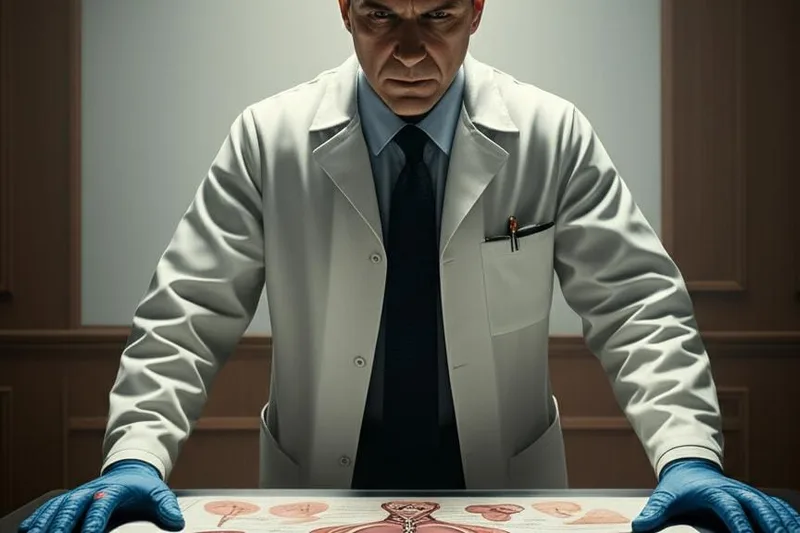
Have you ever heard of an autopsy? You may have seen it in a movie or on the news. Although this is a sensitive topic, it is worth knowing about it. Because, it is a very important thing in medicine and law. So, today we will talk about what an autopsy is, who does it, how, and why.
What exactly is an autopsy?
Simply put, an autopsy is a special medical examination that is performed after someone dies to determine the cause and sometimes the manner of death. It is like a detective's job. A specially trained doctor, called a pathologist , carefully examines the inside and outside of the body of the deceased.
The English word "autopsy" comes from the Greek word "autopsia." It means "to see oneself." That is, the pathologist examines the body with his own eyes and tries to find the cause of death. Some people also call this a "post-mortem examination," especially in countries like England. "Post" means "after" and "mortem" means "death." So the meaning is the same.
When is an autopsy performed?
There are two main types of autopsy, depending on the reason for which it is performed. Let's take a look at what they are.
1. Forensic Autopsy
This is what we often think of when we hear the word "forensic" or "forensic " in English. These are done as part of legal investigations. The word "forensic" means "relating to the scientific methods of solving crimes." Imagine, if the police were to investigate a suspicious death, this is the kind of investigation that would be conducted.
Generally, in Sri Lanka and other countries around the world, the law specifies specific cases in which a forensic autopsy is required. Generally speaking, the following types of deaths require a forensic autopsy:
- Unnatural: That is, if the death occurred due to something like murder, suicide, or an accident.
- A sudden or unexpected death: especially of a baby or young child.
- If suspicious: If there is any problem with the death.
- If the cause of death is unknown.
- If it is a violent death.
- If it is an unwitnessed death .
- If the death occurred as a result of an accident at the workplace (Acute Workplace Injury).
- A death caused by an industrial hazard: For example, a fire or a toxic chemical leak.
- If there is a death that occurred during or after medical or surgical treatment, and if there is an allegation of medical negligence.
- Anesthesia-related death is:That means a death that occurs after anesthesia is administered for surgery or another medical procedure.
The people who have the authority to order such a forensic autopsy may vary from country to country. For example:
- Coroner or Medical Examiner
- Magistrate
- Police
2. Hospital autopsy (Clinical Autopsy)
This is also called a Pathological Autopsy . This is usually done by a pathologist in a hospital to determine the exact cause of death in the event of a natural death , or to better understand it.
A natural death is a death that occurs when the body stops functioning due to an internal cause, such as cancer, heart attack, or infectious disease. That is, there is no external cause of death (e.g., injury, drowning).
Sometimes, the next of kin of the deceased – that is, the family – can request such an autopsy. Imagine, the family wants to know, "What really happened to our person, what exactly was the illness?" Then they can request this. Alternatively, the doctor who treated the person can also get permission from the relatives and perform such an autopsy.
How long after death can an autopsy be performed?
An autopsy can be performed at any time after death. However, it is best to do it as soon as possible. This is because, after about 24 hours, the body's organs and other tissues begin to decompose. This makes it difficult to perform some tests and assess the accuracy of the results.
Forensic pathologists can perform autopsies on decomposed bodies or bodies that have been exhumed. However, the amount of information and evidence that can be found in such cases may be limited.
Who is doing this autopsy?
As we mentioned earlier, this is done by a specialist called a pathologist . Pathology is a branch of medicine that involves examining body tissue samples in a laboratory for diagnostic or forensic purposes.
Pathologists who perform autopsies are medical doctors. They have extensive knowledge and specialized training about the human body. Typically, becoming a pathologist requires between 11 and 13 years of education.
You may have heard of a person called a "Medical Examiner" performing autopsies. "Medical Examiner" is often used as a job title for a forensic pathologist, usually a government employee who performs forensic autopsies.
What is actually done during an autopsy?
The process of performing an autopsy can vary slightly depending on the reason for the autopsy. Forensic autopsies are often very detailed. Almost every part of the body is examined. They also usually include crime scene investigation and toxicology – the study of poisons, their effects, and their identification.
However, during clinical autopsies, only specific parts of the body can be examined. Also, toxicology tests are not usually performed during these examinations.
In general, the steps of an autopsy may look like this:
1. The pathologist carefully places the body of the deceased on an examination table.
2. Then, the outside of the body is carefully observed. They look for anything unusual, anything that could be related to the death. They record all of this. They may also take photographs and X-rays of the body.
3. Next, the pathologist uses a sharp scalpel to cut the skin from the collarbone to the lower abdomen and examines the inside of the body. There, all the tissues and organs inside the body are removed and examined, as well as specific ones.
4. Small tissue samples are taken from organs and examined under a microscope.
5. Sometimes, the pathologist cuts open the skull and scalp and examines the brain.
6. Body fluid, tissue, and organ samples are taken and various tests (e.g., chemical analyses, toxicological analyses) are performed in laboratories.
7. In forensic autopsies, "unnatural" objects (e.g., debris, bullets) found inside or outside the body are collected and examined.
8. After a forensic autopsy, the pathologist usually puts the organs back into the body, except for the brain, and sews up the skin tightly. That is, they try to make it as close to the original as possible. However, in clinical autopsies, organs are often not put back into the body. This is because the organs can be used for further testing, and perhaps even for medical students' studies.
9. However, pathologists always try to treat the body of the deceased with respect and bring it to the best possible cosmetic condition.
Sometimes, the pathologist may need to keep some organs for further testing, or may retain organs as specified in the Consent Form. After all these tests are completed, the pathologist prepares a Detailed Report.
Additional Objectives of a Forensic Autopsy
As we mentioned earlier, the main purpose of every autopsy is to determine the cause of death. However, forensic autopsies have several other specific purposes:
- Establishing Identity: Sometimes it is not known who the deceased is. Then things like fingerprint and DNA tests can help with this.
- Helping to confirm or refute allegations about the manner of death: That is, helping to determine whether a death was a murder or an accident based on medical evidence.
- Estimating Time Since Death.
How long does an autopsy take?
It usually takes a pathologist two to four hours to examine the body. The autopsy will be completed and preliminary results will be available within two to three days.
However, it can typically take six weeks or longer to prepare a full autopsy report. There are several factors that can contribute to this delay:
- Whether it is a forensic or clinical autopsy.
- The complexity of the death and/or the complexity of the evidence.
- Whether the pathologist needs to wait for the results of other tests (e.g. blood tests, DNA tests).
- The number of autopsies a pathologist has to perform at a given time and the number of pathologists in that area.
What is in an Autopsy Report?
An autopsy report is a document that contains detailed information about every observation, examination, and test performed on the body.
This usually clearly states the Cause of Death and the General Manner of Death . The Pathologist, based on scientific and medical evidence, categorizes the manner of death into one of five categories:
1. Accident
2. Natural Causes
3. Homicide
4. Suicide
5. Undetermined
Sometimes, no matter how well a pathologist performs an autopsy, the cause of death cannot be determined. This is called a "negative" or "obscure" autopsy . In the future, with advanced laboratory techniques, it may be possible to determine the cause of such deaths at a later date.
What does an autopsy report actually say?
An autopsy report contains the results of scientific observations and tests made on the body and the contents of the body. However, a forensic autopsy alone cannot legally determine how someone died. In most countries, the final decision is made by the Court of Law. Detectives and other legal representatives combine the information in the autopsy report with other evidence they have collected to come to a conclusion about the manner of death.
It is important to remember that no matter how much knowledge and training pathologists have, they are human beings just like us. Like everyone else, they can make mistakes. Or, sometimes, they may not be able to determine the exact cause of death. In some cases, the family or legal authorities can request that the body of the deceased be examined a second time by another pathologist.
What are the benefits of an autopsy?
There are several benefits that can be gained from an autopsy. Let's take a look at what they are:
- Expanding medical knowledge: Clinical autopsies, in particular, allow doctors to increase their understanding of diseases and how they affect our bodies. The medical knowledge gained from this will be very important for improving medical treatment in the future.
- Preventing more deaths: In the past, pathologists who performed forensic autopsies have identified public health emergencies, such as anthrax terrorist attacks. Similarly, public health hazards, such as defective cribs or car seats, that have caused infant deaths, have also been identified through such examinations.
- Identifying Genetic Conditions: Sometimes, an autopsy reveals that the deceased died from a previously undiagnosed or misdiagnosed hereditary condition. This can help blood relatives of the deceased learn about their risk of developing the condition.
- Providing Legal Evidence: Autopsies are very helpful in solving criminal cases like murder. However, they can also provide legal evidence in cases like workplace deaths, environmental hazards, or medical malpractice. These types of deaths can even lead to lawsuits.
- Clearing doubts:When a clinical autopsy provides answers about the cause of death, confirming that the diagnosis and treatment the deceased received were correct, it often provides a sense of closure or solace to family and loved ones. Rather than dwelling on doubts, having answers can help you grieve and cope with the death of your loved one.
How much does an autopsy cost?
Most hospitals do not charge for clinical autopsies performed by a pathologist, and autopsies performed under the authority of a coroner or medical examiner are also provided free of charge.
However, there may be a fee for transporting a body to and from a hospital. In addition, you may have to pay for genetic testing to identify inherited conditions.
Finally, what to remember (Take-Home Message)
Autopsies are very important to the medical field as well as to the administration of justice. They are a great help in expanding medical knowledge and finding answers to unknown questions.
If you have to undergo an autopsy on your loved one, know that the pathologist will handle the body with great care and respect. They will use their expertise to provide you with every possible medical answer.
It's a bit difficult to talk about something like this, but I hope this information is useful to you.
👩🏽⚕️ Additional questions (FAQs)
💬 What is an autopsy?
An autopsy is a rigorous examination by a doctor after someone dies to determine the exact cause of death with 100% accuracy. This involves examining the body for external injuries, as well as opening the body and sending internal organs like the heart, brain, and lungs for laboratory tests.
💬 Is this being done just because the police say so (for murders)?
No. There are two main types of autopsies. One is a forensic autopsies (for accidents, poisonings, and murders). The other is a clinical autopsy, which is performed at the request of the family or doctors. If the person died of a disease that could not be diagnosed in a hospital, this is done at the request of the family to determine if the disease was contagious to other family members.
💬 Will an autopsy result in a body that is too deformed to be held for a funeral?
Absolutely not! This is done with great respect and aesthetics by the doctors. After the examination, the incisions are sewn up neatly, so that when you put on a dress, it is almost impossible to see that an autopsy was performed. The body can be placed in an open casket, as if it were a funeral.
`Autopsy, Postmortem examination, Cause of death, Pathologist, Forensic Autopsy, Clinical Autopsy


💬 Comments (0)
No comments yet. Be the first to share your thoughts here.
Add Your Comment