

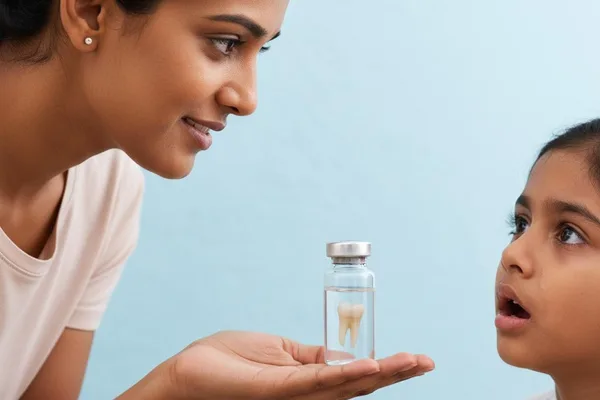
Imagine your child falling while playing and bleeding from the mouth. When you look, there is no front tooth! Or you get hit by a ball while playing cricket and your own tooth falls out. There are no words to describe the panic and fear that comes to mind at such a time, right? Many people think that if a tooth falls out, it cannot be put back in, so it is over. But that is not the truth. If you don't panic, do the right thing quickly, and do exactly what is right, there is a great chance that the tooth will be saved and restored to its original shape. Let's talk about this today.
What is an avulsed tooth?
Simply put, a tooth being knocked out means that due to some accident, the tooth, along with its root, completely comes out of its socket. This is one of the most serious injuries that can happen to teeth. Doctors call this ``Dental Avulsion``.
The most important thing is that this is a dental emergency . This means that you need to seek treatment immediately, without delay. The chance of saving the tooth depends on how quickly you act.
How common is this? And who is more likely to get it?
This is more common than we think. Especially among children. Most often, these types of accidents happen to boys and girls between the ages of 7 and 11. This is because that's when girls are most likely to run around and play.
The teeth at the front of our mouth, the incisors, are the ones that are most likely to fall out. This is because those teeth are the first to be damaged if they fall or hit something.
Symptoms and causes of tooth loss
It's not hard to recognize when a tooth is loose, but it's important to be aware of the possible causes.
| Symptoms | Common Causes |
|---|---|
| - A gap where the tooth used to be - Mouth pain - Bleeding gums | - Falls and falls. - Bicycle accidents. - Playing contact sports like cricket, rugby, football, hockey. - Traffic accidents. - Being attacked. |
To save a knocked-out tooth, here are the things you need to do immediately! (This is the most important part)
This part is very important. If you treat a tooth properly within 30 to 60 minutes (one hour) of the time it falls out, you have a much better chance of saving it. Here are the steps you need to take, in order.
1. Calm down, find the tooth: Don't panic at first. Carefully find the tooth that fell to the ground.
2. Hold the tooth properly: This is the most important thing. Only hold the crown of the tooth (the white part we eat). Never touch or grab the root of the tooth. If the delicate cells around the root of the tooth are damaged, the tooth will not be able to grow back.
3. Clean gently: If there is dirt or dust on the tooth, gently rinse it with clean water, or best of all, with fresh cow's milk .
Warning: Never soap, brush, wipe with a cloth, or let it dry. Doing so will kill the living cells at the root of the tooth.
4. If possible, replant the tooth: Try to slowly replant the tooth into its socket. Make sure the root goes in. Hold it in place by chewing on a clean tissue or piece of gauze. This is called ``Replantation''.
5. See a dentist immediately: Whether or not the tooth can be reattached, the next thing to do is to see a dentist immediately. Go as soon as possible. If necessary, go to the Emergency Department (ETU) of the nearest hospital.
What to do if the tooth cannot be put back in its place?
Sometimes, whether due to pain or fear, it may not be possible to put the tooth back in. In such cases, there is a way to save the tooth and take it to the doctor.
- The best way: Put some fresh cow's milk in a small cup and dip your tooth in it. The ingredients in milk can help keep the cells at the root of the tooth from dying.
- Second method: If you can't find milk, hold the tooth inside your mouth, between your cheek and gums, or under your tongue. Your saliva will keep the tooth moist.
- What not to do: Never immerse your tooth in water. Plain water can damage the cells at the root of the tooth. Also, don't let the tooth dry out.
What does a dentist do?
Whether you are re-implanting a tooth or leaving it in the milk, the first thing the dentist will do is examine the condition of the tooth.
- If you leave the tooth, they will check if it is in the right place and, if necessary, put it in the right place.
- If you bring the tooth, he will clean it and put it back in the socket.
- Then, to keep the tooth stable and not move, it is connected to the two healthy teeth on either side and secured with a small wire-like device called a ``splint.'' This needs to be left in place for several weeks.
- Sometimes, the vital part of the tooth (pulp) can be damaged and become infected, so a root canal treatment may be necessary at a later date.
After re-sharpening the tooth, you need to be careful.
After re-sharpening the tooth, you need to be very careful until it heals properly.
| What to do | Description |
|---|---|
| Diet | For two weeks, eat only bland, liquid foods like soup, yogurt, and rice. Avoid eating anything that requires chewing loudly. |
| Temperature | Avoid eating and drinking very hot or very cold things. |
| Oral health | Brush your teeth gently with a soft toothbrush after each meal. Use an antiseptic mouthwash (e.g., Chlorhexidine mouthwash) twice a day as prescribed by your doctor. |
| Pain | If you have pain, take a painkiller such as NSAIDs as directed by your doctor. |
| Activities | Avoid playing contact sports completely until the tooth heals. |
Possible complications of a re-rooted tooth
Re-sharpening a tooth is not always 100% successful. Sometimes, complications can occur.
- Ankylosis: The tooth may become attached to the jawbone and appear to sink into the gum.
- Inflammatory root resorption: The body's immune system dissolves the root of the tooth. The tooth then begins to move and may fall out again.
- Pulp necrosis: The vital part inside the tooth (pulp) can die. This can cause the tooth to discolor and cause pain. This may require root canal treatment.
The dentist keeps telling you to come in to see if things like this happen. You have to have checkups in the first month, then every 3 months, and then for a year.
What are the options if the tooth cannot be saved?
Sometimes, either because the damage to the tooth is severe or because it was taken too late to the dentist, the tooth may not be saved. If that happens, there are several options to fill the void.
- Partial denture: A removable artificial denture.
- Dental bridge: An artificial tooth that is made like a bridge by grinding down the two teeth on either side of a missing tooth, placing crowns on them, and connecting the two.
- Dental implant: A titanium screw-like structure is fixed to the jawbone and an artificial tooth is placed on top of it. This is the best and most permanent solution available.
Some frequently asked questions
If a baby tooth falls out, do I need to get it re-sharpened?
No, you should never do that. If you try to re-sharpen a loose baby tooth, it can damage the permanent tooth that is coming in underneath. So if a child's baby tooth falls out, stop the bleeding and see a dentist. He or she will check to see if the permanent tooth has been damaged.
What to do if you can't find the loose tooth?
This can be a bit serious. Most of the time, you might have swallowed it. It's not a big deal, and it will pass out of your body in a few days. However, it can also be inhaled into your lungs and be ``aspirated.'' This is dangerous, and can cause lung infections (Aspiration Pneumonia). So if you can't find the tooth, you should definitely see a doctor right away and get a chest X-ray to see if it has gone into your lungs.
Can't accidents like this be prevented?
Some injuries cannot be prevented. But many injuries while playing sports can be prevented. Especially when playing contact sports like rugby, hockey, and boxing, wearing a mouth guard can greatly reduce the risk of damage to your teeth.
Take-Home Message
- A tooth that falls out first is a dental emergency. Time is of the essence.
- Always handle the extracted tooth by the crown (the white part). Never touch the root.
- Wash your teeth with soap, do not rub them. Rinse gently with milk or clean water.
- Put the tooth back in place as soon as possible and see a dentist.
- If you can't put it back in, put it in a cup of milk and go to the doctor immediately.
- If your child's baby teeth fall out, never try to re-root them.




💬 Comments (0)
No comments yet. Be the first to share your thoughts here.
Add Your Comment