
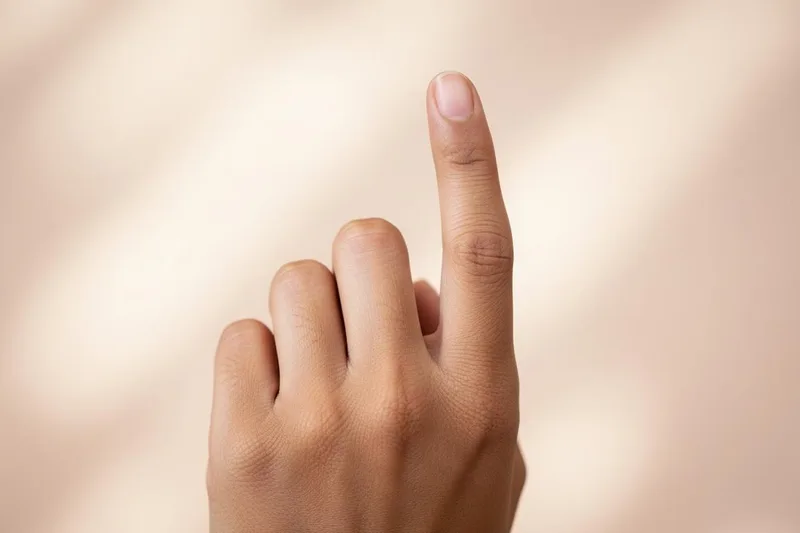
Have you ever seen, or experienced, a finger that is bent in an odd way and is very difficult to straighten? Perhaps the finger looks like it is bent in the middle and stuck, with the tip pointing upwards. This can be a really disturbing experience for some. Today we are going to talk about a condition that occurs in fingers, which is medically known as `Boutonnière Deformity`.
What is this `Boutonnière Deformity`?
Simply put, Boutonnière Deformity is a condition where the middle joint of a finger (or sometimes, rarely, a toe) is unable to straighten and is stuck in a bent position. This means that the middle joint of the finger is bent downwards and cannot be straightened . At the same time, the end joint of the finger, the joint where the nail is, is bent upwards and looks like a point.
We have a joint in our finger. That middle joint, that is, the second joint from the palm – we call it in medicine the `Proximal Interphalangeal joint` (proximal interphalangeal joint) or `PIP joint` (PIP joint) for short – that is what cannot be bent, and gets stuck when bent. At the same time, the end joint of the finger – we call it the `Distal Interphalangeal joint` (distal interphalangeal joint) or `DIP joint` (DIP joint) – it is bent backwards and pointed upwards.
This is called `boutonnière`, which means `buttonhole` in French. The reason for this condition is that when a `tendon`, a strong tissue that connects a muscle to a bone, at the top of the finger, is damaged, a small hole forms between the fibers, like a buttonhole. That's where the name comes from. If this `tendon` doesn't work properly, you won't be able to straighten your finger joint.
Why is this happening? What are the reasons?
The main cause of this `Boutonnière Deformity` is damage to the tissue in the finger called the `central slip tendon`. This `tendon` is what helps us straighten the middle joint of the finger. It runs along the top of the finger. You may even see it above the joint.
Damage to the central slip tendon in an accident
Most of the time, this situation is caused by an accident. Consider things like this:
- A finger gets stuck or hit hard: For example, when you are playing a sport like volleyball or netball, a ball hits your finger with great force. Or your finger gets stuck in a door. In such a situation, the tendon can be pulled or torn.
- Fracture of a finger: If a bone in a finger breaks, a fragment of the broken bone can damage the tendon.
- Dislocation of a finger joint: When a joint is dislocated, the tendon can also be stretched and torn.
- A cut or a hard blow from a sharp object: If the finger is cut by something like a knife, or if something heavy falls on the finger, this tendon can be damaged.
Although this type of `central slip tendon` injury can happen to anyone, it is more common among athletes, as they are more likely to suffer from sports injuries.
Arthritis and other conditions
In addition to accidents, Boutonnière Deformity can occur for several other reasons:
- Rheumatoid arthritis: This is also a major cause. Due to the long-term swelling and pain in the joints of the hand, the tendon can become weak, stretched, and torn.
- Burn injuries: Sometimes a tendon can become weak and even rupture due to a burn.
- Congenital hand deformity: Rarely, this can be a congenital disorder.
- Connective tissue diseases: Some genetic diseases can weaken the body's connective tissue. That may also be a cause of this.
Simply put, if that `central slip tendon` becomes weak or ruptures, it can't pull the middle joint (`PIP joint`). Also, it affects the other `extensor tendons` that pull the tip joint (`DIP joint`), and they start pulling more. That's what causes that weird bend.
What are the symptoms of this?
The main symptom of this condition is an abnormal position of the finger joints . This means:
- You will not be able to straighten the PIP joint .
- At the same time, the DIP joint is bent upwards and hyperextended .
In addition to this, you may also feel things like:
- Joint pain and swelling.
- Joint stiffness can increase, especially over time.
Sometimes, these symptoms can appear right after an injury to the finger. Or they can appear weeks later. However, if you have a condition like arthritis, this `Boutonnière Deformity` is more common. You may first notice that it is a little difficult to bend and straighten your finger properly.
How does a doctor recognize this?
When you go to see a doctor, they will examine your finger carefully. They will ask you about your symptoms and your medical history. Boutonnière Deformity is easy to recognize when you see it. However, it may not be so obvious when it first starts.
Then the doctor may perform a small test called the `Elson's test`.
Here's how it's done: You're asked to bend your fingers at a point, like this: a corner. Then the doctor presses down on the middle phalanx of your index finger (or the injured finger) and asks you to straighten your finger. If you can't straighten your finger against resistance, they can tell that there's a problem with the central slip tendon.
In addition, the doctor may order an X-ray . This can help determine the extent of the injury and any bone damage. It can also help plan treatment.
Okay, now what is the treatment for this?
Most of the time, doctors start treating Boutonnière Deformity with non-surgical methods. That is, with conservative treatments. But the most important thing is to get treatment as soon as possible . The longer you wait to get treatment, the harder it can be to correct this deformity, even with surgery.
Conservative treatment
If your condition is recent, the first thing your doctor will do is put a splint on your finger . This splint will keep your PIP joint straight for a few months. This will give the damaged tendon time to heal. After this time, you will need to do physiotherapy for a few months. This means doing special exercises.
Surgical treatment
However, if the injury is severe, or if it is a chronic condition that has not improved with non-surgical treatments, you may need surgery . Scar tissue may form on your finger, causing it to become stuck in the wrong place. Or the surgeon may have to reattach some of the parts.
The surgeon may do things like:
- Repair or reconstruct the damaged central slip tendon.
- Reducing tension on other extensor tendons or bringing them into proper position.
- If there is arthritis, the `PIP joint` may be repaired or `fused` together .
After surgery, you will need to wear a splint on your finger for several weeks. After the first week, you will be given some hand exercises to do. Your physiotherapist will lead your rehabilitation program for the next few months.
What kind of hope can be had after treatment?
Boutonnière Deformity is a treatable condition . But time is of the essence . If you seek treatment immediately after the accident, with or without surgery, you can make a full recovery. However, if you wait a while to recognize and treat this condition, it can be a little more difficult to cure.
Also, the cause of the condition is important . If you have long-term conditions like arthritis, the healing process can be hindered. Severe injuries and congenital disorders are more difficult to correct with surgery. Sometimes, surgeons can restore some of the flexibility of the finger joint, but not all of it.
This condition can take months to heal. It also requires a lot of commitment on your part - especially when you start exercising your finger. However, many people who follow the instructions given by their medical team have good results.
Remember, if you have an accident with your finger and can't move it properly, you should definitely see a doctor. Just because your fingers are small, don't assume that the accident is minor. Your fingers are very complex and delicate organs. Even a small accident can cause more damage than you think.
Damage to one tendon in your finger can affect the other tendons that are connected to it. Before you know it, the very mechanism that helps you move your finger can be disrupted. To recover, you have to rehabilitate these very small parts.
The most important thing we need to remember from this story! (Take-Home Message)
Okay, so we've talked a lot about Boutonnière Deformity. Finally, here are the most important things you need to remember:
- If the middle joint of the finger is bent and the end joint is pointed upwards, it may be a `Boutonnière Deformity`.
- This is often caused by an injury to the finger (especially the central slip tendon) or arthritis .
- The main symptoms are pain, swelling, and inability to straighten the finger .
- It is very important to seek medical advice as soon as possible. The longer it is delayed, the harder it is to treat.
- Treatment includes splinting, physical therapy, and sometimes surgery .
- Time and your commitment are essential for recovery. Follow your doctor's instructions exactly.
- Don't take even a minor injury to your fingers lightly. See a doctor immediately.
So, I hope this information is helpful to you. If you have any of these symptoms, don't panic and see a doctor for advice. With prompt treatment, you can get a good recovery!
` Boutonnière Deformity, finger bending, finger injury, central slip tendon, arthritis, finger surgery, physiotherapy


💬 Comments (0)
No comments yet. Be the first to share your thoughts here.
Add Your Comment