
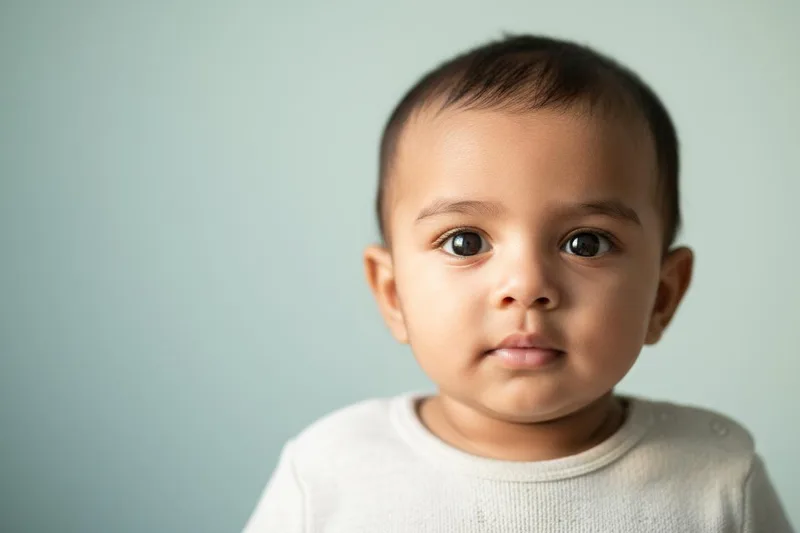
When you look at your little one's eyes, have you ever noticed that one or both eyes seem a little bigger than the other? Or, do you notice that the baby's eyes gradually get bigger as the months go by? Sometimes this can be a sign of a condition called Buphthalmos . Don't worry, we'll talk about it all in simple terms today.
Do you know what Buphthalmos is?
Simply put, buphthalmos is a condition in which a baby's eye or both eyes are larger than normal, either at birth or within the first few months of life. This is a congenital condition , meaning it is present from birth. Some babies may have this enlargement in only one eye (unilateral), while others may have it in both eyes (bilateral).
Imagine, this is how the name "buphthalmos" came about. In Greek, "bu" means cow, and "ophthalmos" means eye. So it got its name because it has big eyes like a cow. The ancient Greek physician Hippocrates was the first to identify this condition.
This is an autosomal recessive genetic condition . This means that for a child to have this condition, the child must receive the affected gene from both parents. Think of it like a lottery. Both parents may have the gene, but they may not know it. On average, one in four children of such a couple will have this condition.
How common is this condition?
Buphthalmos is a relatively rare condition. It occurs in about one in 30,000 births . It can affect both sexes. However, some studies have found that people in certain regions, such as Slovakia, Saudi Arabia, and southern India, are at a higher risk of developing the condition.
What are the symptoms of buphthalmos?
The most obvious and obvious symptom of a newborn baby or a baby who is a few months old is that their eyes appear large. One or both eyes may be large. Depending on the cause of this, your baby may also experience other symptoms. These include:
- Tears constantly flowing from the eyes, the eyes appearing red, and the eyes always being unusually wet .
- Sensitivity to light (photophobia) . This means that the baby does not want to look at the light, closes his eyes, or becomes agitated.
- Increased frequency of blinking, or a feeling of squinting.
- The cornea , the normally clear, glass-like part of the eye, appears cloudy. As if covered in fog.
- The cornea stretches, thins, and sometimes even becomes streaked .
If your baby has one or more of these symptoms, you should definitely see a doctor.
Why is this happening to our baby? What are the reasons?
The main cause of buphthalmos is a condition called primary congenital glaucoma or primary infantile glaucoma . You may have heard of glaucoma. Glaucoma damages the optic nerve inside the eye, which can lead to vision loss. It is believed that this happens because a type of fluid produced inside the eye does not drain properly, causing a build-up of pressure inside the eye (intraocular pressure or IOP) .
- Primary congenital glaucoma is glaucoma that begins at birth.
- Primary infantile glaucoma is glaucoma that begins between birth and three years of age.
In addition to this main cause, buphthalmos can occur due to several other reasons:
- Aniridia: This is a very rare condition. It is characterized by the complete or partial absence of the colored part of the eye, the iris . Aniridia can affect vision.
- Neurofibromatosis type 1: This is also a condition that is often hereditary. Tumors can form on the nerves, which can also cause eye problems.
- Sturge-Weber syndrome: This is also a genetic condition. It causes blood vessels to grow excessively, forming lumps called angiomas . This condition can affect the skin, brain, and eyes.
- Birth injury: If the baby's eyes are damaged during birth, that can also be a cause.
What kind of tests are done to find this?
Parents are often the first to notice a change in their child's eyes. If you suspect something is wrong with your child's vision, seek medical advice immediately . Your pediatrician will likely refer you to an eye care specialist.
This is especially important in conditions like buphthalmos and congenital glaucoma, as early treatment is more likely to save the child's vision .
To accurately diagnose buphthalmos, the doctor may need to put the child under anesthesia and perform several tests, such as:
- A thorough eye exam: This will allow the doctor to check for any cloudiness, scarring, or swelling of the cornea. They will also measure the eye and check for cupping of the optic disc, where the optic nerve exits the eye.
- Retinoscopy: This test allows the doctor to determine if the child has refractive errors, such as myopia (nearsightedness) .
- Gonioscopy: This test checks whether the drainage system of the eye is working properly. Healthy eyes produce and drain fluid regularly. In glaucoma, this fluid does not drain properly and builds up, increasing pressure and damaging the optic nerve.
- Ultrasound biomicroscopy: This is a painless test. It can take clear pictures of the front of the eye and can also detect problems with fluid drainage. It can produce more detailed images than a regular ultrasound (sonogram).
What are the treatments for Buphthalmos?
When treating buphthalmos, it is very important to control the pressure inside the eye (ocular pressure) . There are several ways to reduce this pressure. Medication is one of them.
- Eye drops or topical items are used for this purpose. These contain medications such as beta blockers , prostaglandin analogs , or carbonic anhydrase inhibitors .
There are also surgical procedures that can help drain the fluid inside the eye and reduce pressure:
- Placing small implants inside the eye.
- Making small cuts in the structures of the eye.
- Removal of tissue from the eye.
In fact, if your child has buphthalmos, he or she may also have other conditions that require treatment (such as neurofibromatosis type 1, Sturge-Weber syndrome, or aniridia). The doctor will also treat those conditions.
Is there a way to prevent this?
There is no way to prevent buphthalmos, but identifying the condition early in a child's life and starting treatment early can help prevent serious consequences .
What happens if you have buphthalmos? What can you expect?
The best thing is that buphthalmos is a treatable condition . To prevent vision loss, it is best to diagnose and treat the condition as soon as possible.
How can I take care of my child in this situation?
It's important for everyone to have regular eye exams. This is especially important for someone with a congenital eye condition. Ask your doctor about any changes in your child's vision and when they should see a doctor.
In addition to these tests, do everything you can to maintain healthy eyes. These things are important for good eye health:
- Eating healthy and drinking enough water.
- Getting enough sleep and engaging in physical activity .
- Wear protective glasses when in the sun, working, and playing sports.
- Avoid smoking (this also applies to adults around the child).
It is very important to take care of a child's eye health from the earliest days of life until adulthood. This is especially true for eye conditions that begin at birth or in the first few months of life. If you have any doubts or notice any changes in your child's vision, see a doctor immediately.
Finally, things to remember (Take-Home Message)
If your baby's eyes appear unusually large, it could be buphthalmos . This is often associated with congenital glaucoma .
- Don't worry , this is a treatable condition.
- Early detection and treatment are the best ways to protect a child's vision.
- If you have the slightest doubt, see an ophthalmologist immediately .
- It is essential to follow medical advice and attend regular follow-ups .
Remember, you are not alone. Doctors and health workers are ready to help you and your baby.
` buphthalmos, infantile glaucoma, congenital glaucoma, eye enlargement, eye pressure, optic nerve, cornea


💬 Comments (0)
No comments yet. Be the first to share your thoughts here.
Add Your Comment