

When you or someone in your family has a fever or body ache, the doctor will order a blood test, right? You've probably seen the three letters 'CRP' on that report. Many people get a little worried when they see this. They think, "Oh, this is high, I don't know if it's some serious illness." What exactly is CRP? Does this really indicate a serious illness in our body? Let's talk about this today to clear up all the questions that are on our minds.
Simply put, what is CRP?
CRP is the short name for C-Reactive Protein . This is a type of protein that is present in our own body. Who knows what makes it? Our liver makes it. But it doesn't always make it. When there is inflammation somewhere in our body, that is, simply put, inflammation or infection , our liver makes this protein called CRP and releases it into the blood.
Think of it this way. Our body is like a fortress. If an enemy like a virus or bacteria enters this fortress, or if there is an injury somewhere in the body, our immune system, the defense force, comes into battle. It is during this battle that things like swelling, redness, and pain occur. As soon as this battle begins, a signal is sent to the liver saying, "Okay, now a battle has begun, make CRP and put it in the blood."
That means, CRP is just a 'marker' that tells us that there is inflammation, that is, infection or inflammation, somewhere in our body. It does not tell us exactly what the disease is or where it is.
When do doctors give a CRP test?
A doctor will order a CRP test if they suspect an infection or inflammation in your body after looking at your symptoms. This can help diagnose a specific disease, as well as confirm that you don't have certain diseases.
This test is often used when:
- Check for severe bacterial infections like sepsis .
- If you suspect fungal infections inside the body.
- Look for conditions like bone infections (osteomyelitis) .
- If you suspect inflammatory bowel disease (IBD) .
- Find the cause of joint pain, such as arthritis .
- Look for autoimmune diseases like rheumatoid arthritis or lupus .
- Learn about pelvic inflammatory disease (PID) in women.
Additionally, doctors also use this CRP test to check for internal infection after major surgery.
What symptoms might mean you need a CRP test?
If you have one or more of the symptoms below, your doctor may suspect an infection and order a CRP test.
| Symptom | A simple explanation |
|---|---|
| Fever | Sudden increase in body temperature. |
| Chills | Extreme chills and shivering that precede or accompany a fever. |
| Rapid breathing (Tachypnea) | Breathing faster than normal, feeling like you're running out of breath. |
| Rapid heartbeat (Tachycardia) | Heart rate increases significantly even when just standing still. |
| Nausea and vomiting | Vomiting with stomach pain. |
Do you check CRP during treatment?
Yes. If you are already being treated for an infection or inflammatory condition, doctors also use the CRP test to see if the treatment is working. For example, if your CRP was at 100, and after starting medication, it went down to 20, that means the medication is working and the infection is being controlled . That's a good sign.
How to do the CRP test and how to prepare for it?
This is a very simple blood test. There is no special preparation required for this. You do not need to fast or drink water.
This is what happens when blood is drawn:
1. You will be seated in a chair, and a nurse or a trained person will find a vein in your arm. Usually, the blood is taken from the inside of your elbow.
2. Clean the area with a small piece of cotton wool and apply a disinfectant.
3. Then a very small needle is inserted into the vein and a small amount of blood is drawn. At this point, you may feel a slight sting, like being bitten by an ant . Don't worry, it only lasts a few seconds.
4. After the required amount of blood is taken into a test tube, the needle is removed, a piece of cotton is placed in that place and pressed.
5. Then a little plaster is applied. That's it! The whole job doesn't take more than five minutes.
The area where the blood was drawn may be slightly bruised and blue. This will heal on its own in a day or two.
How to understand the values in the CRP report?
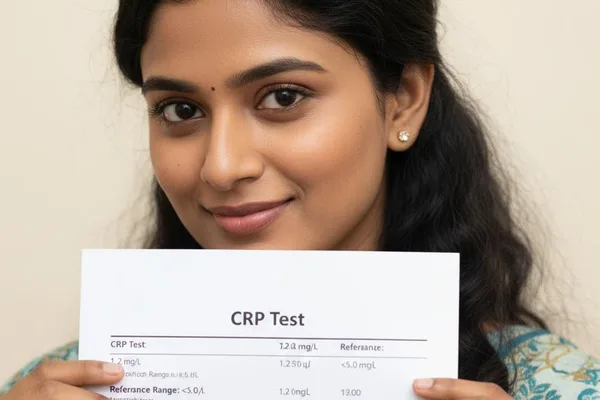
You will usually receive your CRP report within a day or two. It shows your CRP value in milligrams per deciliter (mg/dL).
Normally, a healthy person's CRP level is less than 0.9 mg/dL . However, sometimes CRP levels can be slightly elevated. The following may be the cause:
- Cigarette smoking
- Common cold
- Diabetes
- Insomnia or sleeplessness
- Gum disease (Gingivitis)
- Obesity
- Pregnancy
- A recent minor injury
Also, CRP levels may naturally be slightly higher in women and older people.
What if the CRP value is high?
If your CRP level is significantly elevated, it means there is some inflammation in the body. The doctor can make an opinion based on the level of inflammation.
| CRP level (mg/dL) | What this could mean |
|---|---|
| Moderate increase (1.0 - 10.0) | Autoimmune diseases such as rheumatoid arthritis (RA), lupus (SLE), myocardial infarction, pancreatitis , and bronchitis may occur. |
| Significant increase (> 10.0) | It can be caused by an acute bacterial or viral infection, systemic vasculitis , or serious trauma. |
| Very severe elevation (> 50.0) | Most often (about 90%) CRP levels rise to this level due to a severe bacterial infection. In such cases, prompt treatment is required. |
Should I be worried if my CRP level is elevated?
Absolutely not. Don't panic if you see a slightly high value on your CRP report. As we discussed earlier, CRP can be slightly elevated for many reasons, including a minor infection, smoking, and obesity.
The important thing is that CRP is just one piece of the puzzle. Your doctor will put your symptoms, other blood test results, and your physical examination together to come to a conclusion.
So, don't try to diagnose yourself based on your CRP level. Leave it to your doctor . If he or she needs to, he or she will order a few more tests to pinpoint the cause.
Take-Home Message
- CRP is a simple blood test that shows if there is inflammation or infection somewhere in your body.
- This alone cannot tell exactly what the disease is or where it is. It is only a 'signal' that can help the doctor.
- There can be many reasons for a slightly elevated CRP value. So don't panic after seeing the report.
- A very high CRP level (above 50 mg/dL) often indicates a severe infection and may require urgent medical attention.
- Always talk to your doctor and seek advice, rather than jumping to conclusions about the values in your CRP report.




💬 Comments (0)
No comments yet. Be the first to share your thoughts here.
Add Your Comment