
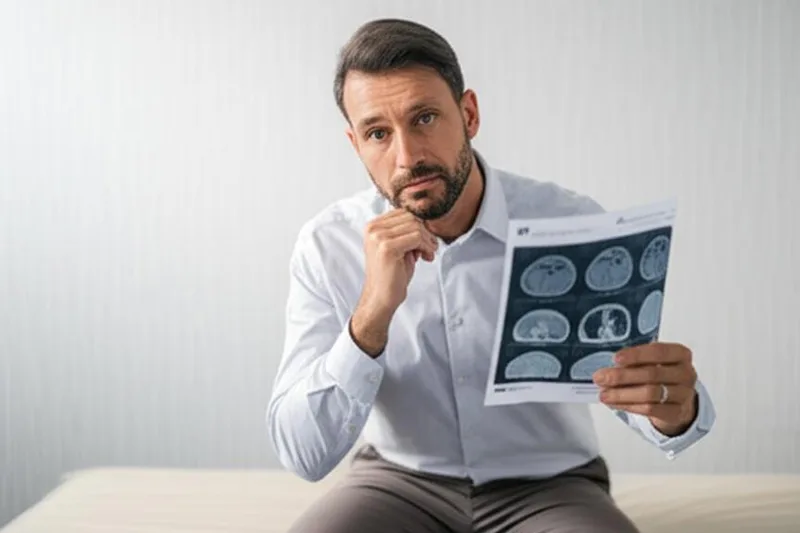
Has your doctor ever ordered a CT scan for you? Perhaps they recommended this test to find a problem inside your body, plan ahead for surgery, or see if a treatment is working. But the word "CT scan" can make some people a little nervous because it uses radiation. So you may have wondered if this radiation can cause cancer. Today, let's talk about it in a simple way that will dispel any fears or doubts you may have.
What actually happens during a CT scan?
Simply put, a CT scan is a special X-ray test that can take very clear, detailed 3D images of things inside our body, such as organs, bones, and blood vessels. This uses a type of radiation called X-rays. In medical science, this is called ionizing radiation. This means that these rays have the ability to damage the DNA molecules that store genetic information inside our body's cells. When DNA is damaged, cells begin to divide abnormally and, over time, there is a very small chance that they will become cancer cells.
Now you're probably thinking, "Oh, so this is dangerous, right?" Don't worry. Let's take a look at the size of this.
We are exposed to more radiation from a CT scan than from a regular X-ray or a mammogram for breast cancer. For example, the amount of radiation emitted from a single chest CT scan can be the same as from 100 or more regular chest X-rays. While that may sound like a lot, the total amount of radiation our bodies receive is actually very small.
The important thing is that we are all naturally exposed to radiation in our daily lives. There are natural radioactive substances in the soil, rocks, and air around us. The unit of measurement for this radiation is called the millisievert `(mSv)`. On average, a person is exposed to 3 mSv of radiation per year from the environment alone.
Now, look at how much you get from a CT scan.
- Depending on the part of the body being scanned and the radiation dose administered, a single CT scan can deliver between 1 mSv and 10 mSv .
- A low-dose chest CT scan delivers as little as 1.5 mSv.
- A typical chest CT scan can deliver about 8 mSv.
That means the amount of radiation you get from one CT scan can be as much as the amount of radiation we naturally get in a few years. The more CT scans you have, the more radiation you are exposed to. However, if your doctor says you need it, don't be afraid to have the test because of this risk.
So what is the real chance of developing cancer?
Okay, now let's get straight to the point. What is the chance of developing cancer from the X-rays in a CT scan? Actually, the risk is very, very low .
Studies have found that the chance of developing malignant cancer from any given CT scan is a very small one in 2000 .
This risk is not the same for everyone. It depends on several factors:
- Age: Because young children's bodies are still growing, their cells divide more quickly than adults. This makes them slightly more sensitive to radiation. Children are also more likely to develop cancer in the future.
- Gender: Women are at slightly higher risk than men.
- The part of the body being scanned: Some organs are more sensitive to radiation than others. In particular, cells in the breast, lungs, thyroid gland, and bone marrow divide rapidly, making them more sensitive than organs with slowly dividing cells, such as the brain.
But remember, your doctor will only recommend a CT scan after determining that the benefits of the test outweigh this small risk . If a correct diagnosis can save a life, it is worth taking this small risk.
Things you can do to protect yourself from this risk
This doesn't mean you should stop getting CT scans. However, it's wise to make sure that you really need each test. Before any imaging test, ask your doctor these questions.
| Question to ask | Why is this important? |
|---|---|
| Why do I need this scan? | To understand the need for testing. |
| How will this affect my treatment? | To learn how treatment is determined based on the test results. |
| What are the risks of this? | Talk openly with the doctor and overcome your fears. |
| Can't this be detected with another test that doesn't use radiation, like an MRI or ultrasound? | To find out if there are options. Not every disease can be detected with every test, but it's good to know. |
| How can I protect other parts of my body during the scan? | Be aware of safety measures. |
Other things you can do
- Ask for the lowest dose: Your doctor will always try to use the lowest possible dose of radiation during the test, especially if you are having multiple scans.
- Ask about a lead apron: Ask the technician if they can cover the areas of your body that you don't want to scan with a lead apron. This will stop unnecessary X-rays from hitting those areas.
- Keep a record of your tests: Keep a record of all the CT scans and other X-ray tests you have. This will give you an idea of how much radiation you have been exposed to. It can also help you avoid having to repeat a test you have already had.
Here are some things to note:
- Type of scan performed
- Date of examination
- Radiation dose received (if possible, will be mentioned in the report)
- Name of the hospital or institution that performed the test
If you still have doubts or concerns about this, there is nothing wrong with seeking advice from another doctor (a second opinion) . Another doctor may be able to recommend a different test option.
Take-Home Message
- A CT scan is a very important and useful medical test for diagnosing diseases.
- The risk of developing cancer from the radiation it emits is very, very small. Often, the benefits of the test far outweigh this small risk.
- Talk openly with your doctor about your fears and concerns. Ask why the test is necessary and whether there are other options.
- Always ask for the lowest possible radiation dose and to protect unwanted body parts.
- Keeping a record of all the radiological tests you have can help avoid unnecessary repeat tests.


💬 Comments (0)
No comments yet. Be the first to share your thoughts here.
Add Your Comment