
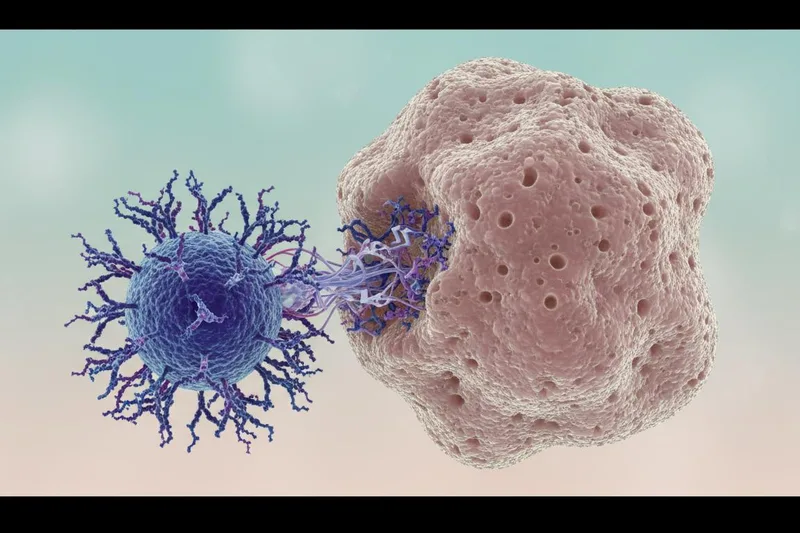
Have you ever thought that our body can fight cancer on its own? In fact, our body has a very clever defense system called the immune system. It has a special part of it called T-cells, which are like soldiers. Their job is to find and destroy foreign germs and mutated cells that enter the body. But sometimes, cancer cells are very cunning. They hide from these T cells, trick them and grow inside the body. At such times, we are going to talk about a new, amazing treatment that helps our own T cells recognize and destroy cancer cells by giving them "special training."
Simply put, what is CAR T-cell therapy?
While the name may sound complicated, the concept is quite simple. CAR T-cell therapy is a type of immunotherapy. It involves taking some of your own T cells and genetically modifying them in a laboratory.
Think of your T cells as police officers. Cancer cells are like thieves in disguise. Usually, the police can't recognize these thieves. CAR T-cell therapy is like giving your police officers (T cells) a special pair of glasses. This mirror is called a 'Chimeric Antigen Receptor' (CAR) . It is made in the lab and attached to the T cells.
Now, when this special mirror is put on, the T cells are able to precisely recognize specific proteins (antigens) on the surface of cancer cells. The previously hidden cancer cells are now clearly visible. The T cells, which have gained these superpowers, then go directly to attack the cancer cells and destroy them. This treatment is a great help in completely curing some types of blood cancer and in helping others to live longer with cancer.
What types of blood cancers does this treatment treat?
Currently, CAR T-cell therapy is only used for certain types of blood cancer that have not responded to other treatments (such as chemotherapy) or that have come back after treatment. Since it is still a very new treatment, it is not given to all cancers.
The table below shows which types of cancer this treatment is currently approved for.
| Cancer Type | Description |
|---|---|
| B-cell acute lymphoblastic leukemia (ALL) | B-cell acute lymphoblastic leukemia |
| Diffuse large B-cell lymphoma | Diffuse large B-cell lymphoma |
| Follicular lymphoma | Follicular lymphoma |
| High-grade B-cell lymphoma | High-grade B-cell lymphoma |
| Mantle cell lymphoma | Mantle cell lymphoma |
| Multiple myeloma | Multiple myeloma |
| Primary mediastinal large B-cell lymphoma | Primary mediastinal large B-cell lymphoma |
How does this treatment process happen?
This entire process takes place in several steps. It's like training soldiers for war and then sending them back to the battlefield.
Step 1: Collecting your T cells
First, your body needs to collect white blood cells, especially T cells. This is done through a process called leukapheresis . This involves sending your blood through a machine, which separates out only the white blood cells, and returning the rest of the blood to your body. This is like donating blood, but only a portion of the blood is taken and the rest is returned.
2. Step: Send the T cells to the lab and modify them
Next, the T cells taken from you are sent to a specialized lab. There, scientists use genetic engineering to insert the CAR (Chimeric Antigen Receptor) we talked about earlier into the T cells. Then, these new super-powered CAR T-cells are grown in the lab until they number in the millions. This process can take anywhere from three to six weeks .
3. Step: Preparing your body
Until the CAR T-cells are developed in the lab, your doctor may give you other treatments (bridging therapy), such as chemotherapy, to control your cancer.
Then, a few days before the newly created CAR T-cells are given to you, you'll be given a low-dose chemotherapy. It's called lymphodepleting chemotherapy . This works by depleting your body's existing immune cells, creating a better environment for the new, super CAR T-cells to work.
4. Step: Returning super T cells to the body
This is the main event. Just like giving a saline solution, the newly created CAR T-cells are injected into your body through a vein (intravenous line - IV). This takes between 5 and 30 minutes. Once these cells enter the body, they begin to multiply on their own, seeking out and destroying cancer cells. Because these cells stay in the body for a long time and fight cancer, some call this treatment a "living drug."
What happens after treatment? What are the risks?
Because this is a very strong treatment, sometimes serious side effects can occur. Therefore, you will have to stay in the hospital for about a week to ten days after the treatment. Doctors and nurses will monitor you closely.
The most important thing is that you should stay within easy reach of the hospital where you received treatment for the first month after leaving the hospital. Also, you should have someone with you 24 hours a day . Also, it is not a good idea to drive for two months .
Main Side Effects
There are two main and most common side effects of this treatment. Although these can be dangerous, medical teams are well-equipped to treat them.
| Type of side effect | Possible symptoms |
|---|---|
| Cytokine Release Syndrome A powerful immune response that occurs in the body when CAR T-cells destroy cancer cells. |
|
| Neurological Issues Effects on the brain and nervous system. | |
| Other possible side effects | |
| |
How successful is this treatment?
CAR T-cell therapy has brought new hope to many people battling blood cancers, especially those who have not responded to other treatments.
- For example, more than 85% of children who received this treatment for childhood acute lymphoblastic leukemia (ALL) had a complete remission of their cancer after treatment. And, 60% of them were still cancer-free one year after treatment.
However, we need to understand that this is not a magic cure-all that will work 100% for everyone. For some people, this treatment will completely cure their cancer. For others, it will help them control their cancer and live longer. Also, for some people, this treatment may not be successful.
This technology is still evolving. Researchers around the world are constantly trying to improve this treatment, reduce side effects, and see if it can be used for other types of cancer.
When should you see a doctor?
The side effects of this treatment, especially Cytokine Release Syndrome and neurological problems, can be life-threatening . So before you leave the hospital, ask your doctor what symptoms you should be especially aware of.
If symptoms such as fever, chills, headache, and nausea persist, it could be a sign of a serious condition. If so, call your doctor immediately or go to the hospital's Emergency Department (ETU).
If you or someone you know has blood cancer, talk to your doctor about whether CAR T-cell therapy is right for you. While this treatment is not for everyone, it can be a life-changing experience for the right person.
Take-Home Message
- CAR T-cell therapy is a "living medicine" that turns your own immune T cells into super cells that kill cancer cells.
- This is currently only used for certain types of blood cancer where other treatments have failed.
- The process involves collecting your cells, modifying them in the lab, and returning them to your body.
- Because serious side effects may occur after treatment, it is imperative to remain under constant medical supervision in the hospital.
- While this treatment brings new hope to many, it is important to understand that it does not provide a guaranteed cure for everyone.
- Only your oncologist can decide if this treatment is right for you, so be open and honest with him or her about everything.


💬 Comments (0)
No comments yet. Be the first to share your thoughts here.
Add Your Comment