
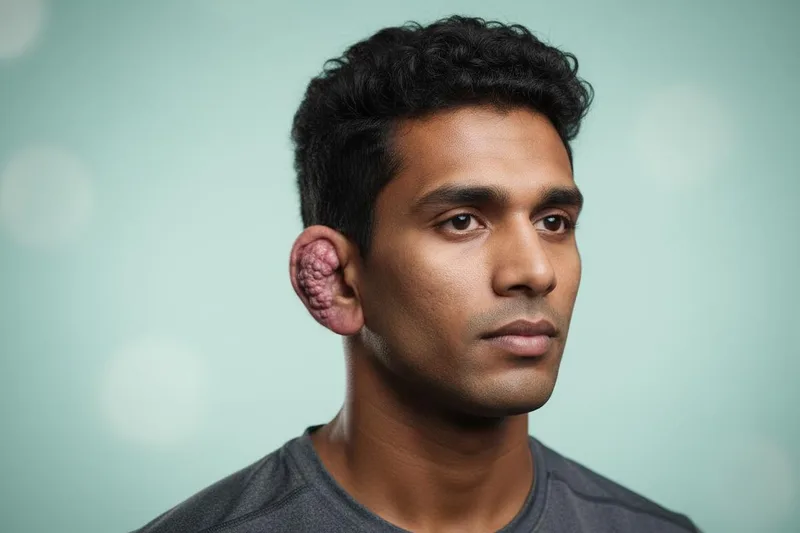
You may have noticed that sometimes, the ears of some athletes, especially those who play contact sports like boxing, rugby, and wrestling, are a little strangely shaped, swollen, and look like a small piece of cabbage. That's why we call it 'Cauliflower Ear' or 'Wrestler's Ear'. Doctors also call it `(Auricular Hematoma)'. Today, we will talk about what this really is, why it happens, what can be done about it, and how to be careful.
What is 'Cauliflower Ear'?
Simply put, 'cauliflower ear' is when your ear gets a hard blow or a good push, the shape of your ear changes, becomes wrinkled, and looks like a cauliflower. Think about it, under the skin of our ears there is a thin, flexible part called cartilage. That's what gives the ear that shape. When the ear is hit hard, the thin blood vessels between this skin and cartilage break, and blood collects in between. This is what is called a ``hematoma'' or 'blood clot'. Over time, as this wound heals, the ear folds inward, shrinks, and looks like the aforementioned cauliflower.
This not only changes the shape of the ear, but can sometimes lead to infections and even hearing loss. But the strange thing is, some martial artists consider this 'cauliflower ear' as an 'award' for their skill in the sport. However, even if you are the one who makes the decisions about your body, if you are thinking of knowingly getting 'cauliflower ear', it is very important to be aware of the risks involved.
This is not something that only happens to athletes. Anyone can develop this condition if they sustain an ear injury. Therefore, it is best to seek medical advice immediately, regardless of the type of ear injury.
How common is this condition?
There are no exact statistics on how common this is in the general population. However, it is very common among boxers, wrestlers, martial artists, and anyone who plays contact sports. A study conducted in Finland found that 96% of national-level combat sports champions had experienced some form of 'cauliflower ear'.
What are the symptoms of 'Cauliflower Ear'?
If you have 'cauliflower ear', you may experience one or more of these symptoms:
- Change in ear shape: This is the main symptom. The ear becomes swollen, bulging, and looks unnatural.
- Blurred vision: Sometimes it can be due to the effects of the injury.
- Discoloration, swelling, or bruising of the outer part of the ear: These can be seen when blood collects.
- Ear pain: There may be severe pain initially after the injury.
- Bleeding from the ear: May occur with injury.
- Headache: Due to the impact of a blow to the ear.
- Hearing a ringing in the ears (Tinnitus): Like a "ringing" sound.
What causes 'cauliflower ear'?
The main reason for this is a hard blow to the ear with something that is not sharp , or a strong blow to the ear. Think of it like someone falling on your ear while playing rugby, or getting punched hard in the ear while boxing.
When this happens, the delicate blood vessels that supply blood to the cartilage in the ear – the fragile part that gives the ear its shape – are damaged. Then, blood begins to accumulate between the skin of the ear and the cartilage. This blood accumulates between the membrane that surrounds the cartilage, called the perichondrium, and the cartilage.
The cartilage gets its nourishment from these blood vessels. When the blood supply stops, the cartilage tissue begins to die without receiving nourishment. In medicine, this is called ``necrosis.'' After that, new cartilage and scar tissue are formed. But they form in clumps, unnaturally. That's why they look like cabbage blossoms. Experts still don't have a clear idea why the newly formed cartilage becomes clumped and deformed like this.
What complications can arise from this condition?
The main complications that can occur from 'cauliflower ear' are:
- Permanent ear deformity: If not treated properly, the shape of the ear can be permanently changed.
- Hearing loss: This can happen if the inner parts of the ear are also affected.
- Infections: Infections can occur if germs get into the collected blood.
Important: If you get an ear infection, additional complications can occur. For example:
- Fever.
- Increased ear pain.
- Increased swelling.
- Pus draining from the ear.
How to identify 'cauliflower ear'?
A doctor can easily diagnose this by examining your head and neck. They will also want to check for other health problems that may be related to the ear injury. Here are some things they can do:
- Checking for a ruptured eardrum.
- A thorough neurological evaluation: Check to see if the brain, spinal cord, or nerves have been affected.
- Cranial nerves: These are the nerves that help us hear, taste, smell, and touch.
Sometimes a CT scan may be done to see if there is any damage to the head.
How to treat 'cauliflower ear'?
There are several treatments for this. The most important thing is to get treatment as soon as possible.
- Incision and drainage: The doctor makes a small incision and drains any blood and fluid that has collected. Then, a compression dressing is applied to the ear to prevent further bleeding. This can be done as soon as possible, within a few hours of the injury , to greatly reduce the risk of permanent ear deformity.
- Ear reconstruction surgery (Otoplasty): This surgery is performed if the ear has been permanently damaged or deformed. This can improve the appearance of the ear to some extent.
If you get treatment early, you may not even develop cauliflower ear. That's why we recommend seeing a doctor as soon as you have an ear injury. In the meantime, apply ice to the ear to reduce pain and swelling.
Can I remove the blood from the 'cauliflower ear' on my own?
This is a dangerous thing to do. Some people try to remove this blood by themselves with a needle. This can cause two problems.
1. Ear infections can occur: If done improperly, germs can enter the ear and cause more serious infections. This can lead to more problems.
2. Blood will fill back up: There is no way to compress the eardrum by simply removing the blood. When a doctor does this, they will apply a special pressure bandage to stop the blood from filling back up. If left alone, the space where the hematoma formed will fill back up with blood. That is why many people have recurring episodes.
Therefore, if you have an ear injury that looks like it could be developing 'cauliflower ear', seek medical advice immediately. For best results, doctors prefer to start treatment within the first six hours of the injury.
How long does it take to recover after treatment?
The healing time can vary from person to person. It mainly depends on these factors:
- The seriousness of your condition.
- How long did it take for the ear injury to heal?
- What kind of treatment did you receive?
Typically, if you have had an incision and drainage, most people will recover in about two weeks . If you have had a surgery like ``Otoplasty'', it may take about four weeks to heal. Your doctor will tell you how long it will take depending on your condition.
Can Cauliflower Ear be prevented?
Yes, this can definitely be prevented. Especially when playing those contact sports we mentioned earlier, it's best to use properly fitting, protective headgear . You also need to make sure that the headgear you buy fits your head properly.
What happens if I have 'cauliflower ear'?
'Cauliflower ear' is not something that will get better on its own . If treated quickly, it can heal without major complications. However, it has a high chance of recurring. That means the space between the skin and the cartilage fills up with fluid again.
If left untreated, the ear deformity usually becomes permanent within seven to ten days. The cartilage dies, causing the top edge of the ear to droop.
How can I take care of myself? / When should I see a doctor?
Prompt treatment can reduce the risk of permanent deformity. As soon as the injury occurs, apply ice to the ear as soon as possible until you can see a doctor. Apply ice for 15 minutes, remove for 15 minutes, and then apply ice again. Continue doing this until you can see a doctor.
For any type of ear injury, see a doctor as soon as possible. This can help prevent permanent disfigurement and deformity. See your family doctor, or go to the emergency room at your nearest hospital.
Remember, even if the ear injury seems minor to you, seeing a doctor is a must.
What questions should I ask my doctor?
If you have 'cauliflower ear', you can ask your doctor questions like these:
- What kind of treatment do I need?
- How soon do I need treatment?
- Will my ear be permanently damaged or deformed?
How painful is 'cauliflower ear'?
When your ear is first hit, it can be very painful. Many people report that the discomfort and swelling gradually subside after a few days. However, if your ear becomes infected, the pain may persist, and may even increase.
If you're a martial artist, you're probably already familiar with 'cauliflower ear.' You may even be "looking forward to" getting one! While it's usually treatable, it can also lead to other health problems, such as frequent ear infections and hearing loss. So, even if the injury seems minor to you, it's important to let a doctor know.
So, what did we learn from this story? (Take-Home Message)
Okay, so here are the most important things to remember from what we've talked about in this 'cauliflower year':
- A condition called 'Cauliflower Ear' can develop if the ear is hit or pushed hard.
- This is most common among people who play contact sports (e.g. boxing, rugby, wrestling).
- The main symptoms are a change in the shape of the ear, swelling, redness, pain, and possibly blood accumulation.
- It is very important to seek medical attention quickly, otherwise the ear may become permanently deformed and look like a cauliflower.
- Never try to drain blood from your ear yourself. This can lead to serious infections and make the condition worse.
- This condition can be largely prevented by using properly fitting protective headgear when playing sports, especially in high-impact sports.
- Even if you have a minor ear injury, don't ignore it. Definitely see a doctor and get advice.
Take care of your ears!
` Cauliflower Ear, Cauliflower Ear, Auricular Hematoma, Ear Injuries, Ear Disorders, Sports Injuries




💬 Comments (0)
No comments yet. Be the first to share your thoughts here.
Add Your Comment