
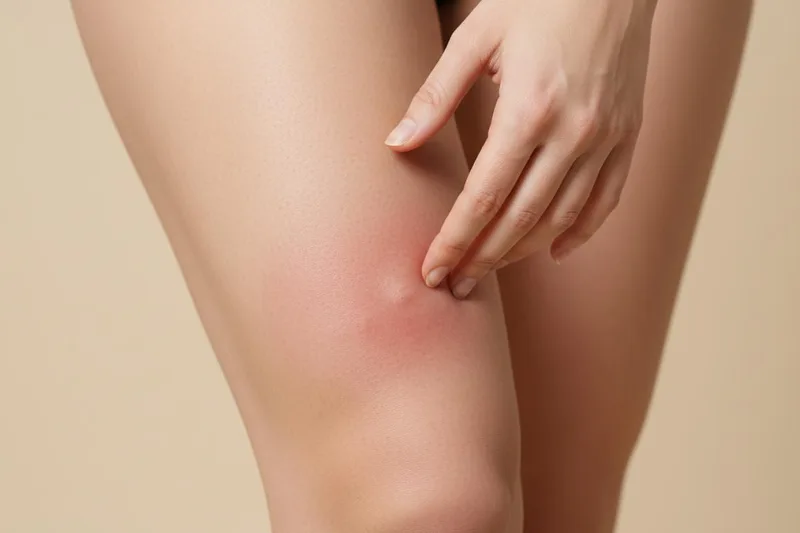
Have you ever noticed that a spot on your leg or arm suddenly becomes red, slightly warm, and swollen? It hurts to touch, but you can't figure out why. Most of the time, this condition is caused by a common bacterial skin infection called cellulitis. This is not something you should just ignore and hope will get better. So, let's understand this properly.
What exactly is Cellulitis?
Simply put, cellulitis is an infection caused by bacteria entering your skin and the tissues beneath it. It's like a small hole in the protective wall of our skin, allowing a thief to get in.
Although it can occur anywhere on the body, it is most commonly seen on the lower parts of the body, such as the legs, feet, and fingers . However, it can also occur on the face and hands.
Who is most at risk of developing this condition?
Anyone can get cellulitis, but some people are more likely to develop it. See if you fall into one of these categories.
- For young children: Children often get small scrapes and wounds while running and playing. Bacteria can easily enter through these wounds.
- For those with a skin wound: It could be a small cut, an insect bite, an animal bite, a wound after surgery, a tattoo, or even a piercing to insert something like earrings.
- For those with chronic skin conditions: Conditions such as eczema, psoriasis, or athlete's foot may weaken the skin's protective layer.
- For those who have had chickenpox or shingles: The blisters caused by these diseases make it easy for bacteria to enter the skin.
- For those with a weak immune system: People with diseases like diabetes mellitus, cancer patients, or those taking certain medications that suppress the immune system have a reduced ability to fight infections.
- For those with obesity: People with excess body weight are sometimes more likely to develop blood circulation problems and infections in skin folds.
What are the symptoms of cellulitis?
See if you have one or more of these symptoms. Recognizing them is very important for prompt treatment.
| Symptom | Description |
|---|---|
| Pain and stiffness | The infected area feels painful when touched or pressed. |
| Swelling (Edema) | The infected area appears more swollen than other areas. |
| Warmth | When you touch that area, it feels warmer than other places. |
| Skin discoloration | The skin turns red, purple, or a slightly darker color than your normal skin color. Sometimes it looks like a rash. |
| Water-filled blisters | In some cases, blisters filled with water or pus may form in the infected area. |
| Orange peel skin | The skin may appear bumpy and pitted, like an orange peel. |
| Symptoms of worsening infection | |
| Fever and chills | As the infection spreads throughout the body, fever, chills, and shivering may occur. |
| Fatigue and body aches | You may feel very tired and have body aches. |
How does this happen? Is this a contagious disease?
The main cause of this is bacteria. In particular, two types of bacteria called Streptococcus and Staphylococcus are most often responsible for this. Even the smallest scratch on the skin can enter the body through these bacteria.
Many people think that it is caused by dirt. While there is some truth to that story, it is not always the cause. However, keeping the skin clean, especially if there is a wound, is very important to prevent it.
The good news is that cellulitis is not usually contagious. However, very rarely, there is a small chance that the infection can spread if an open wound from an infected person comes into contact with another open wound.
How does a doctor diagnose and treat this?
In most cases, your doctor will determine if it is cellulitis by simply asking about your symptoms and examining the infected area. Special tests are usually not needed.
However, if the doctor thinks the infection is more serious, he or she may order a blood test to see if the infection has spread to the bloodstream or a bacterial culture to identify the exact bacteria causing the infection.
Treatment methods
As a treatment, your doctor will prescribe antibiotics . These are usually given as pills.
The most important thing is to take this medicine for the full number of days your doctor prescribes. Don't stop taking it as soon as the symptoms subside. Doing so can cause the infection to come back and be harder to treat later.
If the infection is severe, you may need to be hospitalized and given antibiotics through a vein (IV).
Things you can do at home to speed up recovery
If you do these things while taking your medication, you can reduce the discomfort you feel and recover faster.
- Hot compress: Soak a clean cloth in hot water and apply it to the infected area. This will reduce swelling and pain.
- Elevation: If the infection is on the leg or arm, keep it elevated above the level of the heart with something like a pillow for as long as possible. This will reduce swelling.
- Painkillers: You can take a painkiller like paracetamol to reduce pain and swelling. However, be sure to ask your doctor before taking other painkillers (NSAIDs), as they are not suitable for everyone.
When should you definitely see a doctor?
Cellulitis is a condition that requires immediate treatment. If left untreated, the infection can spread to the bloodstream (bacteremia) or the heart (endocarditis), which can be life-threatening. Therefore, if you have these symptoms , see a doctor immediately or go to the hospital's emergency department (ETU).
- If swelling, redness, or pain increases quickly.
- If you don't feel any better after two or three days of starting antibiotics.
- If you see red streaks spreading upward in the infected area.
- If you develop symptoms such as high fever, chills, and vomiting .
How can this be prevented from happening?
If you take care of a few small things, you can greatly reduce the risk of developing cellulite.
- Keep wounds clean: If you get a small scrape or cut, wash it thoroughly with soap and water.
- Cover the wound: After cleaning the wound, apply an antibiotic ointment and cover it with a clean bandage.
- Keep skin dry and clean: Wash your body regularly, dry it well, and keep it dry.
- Keep your nails short: Long nails can harbor bacteria and can cause injuries when you scratch your skin.
- Get proper treatment for skin conditions: If you have conditions like eczema or fungal infections, get them properly treated by a doctor.
Take-Home Message
- Cellulitis is a common, but potentially serious, bacterial skin infection.
- If a spot on your skin becomes red, swollen, hot, or painful, be concerned about it.
- This is not a common contagious disease.
- If you notice any of these symptoms, see a doctor without delay. Do not self-medicate.
- Use the antibiotics prescribed by your doctor for the full number of days prescribed.
- This disease can be prevented by thoroughly cleaning and covering even small skin wounds.




💬 Comments (0)
No comments yet. Be the first to share your thoughts here.
Add Your Comment