
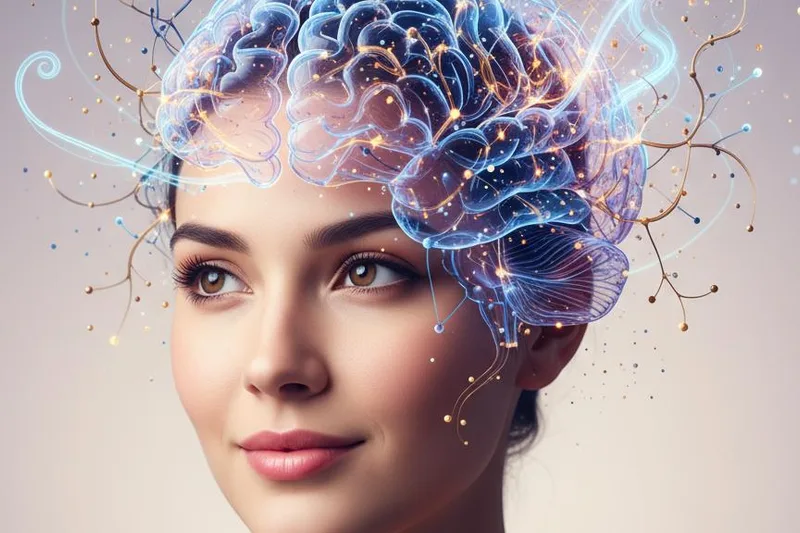
Have you ever wondered how amazing this little organ inside your head, the brain, does? It controls everything we see, hear, think, and do. So today we are going to talk about the biggest and most important part of the brain. That is the cerebrum, or as we say in English, the `(Cerebrum)`.
What is this cerebrum?
Simply put, the cerebrum is the largest part of your brain. It's located at the top and front of your skull. It's involved in almost everything we do during the day, from thinking to taking action. In fact, it's the main control center that makes us who we are, our personality, and our abilities.
Scientists are still learning a lot about the brain and how it works. Although we know a lot, there are still things we don't fully understand. But with the advancement of technology, our knowledge about the brain is increasing day by day.
What is the difference between the cerebrum and the cerebellum?
These two names are somewhat similar, so they can sometimes be confused. However, the functions of these two are very different.
- Cerebrum: This is the largest part of the brain. It controls everything we do consciously , such as thinking, planning, and speaking. It's like the CEO in an office.
- Cerebellum: This is a small part of the brain at the back, at the bottom. Its main function is to balance and coordinate body movements. For example, it helps you keep your balance when you walk and not fall, and it helps you to grasp something accurately when you reach out and grab it. It's like a manager who follows orders from his boss.
What are the main functions of the cerebellum?
We say that the brain controls many of the things we do consciously. Here are some of them. To make this information easier to understand, let's look at it in a table like this.
| Task | A simple explanation |
|---|---|
| Control of the five senses | The brain processes and understands everything you see with your eyes, hear with your ears, taste with your tongue, smell with your nose, and touch with your skin. |
| Language and communication | Different parts of the brain help you read, write, and speak. |
| Short-term memory (Working Memory) | Imagine you're thinking about buying a pack of milk from the store on your way home. This section controls the things you remember for a short time like that. |
| Behavior and personality | The frontal lobe of the brain controls things like your behavior, your personality, choosing right from wrong, and not saying things you shouldn't say. |
| Body movements | When you want to move your limbs, walk, or run, the brain sends the necessary signals to your muscles. |
| Learning, reasoning | When you learn something new, do a calculation, or find a solution to a problem, different parts of the brain work together. |
Some surprising facts about the cerebellum
- Crossed Representation: This is a very strange thing. What you do on the right side of your body is controlled by the left side of your brain. What you do on the left side of your brain is controlled by the right side. This is why if the left side of your brain is damaged, like in a stroke, the right side of your body will lose function.
- The brain's ability to adapt: Your brain can "rewire" itself. This means that it can form new connections between nerve cells in the brain when it is damaged or when you learn something new. This is also called ``neuroplasticity.''
- Specialized areas: Different parts of the brain are specialized for different functions. But the idea that some people are "left-brained" and "right-brained" is not scientifically proven. Both sides of the brain work together.
How is the cerebellum formed?
The outer surface of the cerebrum, the cerebral cortex, is wrinkled like a peeled walnut. It is divided into two halves by a deep groove running lengthwise down the middle. We call these the left hemisphere and the right hemisphere .
These two hemispheres are connected to each other by a bundle of nerve tissue called the ``Corpus Callosum.`` Like a bridge, it is this that transfers information from one side of the brain to the other.
Major regions of the brain (Lobes)
There are five main regions, or ``lobes,'' in each hemisphere of the brain. Each of them has specific functions.
1. Frontal Lobe: Located at the front of the head. It controls attention, behavior control, speech, and some movements.
2. Parietal Lobe: Located at the top of the head. Helps detect sensations such as touch, temperature, and pain. Also involved in understanding the distance and size of objects, language, counting, and decision-making.
3. Temporal Lobe: Located on the sides of the head, above the ears. Helps us understand what others are saying, recognize people and objects, and connects memories and emotions.
4. Occipital Lobe: Located at the back of the head, this is the main center for processing what we see with our eyes, such as movement and color.
5. Insular Lobe: This is located a little further in, below the other lobes. This part is mainly involved in the sensation of taste.
Imagine that you are walking down the street and suddenly a dog comes running towards you. Imagine how fast your brain is working at that moment. You see the dog with your eyes (Occipital Lobe), you hear the barking sound (Temporal Lobe), you remember the fear of being bitten by a dog before (Temporal/Hippocampus), you shout, "Hey, it's a dog!" (Frontal/Temporal Lobe), you decide to run away (Frontal Lobe), and you send signals to your legs to run (Frontal Lobe). All of this happens in a matter of seconds because all these parts of the brain work together.
What are the common conditions that affect the brain?
Any disease that affects the brain can also affect the cerebellum. This includes mental health problems. Here are some of them:
- Alzheimer's disease
- Anxiety disorders
- Attention deficit hyperactivity disorder (ADHD)
- Stroke
- Traumatic brain injuries
- Dementia
- Depression
- Epilepsy
- Parkinson's disease
- Some vitamin deficiencies (especially vitamin B12)
- Brain infections (bacterial, viral)
What could be the symptoms?
When the brain is affected, various symptoms can occur.
- Difficulty speaking or understanding: `(Aphasia)`
- Loss of body balance: unsteadiness while walking, inability to grasp objects properly (Ataxia)
- Behavioral changes and confusion
- Headaches and Migraines
- Memory problems
- Paralysis of body parts
- Tremors
- Vision problems: blurred vision, double vision
If you continue to have one or more of these symptoms, be sure to talk to your doctor about it . It is very important to get treatment on time.
How to maintain good brain health?
There are a few simple things we can do to protect this most precious organ of ours.
- Eat a balanced diet: Nutrients, especially vitamin B12, are very important for brain health.
- Be physically active: Exercise improves blood flow to the brain, which can help protect against diseases like stroke.
- Be careful of infections: Infections, especially those in the ear and eye, can spread to the brain if not treated promptly, so don't ignore them.
- Protect your head: Wear a helmet when riding a bicycle or motorbike. Protecting your head from accidents is very important to prevent brain damage.
- Avoid smoking and excessive alcohol consumption: These habits damage the blood vessels in the brain and increase the risk of diseases such as stroke.
- Use prescribed medications exactly as prescribed: If a doctor has prescribed medications for you for a certain condition, take them exactly as prescribed.
The brain is the most amazing part of our body, helping us with everything we do every day. Taking care of its health is one of the best investments we can make to maintain the quality of our entire lives.
Take-Home Message
- The cerebrum is the largest part of your brain. It controls your thoughts, memory, language, movement, and senses.
- The brain is made up of two main hemispheres (left and right) and several regions (lobes). Each of these regions has specific functions.
- A number of diseases, such as stroke, dementia, and epilepsy, can affect the brain.
- You can maintain good brain health by eating a balanced diet, exercising, protecting your head, and avoiding smoking/alcohol.
- If you experience any problems with brain function, for example, memory loss, difficulty speaking, or feeling lifeless, seek medical advice immediately.


💬 Comments (0)
No comments yet. Be the first to share your thoughts here.
Add Your Comment