
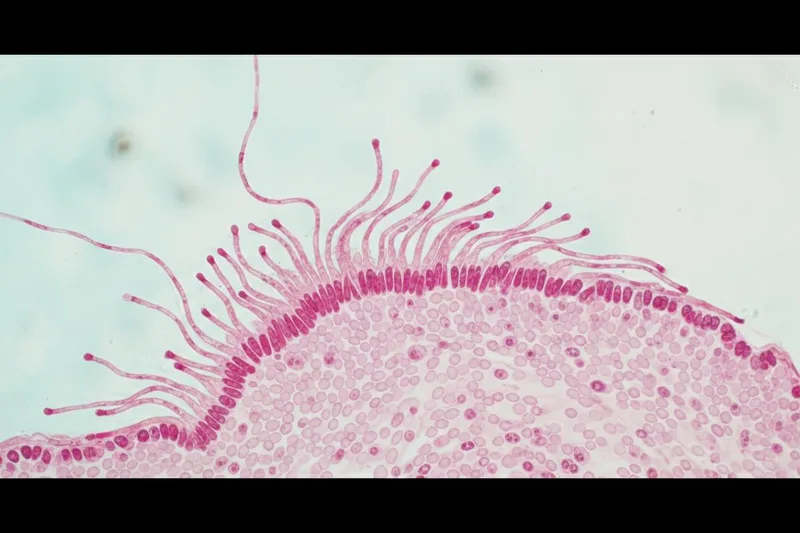
You may have heard the term `(Cervical Ectropion)` when you went to see a doctor, or just from a friend. When you heard it, you might have been a little worried, thinking, "Oh, what is this disease?". This is actually nothing to be afraid of. It is a very common condition that many women have. So today, let's talk about what `(Cervical Ectropion)` is, why it occurs, and whether it needs treatment, in a way that you can understand clearly.
What is `(Cervical Ectropion)`? Let's understand it simply!
Okay, first let's look at what this `(Cervical Ectropion)` is. Simply put, it's when a type of cell inside your cervix starts to protrude from the cervix. Now you might be thinking, "Oh, how does that happen?"
Did you know that our cervix, or "cervix," has two parts? It's like a door to a small room, and our uterus has two parts.
- The outer part of the cervix: This is a very flat, pink area. It's like the skin inside your mouth. It's made up of squamous cells .
- The inside of the cervix (cervical canal): This is a little different. It's like the inside of our intestines, with little finger-like protrusions and a slightly rough surface. This part is made up of glandular cells . These cells help produce the mucus that the cervix needs.
Now, in `(Cervical Ectropion)`, what happens is that some of the glandular cells inside the cervix come out of the cervix and are visible from the outside. Think of it like a flower bud blooming. When the bud is there, the petals inside are not visible. But when the flower blooms, the beautiful petals inside are visible. That's what happens here too. The cervix becomes a bit like "turning inside out". This is not a disease, it's just a change in the body.
Are `Cervical Ectropion` and `Cervical Erosion` the same thing?
Sometimes you may have heard it called `(Cervical Erosion)`. But that is a bit of a misnomer. When we say `(Erosion)`, we think of something as being "washed away". But here, there is no washing away or destruction of the cells. What happens is that, as mentioned earlier, the cells inside are only visible. Therefore, `(Cervical Ectropion)` is the more correct term.
Who is most affected by this situation?
Although this condition called `(Cervical Ectropion)` can occur in any woman, some women are more likely to experience it. It is mainly seen during periods when the body's `(Oestrogen)` hormone levels are high .
- Adolescence: This condition can be seen when a girl reaches puberty, as the level of estrogen in the body increases.
- During Pregnancy: During pregnancy, the level of the hormone `(Estrogen)` increases a lot. Therefore, many pregnant mothers can develop this condition `(Cervical Ectropion).` This is not harmful to the baby or you.
- During Ovulation: This difference can be seen because estrogen levels increase during the days of ovulation in the monthly menstrual cycle.
- For those using birth control pills containing estrogen and progestin: When using this type of birth control pill, cervical ectropion can occur because the body's hormone levels change.
- Those who have had some damage to the cervix (such as a laceration) during childbirth.
The most important thing is that after menopause, that is, after you stop menstruating completely, this condition (Cervical Ectropion) is very rare. Because at that time, the level of (Estrogen) decreases.
How common is `(Cervical Ectropion)`?
This is actually a very common condition. According to surveys, between 17% and 50% of women of childbearing age may have this `(Cervical Ectropion)`. This means that there may be people among your friends who have this condition. So there is no reason to be afraid or embarrassed to hear about this.
What are the symptoms of this?
Here's the important thing. Most of the time, Cervical Ectropion doesn't cause any symptoms. You may not feel any discomfort. You may only find it when you go to the doctor for something else, when he or she examines you. Even if you do, the doctor may not even tell you about it because it's not dangerous.
However, very rarely, some people may experience certain symptoms. But remember, before assuming that these symptoms are caused by `(Cervical Ectropion)`, you should also check if there is another cause. Because these symptoms can also be caused by other conditions that require attention.
- Vaginal discharge: This may be slightly bloody or have a mucus-like discharge.
- Pain or bleeding during or after sexual intercourse (Dyspareunia): This can also be seen sometimes.
- Pain or bleeding when a doctor performs a pelvic exam.
- Spotting (small drops of blood) during menstruation.
- Pelvic pain.
Important: Although cervical ectropion is a harmless condition, if you have these symptoms, you should definitely see a doctor to find out the exact cause, as these symptoms could be caused by something else.
What are the causes of `(Cervical Ectropion)`?
As we mentioned earlier, `(Cervical Ectropion)` is a non-dangerous, non-harmful `(benign`) condition. It simply means that the glandular cells inside your cervix are visible from the outside.
You may have been born with this condition. The most likely cause is the level of the hormone `(Estrogen)` in your body. When `(Estrogen)` levels are high, the chances of seeing this condition increase.
How do you diagnose this?
Most of the time, cervical ectropion does not cause any symptoms, so you may not even know you have it. It is often discovered by a doctor during another test.
- Pelvic exam: This can be seen when the doctor examines the organs of your reproductive system.
- Pap smear: This test, which checks for cervical cancer, can also detect cervical ectropion.
- Colposcopy: In this test, a doctor uses a special instrument (colposcope) to magnify the cervix. This can also be seen.
- Biopsy: Sometimes the doctor will take a small piece of tissue from the cervix and examine it. This can also confirm the condition.
But keep this in mind. Cervical Ectropion is not a "disease" that is found during a routine check-up. So even if a doctor finds you have it, they may not tell you about it unless it is dangerous.
Does this require treatment? `(Treatment)`
Here's another piece of good news! Most of the time, no treatment is needed for `(Cervical Ectropion)` because it is not a disease.
However, in rare cases, if you have cervical ectropion and are experiencing persistent vaginal discharge, a doctor may prescribe medication to help reduce the symptoms. For example, something like boric acid suppositories (a medicine placed in the vagina) may help reduce symptoms.
Even more rarely, if the symptoms are very bothersome, there are small treatments that destroy the cells that have come out.
- Diathermy: A small device uses high heat to destroy the cells.
- Cryotherapy: This involves freezing the cells by applying extreme cold.
Again, these treatments are rarely necessary. If you have any symptoms, the cause is likely something other than `(Cervical Ectropion)`. Therefore, treatment will be determined based on those symptoms.
Can Cervical Ectropion be prevented?
No, there is no way to prevent a condition called `(Cervical Ectropion)`. But don't worry or be afraid about it. Because this is a harmless, normal condition. It is not related to or caused by other dangerous diseases.
What should I think if I have `(Cervical Ectropion)`?
If a doctor tells you that you have ``Cervical Ectropion'', don't worry. It's just a small change in the way the cells in your cervix have grown. It's not a sign of any disease.
When should I see a doctor?
If you have any unusual symptoms, for example, unusual bleeding, pain or bleeding during sex, or any other pain in the lower abdomen in addition to menstrual pain, you should definitely see a doctor. These symptoms may be related to `(Cervical Ectropion)`, or they may be due to other causes. Therefore, it is best to see a doctor and get proper advice.
Don't be scared when you hear the word `(Cervical Ectropion)`. It's just a small change in the way the cells in your cervix look. Don't think of it as a dangerous disease. It's not associated with any risk of disease.
Take-Home Message
Okay, so let's put some of this talk together:
- Cervical ectropion is a harmless, very common condition in which cells inside the cervix protrude outward.
- This is not a disease, just a change in the body.
- Often no symptoms appear.
- This is more common in women with high levels of the hormone `(Estrogen)` (e.g., young women, pregnant women, or those taking birth control pills).
- Often no treatment is needed.
- If you have symptoms like abnormal vaginal discharge, bleeding, or pain, it doesn't necessarily have to be due to `(Cervical Ectropion).` See a doctor immediately to find out the cause.
- Don't be afraid or ashamed of this situation.
So, I hope you have found some relief and clarification for your questions and fears about `(Cervical Ectropion)`. Stay healthy!
` Cervix, Cervical Ectropion, Women's Health, Estrogen, Pap Test, Vaginal Discharge, Gynecology


💬 Comments (0)
No comments yet. Be the first to share your thoughts here.
Add Your Comment