

Have you ever woken up in the morning and noticed a small lump on or under your eyelid? It may be a little red, and it may be a little painful at first. Most of the time, we get a little worried when we see something like this, right? But don't worry, this could very well be a condition called a Chalazion. Today, we'll talk about this in detail, very simply.
What exactly is a Chalazion?
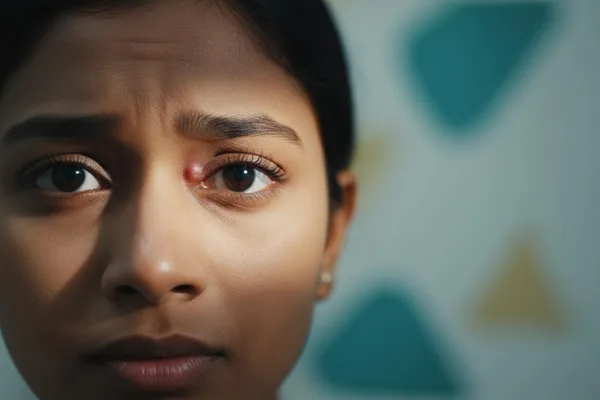
Simply put, a chalazion is a small, red bump or lump that forms on your eyelid. Some people also call it a stye. It forms when a very small oil gland in our eyelids (called a meibomian gland) becomes blocked. Think about it, these glands secrete an oil that helps keep our eyes moist and healthy. So, if this small hole that lets oil out gets blocked for some reason, the oil can't get out and starts to build up inside. Little by little, this oil builds up and slowly forms like a lump.
Initially, this chalazion may be a little painful. But after a few days, the pain will go away. But the lump may remain. Most often, it develops on the underside of the upper eyelid. But occasionally, it can develop on the lower eyelid as well.
Chalazion is usually seen most often in adults between the ages of 30 and 50. It is less common in young children, but it is not impossible to develop it.
How is this different from a stye?
Now you might be thinking, "Oh, is this about a stye ?" It's actually easy to confuse the two because they both look like bumps on the eyelid. But there are some subtle differences between the two.
A chalazion can sometimes be caused by a stye, but these are two different conditions.
- Reason: Both are caused by blocked oil glands. However, a stye is a swelling of the gland caused by a bacterial infection . A chalazion is not an infection, but a swelling caused by a buildup of oil.
- Where it occurs: A stye usually forms right at the edge of the eyelid, near the eyebrow. A chalazion forms a little further in, on the eyelid .
- Pain: A stye often hurts . Sometimes it hurts a lot. However, a chalazion may hurt a little at first, but it usually doesn't hurt much later.
Do you understand the difference? So it's important to get to know these two properly.
What are the symptoms of this?
If you have a chalazion, you may feel things like:
- It looks like a small lump or swelling on the eyelid. This is most often seen on the upper eyelid.
- Although there is a little pain at first, it will gradually decrease or disappear completely .
- As the tumor grows, the area may become red, swollen, and tender.
- The eyes may feel a little irritated and irritated , which may cause tears to flow from the eyes.
- If the chalazion is large, it may press on the eyeball, causing some blurring of vision .
- Sometimes the entire eyelid can swell .
Why do we get chalazions?
As we've discussed before, a chalazion occurs when a small oil gland in the eyelid (the Meibomian gland) becomes blocked for some reason. These glands produce oil that helps keep our eyes moist. So when this gland becomes blocked, the oil builds up inside without a way to get out, and the gland swells. Eventually, this buildup of oil and fluid also causes a small irritation to the skin around the eyelid. All of this comes together to form a hard, oil- and fluid-filled lump on the eyelid.
Is this a contagious disease?
No, chalazions are not contagious. They are not caused by a bacterial infection (like a stye). Therefore, they are not contagious from one person to another. So if you have a chalazion, don't worry about spreading it to others in your household.
Who is more likely to develop these? (Risk factors)
Chalazion is actually very common. Anyone can develop it. However, some people are more likely to develop it. See if these things apply to you:
- If you have had a chalazion before: Those who have had one have a small chance of developing one again.
- If you have chronic blepharitis: Blepharitis is an inflammatory condition that occurs at the edge of the eyelids. People with this condition are more likely to develop chalazions.
- If you have skin conditions: These can also occur in people with certain skin conditions, for example, dandruff (a related condition is seborrheic dermatitis) or rosacea .
- Dry skin: People with dry skin are also more likely to have blocked oil glands.
- During periods of hormonal changes: These conditions can also occur when the body's hormone levels change.
Can a chalazion cause other problems?
Most of the time, a chalazion is not a serious problem. However, sometimes a larger chalazion can press against the cornea (the clear front part of the eye ). This can cause blurred vision or loss of vision . This can be a major complication.
How does a doctor recognize this?
If you have a chalazion, you can see an eye specialist. This could be an optometrist or an ophthalmologist. He or she will examine your eye, confirm whether it is a chalazion, and tell you about the necessary treatment.
When you go to see a doctor, you can generally expect things like:
- Asks about your health history: The doctor will ask about your complete health history. This information will help determine if there are any other underlying medical conditions that could contribute to the development of a chalazion.
- External eye examination: The doctor will carefully examine your eye, eyelid, eyelids, and the surrounding skin.
- Detailed eyelid examination: The doctor will use a bright light and a magnifying tool to look closely at the base of your eyelid. He will also check the oil gland openings on the underside of your eyelid.
What is the best way to treat a chalazion?
Most chalazions can be treated with simple home remedies , and they often resolve on their own within a month or less.
Most importantly, never squeeze or pop a chalazion! Doing so can cause injury, infection, and make the condition worse.
Instead, try these things at home:
Things you can do at home
- Warm compresses: This is the most important thing. Take a clean, soft cloth and soak it in warm water (not too hot, but just enough to be bearable). Then, squeeze out some of the water and place it over the affected eye for about 15 minutes. Do this at least three times a day. The heat will help the blocked oil gland open up and release the oil.
- Good hygiene: Avoid wearing makeup around your eyes while you have a chalazion. Once the cyst starts draining, keep the area clean. Avoid touching your eyes frequently. Take care of your eye health.
When is medical treatment needed?
If your chalazion doesn't improve with home treatments, you should definitely see an eye specialist. In-office treatments may include:
- Drainage through a small incision: The doctor can make a very small incision and remove the accumulated oil and fluid. This is usually done under anesthesia.
- A steroid injection:A steroid injection can also be given into the chalazion to reduce swelling and inflammation.
Can't it be prevented from happening again?
Some chalazions are caused by styes. So if you can prevent the styes from forming, you can also reduce the risk of chalazions. The best way to do this is to maintain good hygiene . See if you have these habits:
- Hand washing: Wash your hands often and thoroughly with soap. Be sure to wash your hands before touching your eyes.
- If you wear contact lenses: Wash your hands before removing your lenses. Clean your lenses thoroughly with a disinfectant and lens cleaning solution. Be sure to remove daily and short-term lenses at the appropriate time.
- Face washing: Wash your face every night before going to bed to remove dirt and makeup. If you frequently get conditions like blepharitis, your doctor may recommend using a special scrub or baby shampoo to clean your eyelids.
- Makeup Cleanliness: Remove all old and expired makeup. Especially mascara and eye shadow, replace them every two to three months. Never use someone else's makeup or share yours with someone else.
How long will this last?
If treated properly at home, a chalazion should heal in about a week . However, if left untreated, it can last for four to six weeks, and sometimes even months .
If it's formed once, can it be formed again?
Yes, if you get one chalazion, you can get another one . That's why maintaining good hygiene, which we talked about earlier, is so important.
When should you see a doctor?
If you have a chalazion and it doesn't get better with home treatments, you should definitely see an eye specialist. He or she can examine your eyes and tell you about other treatments. Also, if you have recurring chalazions (one that gets better and then another one that comes back) , you should tell your doctor about that as well.
What questions should you ask the doctor?
If you have a chalazion, you may want to ask questions like these when you visit your doctor:
- Do chalazions usually get better on their own?
- How long will it take for this to heal?
- What kind of treatment do you recommend?
- What should I do to prevent things like this from happening in the future?
It is very important to ask these questions and clear your doubts.
The last thing I have to say is this (Take-Home Message)
Keeping your eyes healthy is important for your vision and quality of life. However, sometimes, a chalazion, a painless lump or bump on your eyelid, can develop. Although it can be a little bothersome to see, a chalazion is usually nothing to worry about. In most cases, it can be treated with simple home remedies.
Remember, warm water and good hygiene are the key.
Most of the time, these will go away on their own. But if the chalazion persists, doesn't improve, gets bigger, or interferes with your vision, you should definitely see an eye specialist. Then you can get the treatment you need. So, don't panic, take it easy, and take care of it.
👩🏽⚕️ Additional questions (FAQs)
💬 Is Chalazion a Stye?
Both occur on the eyelids, so these are two different things! A stye is a painful blister that forms when bacteria (an infection) enters a hair follicle at the base of an eyelid. A chalazion is a small, usually painless lump that forms when an oil gland inside the eyelid becomes blocked.
💬 Will this never get better? Will I lose my eyesight?
This will not cause vision loss (although it may cause some blurring of vision if the lump becomes too large and presses on the eye). Most of the time, these will resolve on their own within a few months. However, if you want them to resolve more quickly, place a warm compress over the eye 4-5 times a day and gently massage it.
💬 Are there any conditions that require surgery?
Yes. Only if it does not dissolve after 6 months of medication (drops/creams) and the tumor is very large and unsightly, an ophthalmologist will make a small incision inside the eyelid and clean and remove it in 10 minutes.
` Chalazion, Stye, Eyelid Stye, Meibomian Glands, Eye Health, Hot Flashes




💬 Comments (0)
No comments yet. Be the first to share your thoughts here.
Add Your Comment