

Did your doctor recommend surgery to remove gallstones? If so, you may have been told that an 'Intraoperative Cholangiogram' will be performed during the surgery. The name may sound a bit complicated, and you may even feel a little scared. But this is actually a very important test that is done for your safety. Let's take a look at what it is, why it is done, and what benefits it can provide you.
What is Intraoperative Cholangiogram?
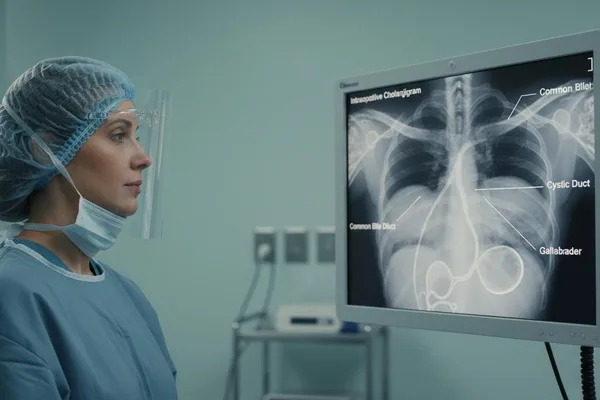
Simply put, an Intraoperative Cholangiogram is a special X-ray test that is performed during your gallbladder removal surgery ( cholecystectomy ). It gives the surgeon a clear 'road map' of the bile ducts inside your body.
The bile produced by our gallbladder and liver travels through a system of small tubes to the small intestine. This system of tubes is called the bile duct. With this X-ray, the surgeon can clearly see how this system of tubes is arranged, how they connect to each other, and whether there are gallstones or other blockages in the tubes.
The main purpose of this is to help the surgeon remove your gallbladder very safely , without causing any damage to the bile ducts.
Why do doctors do this test?
There are several benefits to performing this test during gallbladder removal surgery. It is a great help to the medical team.
| Purpose of the test | A simple explanation |
|---|---|
| Identifying hidden stones | Sometimes, small stones can get stuck in the bile ducts, which may not cause any symptoms at first, but they can cause problems later. This test can detect hidden stones and, if possible, remove them during surgery. |
| Identifying damage to the bile ducts | This test helps to identify any damage to a bile duct during surgery and repair it at the same time. |
| Taking care of the anatomy of the bile ducts | The way organs are arranged inside each person's body can vary slightly. The way the cystic duct from the gallbladder and the common bile duct from the liver connect can vary from person to person. By looking at this "map," the surgeon can perform the operation more safely. |
Are there any special reasons for doing this test?
Some surgeons do this test every time they have a gallbladder removal surgery (routine cholangiography). However, others do it only if there are special reasons (selective cholangiography). If you have one or more of the conditions below, your doctor will likely decide to do this test.
- If you have abnormalities in your liver function tests .
- If the level of pancreatic enzymes is elevated.
- If you have or have recently had pancreatitis .
- If you have jaundice .
- If you have recently had a blockage in the bile ducts, such as stones.
- If you have been tested with an ERCP (endoscopic retrograde cholangiopancreatography) test to see or remove blockages in the bile ducts, but it is not possible to completely see the bile ducts or remove the blockages.
How does this process happen?
This entire process takes place under anesthesia and you are put to sleep, so you won't feel anything. So there's no reason to be afraid of this.
Things you need to do before surgery
Preparing for this is exactly the same as preparing for a gallbladder removal surgery. Your doctor will give you clear instructions about this.
- You will be asked to fast (abstain from eating or drinking) for a few hours before the surgery.
- You should inform your doctor about any medications you are taking. Some medications may need to be stopped or the dosage adjusted before surgery. Never stop taking any medication without your doctor's advice.
- Arrange for someone to take you home after the surgery.
What happens during surgery
1. The anesthesiologist will give you anesthesia and put you completely to sleep.
2. The surgeon makes a small incision or several incisions in the abdomen for the operation.
3. Then, a very fine tube (catheter) is inserted into the cystic duct.
4. Through this tube, a special liquid called contrast dye is injected into the bile duct system. This liquid causes the bile duct system to appear very clearly and white on the X-ray.
5. Now, using the X-ray machine, the surgeon observes the fluid moving through this system of tubes through a monitor.
6. If you see any stones stuck at this time, try to remove them immediately if possible.
7. Using this X-ray "map", the gallbladder is very safely removed, the surgery is completed, and the incisions are closed.
After the surgery
After the surgery, you will be kept under observation in the ward. You will usually be able to go home the same evening or the next day.
What are the risks and benefits of this test?
As with any medical procedure, there are some very small risks, but the benefits are many.
| Advantages | Risks |
|---|---|
| - Since the bile ducts are clearly visible, the risk of damaging them during surgery is greatly reduced. | - Allergic reactions to the contrast dye (this is very rare). |
| - Small stones that were previously undetected can be identified and future complications can be prevented. | - Damage to the bile ducts (but the purpose of this test is to prevent this). |
| - Being able to identify and remedy any damage immediately if it occurs. | - Infection, Bleeding, Pancreatitis. |
The important thing is that the chances of these risks occurring are very low, and your surgical team is well-trained to deal with any such situation.
When should I call the doctor?
When you go home after surgery, be very careful about these symptoms. If you have any of these, you should talk to your doctor immediately . If necessary, you can also go to the Emergency Department (ETU) of the nearest hospital.
- If you experience unexpected or unbearable severe pain .
- If the surgical incision is red, swollen, feels warm , or has pus or blood coming out of it.
- If you get a fever .
If you have the slightest doubt about anything like this, never hesitate to ask your doctor. Your safety is the most important thing.
Take-Home Message
- An intraoperative cholangiogram is a special X-ray test performed to increase your safety during gallbladder removal surgery.
- This helps the surgeon see your bile duct system clearly, perform the surgery without damaging it, and remove hidden stones.
- You will not feel any pain during this test because you have been given anesthesia.
- If you have any questions, fears, or doubts about this, talk to your doctor openly about it before the surgery.
- Be aware of warning signs (fever, severe pain, signs of infection in the incision) that may occur after surgery, and seek medical advice immediately if you notice any of these.




💬 Comments (0)
No comments yet. Be the first to share your thoughts here.
Add Your Comment