
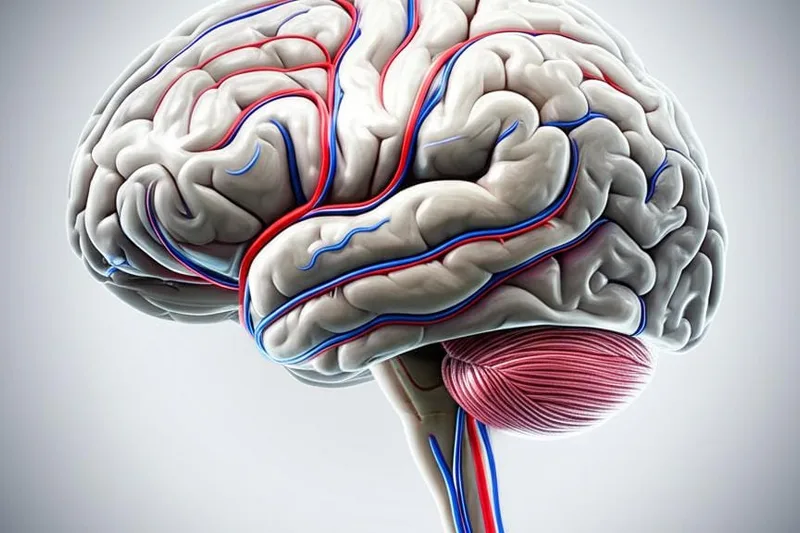
Have you ever heard of the 'Circle of Willis'? Maybe your doctor has told you about it, or you've seen it in some medical report. It's actually a very important part of our brain. It's like a little security system. So, let's talk briefly about what this `(Circle of Willis)` is and what it does, okay?
What is the 'Circle of Willis'?
Okay, so what is the `(Circle of Willis)`? Simply put, it is a system of blood vessels located right under our brain, at the base. It is shaped like a ring, or a five-sided shape (`(Pentagon)`) . There are two main blood vessels that supply our brain with oxygen-rich, clean blood. One is the `(Internal Carotid Artery)` system, and the other is the `(Vertebral Artery)` system. So this `(Circle of Willis)` is where these two main blood vessels connect. The `(Internal Carotid Artery)` mainly supplies blood to the front of the brain, and the `(Vertebral Artery)` mainly supplies blood to the back of the brain.
This is called the 'ring of Willis' after the anatomist Thomas Willis. He is the one who helped us discover a lot about this structure. It is also called by other names, for example:
- ` (Cerebral Arterial Circle)` (Cerebral Arterial Circle)
- ` (Willis Polygon)` (Willis Polygon)
- ` (Loop of Willis)` (Loop of Willis)
This is like a 'fail-safe' for our brain, a safety mechanism. Imagine, if one of these two main blood vessels is damaged, for example, due to a burst blood vessel in the brain (Brain Aneurysm) or a stroke, the other route can supply some blood to that damaged part of the brain through this (Circle of Willis). Isn't that amazing?
Is everyone's (Circle of Willis) the same? Or are there differences?
But here's the thing. Not everyone has a perfect ``Circle of Willis''. According to researchers, less than half of the population has it completely intact. That means there may be slight structural changes in it. When that happens, we call it ``Incomplete Circle of Willis'' .
There are two most common changes, especially in the blood vessel called the Anterior Communicating Artery, which is located at the front of the Circle of Willis:
- Fenestration: This can affect up to 21% of the general population. Fenestration is when a blood vessel splits into two, travels a short distance, and then rejoins. It's like a road splitting in two and then rejoining.
- Duplication: This affects about 18% of cases. Duplication is when two blood vessels that start separately join together to form a single blood vessel.
Now you may be thinking, 'What if my Circle of Willis is also incomplete?' Don't worry. Even if your Circle of Willis is incomplete, you can live a healthy life without any problems. It usually doesn't affect your brain function much. However, if you develop a cerebrovascular disease, such as a stroke, then the effects of that imperfection may be a little more severe. This is not something we can change intentionally. This is determined by the way our blood vessels are formed during the embryonic stage , that is, while we are still in the womb.
How common is an incomplete (Circle of Willis)?
So, how common is this incomplete `(Circle of Willis)`? In fact, researchers believe that it is very common. But it is difficult to say exactly how common. Because, not everyone has a `(Scan)` test of the brain. Only with such a `(Scan)` can the nature of this `(Circle of Willis)` be seen exactly. According to various studies, this `(Circle of Willis)` may be incomplete in between 50% and 90% of adults . That means that most people have it with slight variations.
What exactly is the function of the Circle of Willis?
Let's now talk a little more clearly about the role of this `(Circle of Willis)` again. Think of it as a `(Traffic Roundabout)` where many roads come together.
Each artery that makes up the `(Circle of Willis)` is like a road. There are two main `(Highway)`, that is, the two roads that carry the most blood. Those are the `(Internal Carotid Artery)` system mentioned earlier, and the `(Vertebral Artery)` system. The other small roads in the `(Circle of Willis)` join together, forming a roundabout that connects to those two main highways and allows blood (i.e. traffic) to flow.
The advantage of this is that if there is a sudden 'roadblock' or 'accident' on that main highway (i.e., a major blood vessel supplying blood to the brain), the other highway can send some blood to the affected part of the brain through this roundabout. Simply put, having a complete `(Circle of Willis)` means that there is an additional route (`(Detour Route)`) that can be used in case of any blockage or problem.
If you have a complete `(Circle of Willis)`, it can protect you from some serious conditions. Especially diseases that affect the blood vessels in this `(Circle of Willis)`. For example:
- Fatty deposits inside blood vessels (Atherosclerosis)
- Bleeding into the brain (e.g., due to an injury (Intracranial Hemorrhage))
- Carotid Artery Disease / Carotid Artery Stenosis
- Inflammation of the blood vessels in the brain (Central Nervous System Vasculitis)
- A ruptured blood vessel in the brain (Ruptured Brain Aneurysm)
- Stroke
- Transient Ischemic Attack (TIA) or mini-stroke
However, if you have an incomplete ``Circle of Willis'', the protective function of that circle does not work properly. Then, in diseases related to the blood vessels of the brain like this, the risk of the effects being severe is slightly higher, especially in the case of a stroke.
Where is this (Circle of Willis) located?
You may also want to know exactly where this `(Circle of Willis)` is located. It is located at the `(Base of your Brain)`, in a space slightly outside the brain tissue (`(Subarachnoid Space)`). It is located around the stalk of our `(Pituitary Gland)`, just below the `(Hypothalamus)`. Also, several of our cranial nerves (`(Cranial Nerves)`) pass close to this `(Circle of Willis)`.
When should I ask a doctor about this (Circle of Willis)?
Now you might be wondering, 'When will I hear about this `(Circle of Willis)` from my doctor?' Well, there could be several reasons for that:
- If you have a brain aneurysm: The Circle of Willis is one of the most common places in the brain where aneurysms develop. Researchers say that about 85% of intracranial aneurysms occur in the area of the blood flow in front of the Circle of Willis.
- If you have a stroke: A stroke can occur due to a blockage or bleeding in a blood vessel in the Circle of Willis.
- If you have Moyamoya Disease: This is a very rare brain condition. It occurs when the blood vessels in your Circle of Willis, which supply blood to the front of your brain, gradually become narrowed or blocked.
- If you have 'Subclavian Steal Syndrome': This happens when your 'Subclavian Artery' (the axillary artery) becomes narrowed or blocked. It then 'steals' some of the blood that should be going to your brain through your 'Vertebral Artery' (a major blood vessel in the 'Circle of Willis').
- If you have surgery on your brain: During surgery on this part of your brain – for example, to treat an aneurysm or a problem with your pituitary gland – there is a small risk of damage to your Circle of Willis and the important parts around it. If the Circle of Willis itself is damaged, it can cause a blockage in the blood supply to the brain (Brain Ischemia) or a complete loss of blood supply (Infarction).
- If you have a brain scan: If you have a brain scan, such as a cerebral angiogram or a brain MRI (Magnetic Resonance Imaging), your report may include details about the Circle of Willis and its structure.
What happens if the (Circle of Willis) is blocked?
Imagine what would happen if there was a blockage anywhere in this `(Circle of Willis)`. Most likely, if that happened, a `(Stroke)` could occur. However, as I said before, if you have a complete `(Circle of Willis)`, it may protect you to some extent from the severe symptoms of a stroke.
What is 'Circle of Willis Syndrome'?
Some doctors and medical sources also refer to the previously mentioned `(Moyamoya Disease)` as `(Circle of Willis Syndrome)`. Another name for `(Moyamoya Disease)` is `(Spontaneous Occlusion of the Circle of Willis)`.
What can we do to keep this (Circle of Willis) healthy?
So, what can we do to keep this important ``Circle of Willis'' and other blood vessels in the brain healthy? The most important thing is to control the risk factors for developing cerebrovascular disease if you have them. These risk factors are:
- High Blood Pressure
- High Cholesterol
- Diabetes `(Diabetes Mellitus)`
- Heart Disease
- Chronic Stress
- Obesity
- Smoking / Nicotine Use Disorder
- Alcohol Use Disorder
It is very important to talk to your doctor about ways to manage these conditions.
Let us remember (Take-Home Message)
Okay, so what are the main takeaways from what we talked about today?
The ``Circle of Willis`` is an amazing system of blood vessels at the base of our brain that supplies blood to the brain. It's like a safety net.
>
Not everyone has this complete, and that's normal. There's nothing to be too worried about if it's incomplete, but in some brain diseases, the risk may be slightly higher.
>
The most important thing is to live in a way that keeps our brain blood vessels healthy and prevents diseases like stroke. That means developing good habits and controlling the aforementioned risk factors.
Many people may never even hear about their `(Circle of Willis)`. However, if you have a brain condition, such as an `(Aneurysm),` a doctor is likely to tell you about it. If your doctor ever uses a medical term that you don't understand, don't be afraid to ask for an explanation. You have every right to know what's going on inside your body.
` Ring of Willis, cerebral circulation, stroke, cerebral artery ring, blood vessels in the brain, brain health, aneurysm




💬 Comments (0)
No comments yet. Be the first to share your thoughts here.
Add Your Comment