
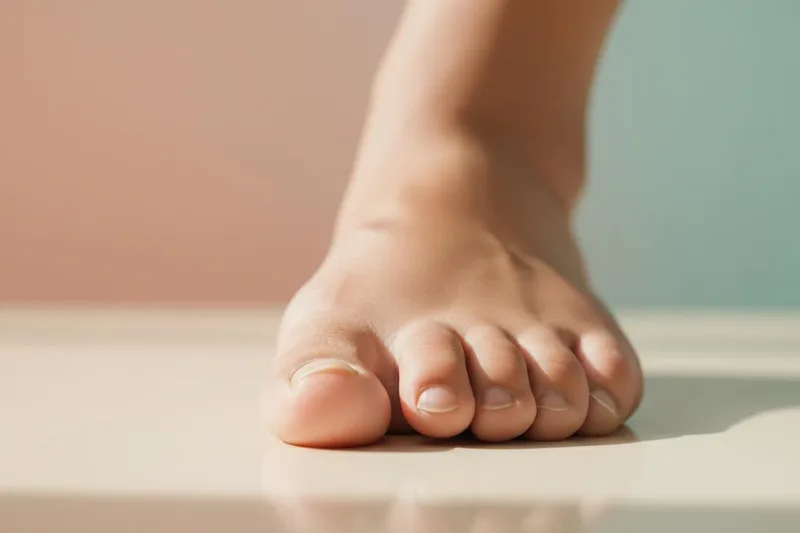
Our feet are truly a valuable part of our body, carrying the weight of our entire body and carrying us around. But sometimes, these feet, especially the toes, can have some minor problems. Have you ever noticed that yours or someone you know has their toes curled inward like a bird's claw? That's what we're going to talk about today, and that's what we call (Claw Toes) . This may be a bit new to some people, but it's important to be aware of this.
What is (Claw Toes)?
Simply put, claw toes are when your toes, especially the big toe, are bent inward in an unnatural 'claw' shape. Specifically, the middle joint and the end joint (the two joints furthest from the ankle) of the toe are bent in this way.
This condition is often seen in people with high arches (called cavus foot), muscle imbalances in the legs, or certain neurological conditions. Especially in people with diabetes, the sensitivity of the feet is reduced, making ulcers more likely to form in these areas.
The most important thing is that if you do not treat this condition (claw toes) quickly, these toes can become permanently stiff and unable to straighten again.
Do Claw Toes Cause Pain? Why Does It Happen?
Yes, often times (claw toes) can be painful. Imagine, what happens when you put on a shoe with your toes pulled in like that? Those toes get stuck on the bottom of the shoe. That's when the problems start.
- Corns and Calluses: Corns and calluses can develop because the toes are constantly rubbing against the top and bottom of shoes.
- Pain: This pushing and pulling causes pain.
- Infections: Although rare, infections can sometimes occur in these areas.
Are there stages of Claw Toes?
Yes, there are mainly two stages:
1. Flexible Stage: This is the earliest stage. At this stage, your fingers are a little stiff, but you can still bend them at the joints. This means that if you try to straighten them slowly by holding them by the hand, you can do it.
2. Rigid Stage: This is the late stage. By now, the fingers are very stiff and unable to move.
If surgery is required, it is most successful in the early, tender stages. That is why we recommend seeking medical advice as soon as possible.
What is the difference between (Claw Toes) and (Hammertoes)?
Now you might be thinking, 'Okay, there's a breed called Claw Toes, but there's also a breed called Hammertoes, what's the difference between the two?' Yes, that's a good question.
Hammertoes are caused by muscle weakness. Also, in a hammertoe, the toe only bends at the middle joint. In a claw toe, both the middle and end joints bend. That's the main difference.
What is the difference between (Claw Toes) and (Mallet Toes)?
Mallet Toe is another type of toe deformity. In this case, only the last joint of the toe is bent. In Claw Toes, as we mentioned earlier, both the middle and last joints are bent.
Who is more likely to develop claw toes?
Generally, people with high arches or those who turn their feet inward when walking are more likely to develop this type of toe deformity.
Is this something that comes from generations?
Yes, these types of finger deformities can sometimes be hereditary. This means that if someone in your family has the condition, there is a chance that you will develop it too.
What are the causes of claw toes?
The main cause of claw toes is often an imbalance in the muscles of the foot. Simply put, some of the muscles in your toes contract too much, causing the tendons to tighten and pull on the joints. There are several reasons why these muscles can become imbalanced:
- Genetic influences (Genes): As mentioned earlier, it can come from heredity.
- Ill-fitting shoes: This is a mistake that many people make without even realizing it. Especially if you wear shoes that are too tight in the front and high in the heels, this can lead to your toes getting pinched. Imagine how your toes feel all day long!
- Nerve damage caused by diabetes: People with diabetes (Diabetes Mellitus) can have weak nerves in their legs. This can cause problems such as these when signals are not sent properly to the muscles.
- Rheumatoid arthritis or osteoarthritis: People with these types of joint diseases are also at risk of developing claw toes.
- Nerve damage caused by alcoholism: Excessive alcohol consumption can also cause this condition by damaging the nervous system.
- Other neurological diseases:
- Some rare neurological diseases like `(Charcot-Marie-Tooth Disease)`.
- Spinal cord tumors.
- Polio and Cerebral Palsy.
- Stroke: This can affect the leg on the side of the paralysis.
- Trauma: It can also be caused by a severe injury to the leg or toes.
What are the symptoms of Claw Toes?
In addition to the fingers being drawn, there are several other symptoms that can be seen:
- Corns: On the tops of the toes or on the soles of shoes.
- Calluses: These are thickened skin caused by rubbing.
- Blisters: Sometimes, blisters can develop in areas that are rubbed too hard.
- Pain: Pain when walking or putting on shoes.
- Swelling: The affected fingers may swell.
- Ulcers: Rarely, ulcers can occur, especially in people with conditions like diabetes.
What makes the condition (Claw Toes) worse?
If this condition is left untreated, it will gradually worsen over time. This means that the fingers may become more drawn out, stiffer, and more painful.
What are granite and limestone?
These are common in people with claw toes. They occur because the joint of the toe rubs against the inside of the shoe and the sole of the foot presses against the shoe. Corns are small, round bumps. Corns are larger, thickened skin of various shapes. They may or may not be painful.
How to recognize (Claw Toes)?
When you go to see a doctor, he or she will carefully examine your feet and toes. They will often touch your toes and check their movement and flexibility.
Sometimes you may be referred for neurological tests, as some neurological diseases can cause weakness in the leg muscles, imbalances, and twitching of the fingers.
Should I see a specialist?
Your primary care physician (your family doctor) may refer you to a podiatrist or a foot and ankle orthopedic surgeon.
What questions can the doctor ask to diagnose (Claw Toes)?
When you visit the doctor, you can ask questions like these:
- When did you start noticing these twitching fingers?
- Do you have corns?
- Are there calluses?
- Have you tried any treatments at home?
- Does your family have claw toes?
- Do you know why they do that?
How to treat (Claw Toes)?
There are both non-surgical and surgical treatments for claw toes, many of which you can do at home.
Non-surgical treatments:
- Wear appropriate footwear: Wear shoes with roomy toe boxes, low heels, and good arch support. Choose shoes that are wide and deep, have soft soles, and have fewer seams around the toes.
- Shoe inserts: Use things like pads and arch supports to provide cushioning for your toes.
- Finger exercises: Do exercises that strengthen and stretch the muscles in your fingers.
- Splint or tape: A splint or tape can be used to keep the fingers in the correct position.
- Avoid high heels and tight shoes: These will only make the problem worse.
Surgical treatments:
The type of surgery you need will depend on the severity of your claw toes. Your doctor will decide on the type of treatment based on whether your condition is early or late stage, flexible or rigid. There are several types of surgery:
- Tendon lengthening and rerouting: Loosens tight tendons.
- Shortening the bones of the phalanx: A small part of the bone (phalanx) of the finger is removed and straightened.
- Temporarily inserting a steel pin: A small pin is inserted to hold the finger in the correct position until it heals.
- Toe fusion: The joint is permanently joined together and the toe straightened.
What exercises can I do?
These are very simple exercises.
- Use your fingers to slowly stretch your toes.
- Then, try to pick up small objects on the ground using your toes. Things you can use for this include:
- Towels
- Marbles
- Small balls
Doing these several times a day will strengthen the muscles in your fingers and increase flexibility.
Is the surgery performed on an inpatient or outpatient basis?
Claw Toe surgery is usually done on an outpatient basis. This means you don't have to stay in the hospital. You can go home the same day.
What are the risks of surgery?
As with any surgery, there are some risks. The risks specific to Claw Toe surgery are:
- Nerve injury
- Stiffness
- Infection
- Recurrence: This condition can recur after treatment. Ask your doctor about ways to prevent it.
How soon will I feel better after treatment?
Usually, you start to feel better after about four to six weeks.
Can Claw Toes be prevented? How can I reduce the risk?
Your doctor may recommend the following:
- Exercise your fingers: Spread your fingers wide and pick up small objects with your fingers.
- Wear good shoes: The best shoes for someone who is prone to developing claw toes are those that provide good support for the arch of the foot, are not too high, and have plenty of space in the front (`extra wide toebox`).
- Use a pumice stone: Use a pumice stone to remove your calluses and calluses.
What is the outlook for people with (Claw Toes)?
If you don't get treatment, your claw toes can become fixed. Walking and running can then become painful and difficult. Therefore, it is very important to see a doctor as soon as symptoms appear and keep your toes from becoming stiff.
Is it possible to live a normal life with (Claw Toes)?
Yes, you can. However, your claw toes can make walking and running a little difficult. That's why early treatment is important.
How do I take care of myself?
Do your exercises properly, keep your fingers extended, and don't hesitate to get surgery if necessary. Always follow your doctor's instructions.
When should I see a doctor?
See a doctor as soon as you notice that you are having difficulty bending your finger joints. The longer you wait, the more complicated the problem can become.
What questions should I ask the doctor about (Claw Toes)?
You can ask these questions when you visit the doctor:
- Do I have (Claw Toes), (Hammertoes), or (Mallet Toes)?
- What home remedies do you recommend?
- What stage are my (Claw Toes) at?
- Do you think I will need surgery?
- What do you think might be the cause of my claw toes?
- What kind of shoes do you recommend for me?
A very important message (Take-Home Message)
Take care of your feet. Wear good, well-fitting shoes. If there are any calluses or corns, gently remove them with a pumice stone. Exercise your toes. Remember, it is very important to seek treatment for claw toes as soon as the symptoms start. If you delay, they can become stiff and unable to bend, and you may even need surgery. So, take good care of your feet! Because they are the ones that carry you everywhere!
` Toe pull, claw toes, bunions, corns, calluses, foot pain, shoe problems


💬 Comments (0)
No comments yet. Be the first to share your thoughts here.
Add Your Comment