

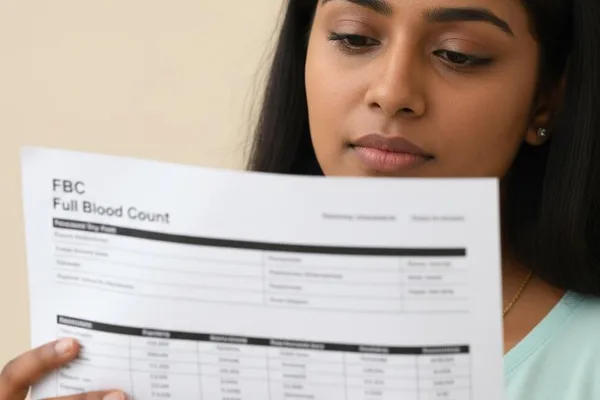
Did the doctor give you a chit for a blood test? Did it say 'FBC' or 'Full Blood Count'? Often, when we see the letters and numbers on this report, we feel a little scared and worried. "What does this mean?" We think. But don't worry. This is a very simple, common blood test that doctors use the most and that tells a lot about the health of our body. Today, we will talk about this simply, in a way that you can understand.
What is this FBC test?
Simply put, a FBC (Complete Blood Count) is a test that looks at the three main types of cells in your blood. Our blood is not just a red liquid. It contains millions of tiny cells that perform many essential functions in our bodies. The FBC mainly looks at these types of cells:
- Red Blood Cells: Those that carry oxygen throughout the body.
- White Blood Cells: Like the body's army, they fight diseases and germs.
- Platelets: These are the cells that help stop bleeding by forming blood clots.
This test helps your doctor get a good idea of your overall health. It is also important to diagnose a disease, monitor an existing condition, see how a medication is affecting the body, and measure the health of the immune system. It is a basic step in diagnosing conditions such as anemia, various infections, and blood cancers .
Why do a 'Differential Count' along with an FBC?
Sometimes you may see "CBC with Differential" on your report. What does this mean?
Think of white blood cells as our army. An FBC counts the total number of soldiers in an army. But a 'Differential Count' goes deeper than that. It counts the number of soldiers in different regiments (for example, infantry, commandos, intelligence officers) in that army.
That is, there are five types of white blood cells, and this 'Differential Count' measures the number of each type separately. This allows the doctor to get a very clear idea of what is happening in your immune system, such as whether you have a bacterial infection, a viral infection, or an allergy.
When does a doctor recommend doing an FBC?
Since an FBC is a very common test, a doctor may recommend it in various situations.
- As part of an annual medical checkup: Get a general understanding of your overall health.
- Look for symptoms that cannot be explained: For example, look for the cause of persistent fever, weight loss, night sweats, unexplained bruising, and constant fatigue.
- Monitor pre-existing medical conditions: Monitor the condition of someone with long-term conditions such as cancer and chronic kidney disease.
- Check the effects of treatments: Some treatments (e.g., cancer drugs) can cause a decrease in white blood cell count. This test is important to monitor such effects.
- During pregnancy: Ensure that the health of the pregnant mother and baby is good.
What conditions can be detected in the FBC report?
This test does not directly say "you have asthma." However, it provides the doctor with many important clues. The values in the report can indicate the following conditions:
| Medical name | Simply put... |
|---|---|
| Anemia | Low red blood cell or hemoglobin levels (as we call it, 'anemia'). |
| Erythrocytosis | Abnormally high red blood cell levels (increased blood thickness). |
| Leukocytosis | Increased white blood cell count (often a sign of infection). |
| Leukopenia | Low white blood cell count (a sign of weakened immunity). |
| Thrombocytosis | Increased platelet count. |
| Thrombocytopenia | Decreased platelet count (seen in diseases like dengue). |
Shall we now look at the values in the report in a little more detail?
Okay, now let's try to understand the letters in the report.
Things to know about Red Blood Cells
These are the 'delivery service' that carries oxygen throughout the body. These are the main values that are spoken about.
- RBC (Red Blood Cell Count): The total number of red blood cells in a volume of blood.
- Hb / Hgb (Hemoglobin): Hemoglobin is the oxygen-carrying protein found in red blood cells. It is measured in terms of its amount. It is what gives blood its red color.
- Hct (Hematocrit): What percentage of your blood is made up of red blood cells.
In addition, there are some other values that indicate the quantity and quality of red blood cells (called 'Red Cell Indices').
- MCV (Mean Corpuscular Volume): The average size of a single red blood cell.
- MCH (Mean Corpuscular Hemoglobin): The average amount (weight) of hemoglobin in a single red blood cell.
- MCHC (Mean Corpuscular Hemoglobin Concentration): The concentration of hemoglobin in a specific volume of blood.
- RDW (Red Cell Distribution Width): This tells you whether your red blood cells are all the same size, or whether they are a mix of large and small cells. It's like looking at whether they are biscuits cut from the same mold, or different sized handmade cookies.
Things to know about Platelets
These are the 'plaster pieces' on our bodies. If we get a cut or injury somewhere, they rush to the spot, stick together, and stop the bleeding.
- Platelet Count: The total number of platelets in the blood sample.
- MPV (Mean Platelet Volume): The average size of a single platelet.
White Blood Cells and their types
This is our body's defense army. Their job is to protect us by fighting germs and diseases. If you do a 'Differential Count', you will get separate details about the different forces of this army.
| Cell Type | Main function (simplified) |
|---|---|
| WBC (White Blood Cell Count) | The total number of all types of white blood cells. |
| Neutrophils | Like quick-response commandos, they are the first to attack bacterial and fungal infections . |
| Lymphocytes | Like intelligence officers. They fight viral infections . They remember previous illnesses and teach the body to fight them off quickly if they get sick again. |
| Monocytes | Cleaning workers. They remove cell debris and germs left behind after an infection. |
| Eosinophils | They fight parasites (like worms). Their numbers also increase during allergies . |
| Basophils | They emit warning signals. These are the ones that release things like 'histamine' during allergies. |
Do you need to prepare for the FBC test?
The best news is that you don't need to do any special preparation for an FBC test. You can eat and drink normally and take your usual medications. There is no need to fast.
However, keep this in mind: If your doctor has ordered another test, such as a fasting blood sugar test or a lipid profile, along with your FBC, you should follow the instructions for that test exactly (e.g., fasting for 8-12 hours). So, if you have any doubts about what is on the chit or what the doctor has said, be sure to ask your doctor again to confirm.
Is the 'Normal Range' in the FBC report the same for everyone?
This is a common misconception. The 'Normal Range / Reference Range' in your FBC report is not the same for everyone. It can vary depending on a variety of factors.
- Depending on the lab performing the test: These values may vary slightly depending on the machines and chemicals used by each lab.
- Depending on your age: 'Normal' values are different for adults and children.
- Depending on your gender: Some values (especially those related to red blood cells) vary due to differences in hormone levels between women and men.
- If you are pregnant: These values may change due to changes in your body during pregnancy.
Therefore, only compare the values in your report with the 'Reference Range' (normal value range) given on the side of the report itself. Do not compare it with someone else's report or with normal values found on the Internet.
What should I do next if the values in the report are too high or too low?
Don't panic if you see a value on your report that is outside the 'Normal Range'. It doesn't necessarily mean you have a serious illness. Sometimes it could be a very simple, easily treatable condition.
The most important thing is this:
Never, ever decide that you have a disease based on what you read on the internet or what someone else says. Only your doctor can give you the most accurate diagnosis, taking into account your symptoms, your medical history, and the values in this FBC report.
Your doctor will review the report and, if necessary, order further tests, start treatment, or perhaps say, "This is not a big deal, we'll check back in a little while." So, be sure to take your report and see your treating doctor.
Take-Home Message
- FBC (Full Blood Count) is a very common and safe blood test that provides a lot of important information about your overall health.
- Don't be alarmed by the numbers and letters on the report. They tell you about the quantity and quality of the different cells in your blood.
- The 'Normal Range' can vary depending on age, gender, and lab. So always compare only to the 'Reference Range' on your report.
- Even if a value in the report is outside the normal range, only your doctor can provide the most accurate interpretation and advice.
- Never self-diagnose or seek treatment on the advice of others. Always see your doctor with your report.




💬 Comments (0)
No comments yet. Be the first to share your thoughts here.
Add Your Comment