
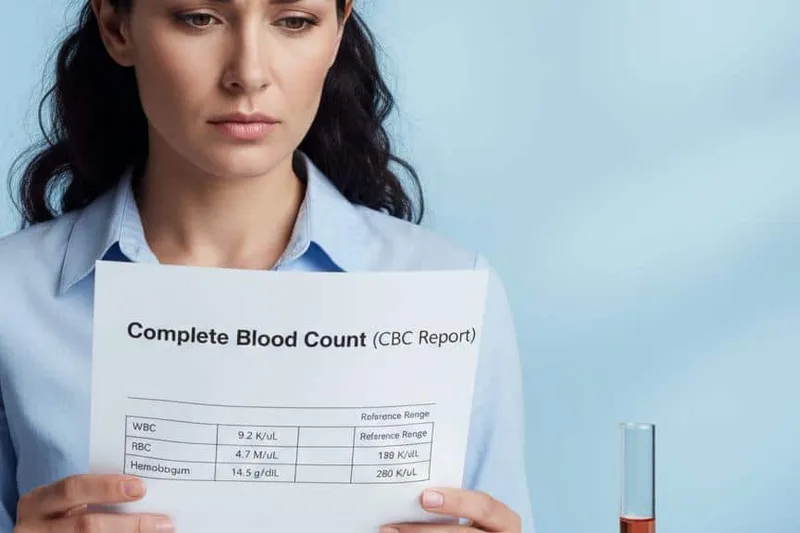
When you go to the doctor, you've probably heard them say, "Let's do a blood test," right? Most of the time, they're talking about the Complete Blood Count, or CBC test that we're all familiar with. This is a very common, basic test. But when you get the report, it's normal to feel a little scared and nervous when you see the letters and numbers on it. So today, let's talk about what's in this CBC report and what it says in a very simple way, in a way that you can understand.
What is this CBC test?
Simply put, a CBC is a test that counts the main types of cells in your blood. Our blood is not just a red liquid. It contains several types of cells that are essential to our bodies. The CBC mainly looks at these three types of cells: red blood cells , white blood cells, and platelets .
Now, let's see when a doctor would order this CBC test:
- As part of a routine health checkup: Even if you don't have any illness, this can be done to make sure everything is fine.
- Find the cause of symptoms: This will help you find the cause of things like constant feeling of weakness, fatigue, fever, and occasional bruising .
- Check for Anemia: The best way to know for sure if you have anemia, which is common among many people in Sri Lanka, is to have a CBC.
- Monitor a pre-existing condition: If you have a blood-related condition, this test is done regularly to monitor its status.
- Check the effects of medications: This is essential to find out if some of the medications you are taking, especially those used for cancer treatment (chemotherapy), are affecting your blood cells.
How do you do this test?
This is very simple and can be completed in a few minutes. You don't have to work very hard.
If you are having just a CBC test, you can eat and drink normally. However, if you are having another test, such as a fasting blood sugar test, your doctor will tell you not to eat or drink for a few hours. When you go to the lab, a nurse or lab technician will take a small sample of blood from a vein in your arm with a small syringe. It only takes a few minutes and feels like a small ant sting. After that, you can go home normally. The blood sample is tested at the lab using a machine and the report is prepared.
What the CBC report says and average values
Okay, now let's look at the most important parts of this report and what they mean. I've put this in a table below for you to understand easily. Remember, these 'normal values' can vary slightly from lab to lab, depending on age and gender.
| What is being tested (symbol) | Simply meaning | Reference Range |
|---|---|---|
| White blood cells (WBCs) | It's like the body's policeman. It protects us from disease by fighting germs. Too many of these can lead to infection. Too few can increase the risk of disease. | 4,500 - 11,000 cells per microliter |
| Red blood cells (RBCs) | They take oxygen from the lungs and distribute it throughout the body. When these are depleted, a condition called "anemia" occurs. | Male: 4.5 - 5.9 million/mcL Women: 4.1 - 5.1 million/mcL |
| Hemoglobin (Hb or Hgb) | This is the protein that holds oxygen inside red blood cells. This is the main thing that measures anemia. | Men: 14 - 17.5 gm/dL Women: 12.3 - 15.3 gm/dL |
| Hematocrit (Hct) | It tells you what percentage of your blood is made up of red cells. If it's low, you may be low in iron. If it's high, you may be dehydrated. | Male: 41.5% - 50.4% Female: 35.9% - 44.6% |
| MCV (Mean Corpuscular Volume) | The average size of a red blood cell. If they are too large, it could be a sign of vitamin B12 or folate deficiency. If they are too small, it could be a sign of anemia, such as iron deficiency. | 80 - 96 |
| Platelets | These cells help stop bleeding and clot blood when there is an injury. | 150,000 - 450,000/mcL |
Very important: Do not judge your condition based on the values in this table. Only your doctor can accurately analyze this report and combine it with your other symptoms and health conditions to come to an accurate conclusion. This article only gives you a basic understanding of this.
What else could be in the CBC report?
Sometimes, if the doctor wants to look more deeply into your condition, he will focus on a few more details in the CBC report. Although the names for them are a little difficult to pronounce, what they mean is very simple.
- MCH (Mean Corpuscular Hemoglobin): This refers to the average amount of hemoglobin in a single red blood cell.
- MCHC (Mean Corpuscular Hemoglobin Concentration): Measures the concentration of hemoglobin in a given volume of blood.
- RDW (Red Cell Distribution Width): Shows how different the sizes of your red cells are. Not all cells are the same size.
- Reticulocyte Count: Measures the number of immature, or newly formed, red blood cells in the body.
- MPV (Mean Platelet Volume): The average size of your platelets.
- PDW (Platelet Distribution Width): Shows how much the sizes of platelets vary.
- White Blood Cell Differential: There are 5 types of white blood cells (neutrophils, lymphocytes, monocytes, eosinophils, basophils). This test shows how many of each type are present separately. This can give a clearer idea of things like infection or allergies.
It is by taking all of this together that the doctor gets an understanding of your overall health. So don't worry if one value in the report is higher or lower. It may be a temporary situation.
Take-Home Message
- A CBC is a very important, basic test that provides information about the cells in your blood.
- This can provide clues about anemia, infections, and a number of other health problems.
- Don't be alarmed if your report shows a value outside the 'normal range'. There can be many reasons for this.
- The most important thing is to show your CBC report to your doctor and ask him for an explanation. Don't just look it up on the internet or try to diagnose the disease on your own.
- If you don't understand what your doctor is explaining, don't be afraid to ask questions again. It's your right to be informed about your health.


💬 Comments (0)
No comments yet. Be the first to share your thoughts here.
Add Your Comment