
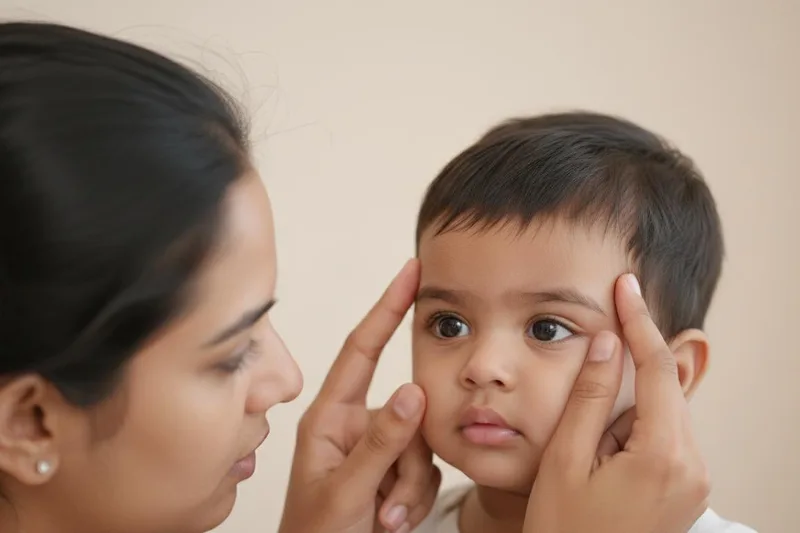
When we look at our little children's eyes, sometimes we notice something strange or different, don't we? Some babies' eyes look a little big, or they often have tears in their eyes, or they don't like to look at the light. These can sometimes be very simple and normal. But at the same time, they can sometimes be a sign of something that needs a little attention. Today we are going to talk about an eye disease that can occur in such small children, especially at birth or in the first few years of life, but if recognized early, it can be well controlled and the child's vision can be protected. This is called congenital glaucoma .
What is congenital glaucoma?
Simply put, congenital glaucoma is a condition that is present at birth or early in life (within 2-3 years) due to certain genetic factors. Now you may be asking, "What is glaucoma?" Glaucoma is a common name for any eye disease that damages the optic nerve, the main nerve inside the eye that helps us see. This damage can gradually lead to vision loss.
Children with congenital glaucoma have high pressure inside their eyes, which is called ocular hypertension . Our eyes produce a special fluid called aqueous humor . This fluid is very important for keeping the eyes healthy. Normally, this fluid is produced and drained properly from the eye. However, in children with congenital glaucoma, this fluid does not drain properly. This fluid then builds up inside the eye, and the pressure inside the eye gradually increases. This increased pressure causes the optic nerve that I mentioned earlier to become compressed. Over time, this can even cause changes in the shape of the eyes. You may notice that your child's eyes have become larger, or the iris (the part of the eye that actually has color - the iris) may become cloudy and discolored.
This is a treatable disease. However, if left untreated, vision can gradually deteriorate and even lead to blindness. Therefore, it is very important to recognize these symptoms and start treatment as soon as possible. Only then can the damage be minimized and the child's vision be protected as much as possible.
What are the symptoms of this disease? How do we recognize it?
In addition to the main symptoms seen in this disease, there are other additional signs.
There are three main symptoms:
These are the three characteristics that doctors pay the most attention to.
- Frequent tearing of the eyes (Epiphora): To be precise, it seems as if tears are leaking from the eyes even without the child crying.
- Photophobia: The child may not want to look at bright light, closing their eyes or turning their face away when they go outside.
- Blepharospasm: It feels like the eyelids are beating rapidly, or like they are trying to close their eyes tightly.
Other signs you may see:
- Buphthalmos: The baby's eyes appear larger and more bulging than other babies. Some parents say, "The baby's eyes are like big, bull's-eyes."
- Blue appearance of the eyeball: The white part of the eye (sclera) can show through the underlying membranes, making it appear blue.
- Whitening or cloudy appearance of the cornea: The clear membrane over the black eye (cornea) becomes cloudy, looking like fog on glass.
You may also notice these things as changes in your child's vision:
- Astigmatism: The child may not see things clearly.
- Myopia: A condition in which objects that are close can be seen clearly, but objects that are far away cannot be seen clearly.
- Anisometropia: Because the vision in one eye is different from the other, the child may try to use only the eye that sees better.
Other things your doctor may find during an eye exam include:
- Corneal Edema: The transparent part of the eye that is in front is swollen.
- Corneal abrasions: The cornea is stretched due to excessive pressure, and fine scratches may form on it.
- Corneal scarring: Long-term damage can cause permanent scarring of the cornea.
These symptoms are usually seen in both eyes, but sometimes they may appear in only one eye.
Why does this (Congenital Glaucoma) occur? What is the cause?
Congenital glaucoma begins with a defect in the development of the child's eye. The most common defect is a defect in the development of the tissue that drains the aqueous humor inside the eye, the trabecular meshwork . Think of it like a hole in a sink. If that hole is not formed properly, the water will not drain properly. This is the same with this one. Because the trabecular meshwork is not developed properly, the fluid inside the eye does not drain properly. Then that fluid accumulates inside the eye, increasing the pressure inside the eye. This increased pressure is what damages the optic nerve. Also, this pressure can cause the cornea, the front of the eye, to enlarge, stretch, become streaked, and even scarred.
This process is gradual. That is, the disease gradually gets worse. How quickly it gets worse depends on the nature of the defect in the child's eye, the amount of fluid that accumulates, and the amount of pressure inside the eye.
Consider, some babies show these symptoms right at birth. That is, the condition has been developing while they were still in the womb (Fetal Development). For other children, symptoms may appear a little later, perhaps a few months or a year or two. This is because the birth defect is not so severe, and it takes a while for symptoms to appear.
Are there different types of Congenital Glaucoma?
Yes, there are several ways doctors classify this disease.
Classification according to age of onset of symptoms:
- Neonatal type: Symptoms appear at birth or within the first month of life.
- Infantile type: Symptoms appear within the first two to three years of life.
Classification according to the nature of the defect causing the disease:
- Primary type: In this type, glaucoma only occurs without any other obvious defect inside the eye. Researchers have identified several gene mutations that may cause this type of primary congenital glaucoma.
- Secondary / Developmental type: In this, glaucoma occurs as part of another identified genetic disease, along with other defects within the eye.
Some genetic conditions that can cause Secondary Congenital Glaucoma:
- Aniridia: Complete or partial loss of the colored part of the eye (iris).
- Axenfeld-Rieger syndrome: A condition that causes various complications related to the eyes, teeth, and navel.
- Sturge-Weber syndrome: A condition that can cause problems with the brain and eyes, along with a large red spot on the face (port-wine stain).
How is this disease accurately diagnosed?
Ophthalmologists, especially when they see the main symptoms mentioned earlier in the eyes of a small child, suspect congenital glaucoma. To confirm that suspicion, the child is anesthetized (under anesthesia) and a complete eye examination is performed. Don't worry, the child will not feel any pain because of the anesthesia, and it is easier for the doctors to examine the eyes accurately.
In this test,
- Tonometry measures the pressure inside the eye .
- Gonioscopy is performed to examine the drainage angle of the eye .
In addition, other tests can be done such as:
- Optical Coherence Tomography (OCT): This allows you to see the optic nerve in more detail.
- Genetic Testing: Check for genetic mutations that may cause the disease.
What is the treatment for this?
Many children with congenital glaucoma will need eye surgery to correct the defect that prevents the fluid from draining from the eye. Surgery is the main and most effective treatment for this condition. Also, the sooner the surgery is performed, the better the results. Medications also play a small role. Your doctor may prescribe medications to take before or after surgery. Very rarely, medications alone are sufficient as a treatment.
Surgery
The main goal of these surgeries is to reduce the high pressure inside the child's eye (Itraocular Pressure). This will reduce damage to the optic nerve and other parts of the eye. It will also prevent further damage. Depending on how quickly the child starts treatment, some of the damage that has already occurred may even reverse. Don't worry, the child will be under anesthesia during eye surgery, so he or she won't feel anything.
Depending on the child's age and condition, the surgeon will choose one of the following surgical methods:
- Goniotomy: This involves making a small incision in the trabecular meshwork, a tissue that filters fluid, at the drainage angle. Surgeons do this using an instrument called a gonioscope.
- Trabeculotomy: Sometimes, if the angle through which the fluid drains through the cornea is not clearly visible, surgeons will go through the white part of the eye (sclera) and make an incision in this tissue using an electrocautery device called a trabeculotome.
- Trabeculectomy: If the above surgeries do not work, the surgeon will go through the white part of the eye (sclera), remove a small piece of the trabecular meshwork, and create a new path for fluid to filter.
- Glaucoma Drainage Device: Sometimes the surgeon will place a small tube-like device (Tube Shunt) in the child's eye. This tube allows the fluid that collects in the eye to collect in a small disc under the thin membrane (conjunctiva) on top of the eye, and then drain it into the body.
Medications
Because medications can have side effects in young children, doctors prescribe them very carefully. Your doctor may give you medications to lower the pressure inside your eye or to increase the clarity of your cornea before surgery. This can improve the results of your surgery. They may also prescribe medications to prevent complications during and after surgery.
The following medications may be used:
- Beta-blockers
- Diuretics (reduce fluid buildup in the eye)
- Prostaglandins
- Alpha-adrenergic agonists
- Antibiotics (prevent infections)
- Corticosteroids (reduce swelling)
- Mitomycin (to reduce scarring after surgery)
What will the situation be like after treatment? (Prognosis)
Surgery for congenital glaucoma is usually successful in reducing the pressure inside the eye and stopping the process that damages a child's vision. Children who receive treatment early, that is, before significant damage occurs, can grow up with relatively normal vision. However, sometimes the damage may not be completely reversed. Also, some children may need additional treatment, such as glasses. The most important thing is to keep taking your child for checkups as your doctor recommends.
Is there a way to prevent this disease?
In fact, although congenital glaucoma can run in families, it often occurs randomly. Genetic testing can tell you if you have a genetic mutation and how likely it is to pass it on to your children. However, we cannot prevent our genes from being passed on to our children. However, we can be prepared if there is a chance that a child will develop this genetic disease. For example, we can be aware of the symptoms and take action quickly.
It's normal to feel overwhelmed when you find out that your child has a congenital condition that requires urgent treatment. On the one hand, you need to make quick decisions about your child's treatment, and on the other hand, you need to control your own fears and anxieties. Sending a small child for surgery and giving them medication is a really difficult thing. But, have faith in your medical team. This difficult time will soon be over, and your child will be on the road to recovery.
Finally, take-home message:
If you notice any abnormalities or changes in your child's eyes – such as enlarged eyes, frequent tearing, or a reluctance to go outside – don't ignore it. It could be something simple, but it could also be a sign of a condition like congenital glaucoma.
- Early detection and prompt treatment are the most important things, so that the child's vision can be preserved as much as possible.
- There is a successful surgical treatment for this disease.
- Continue to take your child for medical checkups as the doctor recommends.
- If you have any concerns or doubts, talk to a doctor.
Remember, your care and prompt action are the greatest strength for your child's future vision.
` Glaucoma, Congenital Glaucoma, Eye Diseases, Eye Diseases in Children, Eye Pressure, Optic Nerve, Optic Nerve


💬 Comments (0)
No comments yet. Be the first to share your thoughts here.
Add Your Comment