
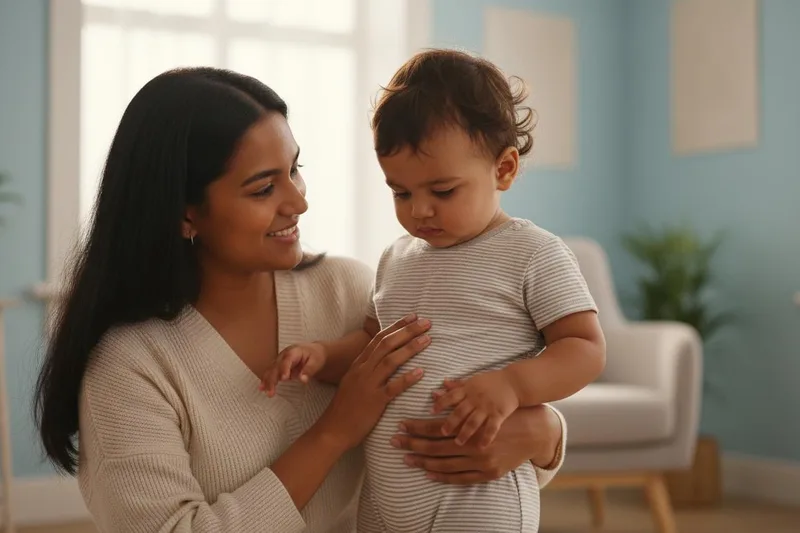
Has your little one not pooped in a couple of days? Is he just having a hard time? Does his stomach feel a little tight? Or does he cry when he poops? Constipation is a common problem that many parents of young children face, and it can be a bit scary. But it's usually nothing to worry about. It can often be cured with simple changes you can make at home. In this article, we'll take a closer look at what causes it, what you can do at home, and when you should see a doctor.
What is constipation in young children?
Simply put, constipation is when your little one's bowel movements are irregular. Not all babies are the same, some babies have bowel movements about twice a day, others every other day. But if they have fewer than two bowel movements a week , and their stools are very hard, dry, lumpy , and difficult to pass, or if there is pain, we call that condition constipation.
Keep in mind, this is very common in young children. Most of the time, it doesn't last long. It's very rare for it to be a symptom of another underlying medical condition. So don't panic at first.
How do I know for sure if my child is constipated?
Young children don't understand how to say, "Mommy, I'm having trouble pooping." That's why we need to pay close attention to their behaviors and symptoms. Here are some signs that your child may be constipated.
| Symptom | Description |
|---|---|
| Decreased frequency of bowel movements | Defecating less than twice a week. |
| The nature of the stool | Hard, dry, lumpy, or very large stools. Difficulty and pain in passing stools. |
| Showing unusual gestures | Standing on their toes, rocking back and forth, and dancing are all ways they try to hold back when they need to defecate. |
| Stomach discomfort | Talking about feeling full, having a stomach ache, or having a stomachache. |
| Nausea and loss of appetite | Showing a reluctance to eat or feeling nauseous because the stomach is full. |
| Blood in the stool | Anal fissures, which are tiny tears in the anus that occur when passing hard stools, can cause blood to appear as drops or streaks in the stool. |
| Defecation in underwear | Sometimes you may see a little liquid stool on your underwear, similar to diarrhea. This is not actually diarrhea. It is just a small amount of liquid leaking out (overflow) from a hard lump of stool that is trapped inside. |
What causes constipation in young children?
There are several reasons for this. Let's break them down into two parts.
Withholding is the main cause!
This is the most common cause of constipation in young children. Imagine, your little one is playing hard. Even though he needs to poop, he is too lazy to stop playing and go to the toilet. So he holds it in. When he holds it in, the body absorbs more water from the stool in the colon. Then the stool becomes harder and drier. The next day, when he tries to pass it, he feels pain. Fearing that pain, the child avoids the next time he needs to poop. This just goes on like a vicious cycle.
There may be other reasons why a child may not poop like this:
- Toilet Training: Some children are afraid of the toilet and don't want to get used to it. So, despite the pressure, they may not defecate.
- Fear of pain: Remembering the pain you felt when passing hard stools the previous day, you are afraid of experiencing the same pain again.
- Coping with change: This can also happen due to the stress of starting a new school, changing home environments, or traveling.
- Reluctance to use public toilets: Some children do not like to use a toilet outside the home, especially a public toilet.
Other possible causes
- Diet: A diet low in fiber is a major cause. Constipation can occur when you eat too many starchy foods like bread, rice, and noodles and eat too few vegetables, fruits, and greens.
- Lack of water intake: Not drinking enough water during the day can also cause hard stools.
- Certain medications: Certain medications for coughs, colds, and iron pills can also cause constipation as a side effect.
- Other medical conditions: Very rarely, constipation can be a symptom of another medical condition. For example, conditions like Hirschsprung disease, Celiac disease, Hypothyroidism, or Diabetes. But these are very rare.
Remember, don't worry if your child has constipation because they have a serious illness. More than 95% of the time, the cause is the simple things we discussed above.
How does a doctor find this?
When you take your child to a doctor, the first thing he or she will do is ask you some questions.
- What is the child's bowel movement pattern?
- What are the things you eat and drink?
- Has toilet training started?
- Are you taking medication for another illness?
Then, the doctor will examine the child. He or she will especially feel the child's abdomen . They will check for any swelling, tenderness, or lumps in the abdomen. Sometimes the rectum may also be examined to see if there are any fissures or other problems.
In most cases, constipation can be confirmed by this test. Special tests are rarely needed. Only if another medical condition is suspected, your doctor may recommend some of the following tests:
- Abdominal X-ray: To see how much stool is stuck in the intestines.
- Blood tests: Check for other infections or diseases.
- Stool test: Check for blood or infection in the stool.
- Rectal biopsy: A very small piece of tissue is taken from the rectum for examination. This is only done if there is a suspicion of a condition such as Hirschsprung disease.
What can happen if this is ignored?
Constipation is usually temporary, but if the condition persists and is left untreated, it can lead to some complications.
- Fecal impaction: A hard, solid mass of stool that becomes lodged in the intestines and rectum. This can be too large for the child to pass on their own.
- Encopresis: The involuntary leakage of stool into the underwear. This is caused by the leakage of fluid from around a trapped stool mass.
- Anal fissures: A delicate tear in the skin of the anus caused by hard stools. This can cause pain and bleeding.
- Rectal prolapse: A protrusion of part of the rectum due to prolonged straining to defecate.
- Hemorrhoids: Swollen veins around the anus.
How to treat and prevent constipation?
The best thing about this is that it can often be controlled with simple changes you can make at home.
Things you can do at home
1. Changing the diet:
- Give more fiber-rich foods . Fruits like papaya, mango, avocado, bananas (well ripe), and oranges.
- Vegetables like spinach, beans, carrots, sweet potatoes, and pumpkin.
- Grains and legumes like lentils, oats, peas, and green beans.
- If you are serving bread, offer something like bread made from atta flour or kurakkan bread instead of white bread.
2. Giving more fluids:
- Water is best. Encourage your child to drink small amounts of water throughout the day.
- Fresh fruit juice (with less sugar) can be given. Prune juice in particular is very good for constipation. However, it is wise to consult your doctor before giving any type of fruit juice to your child.
3. Establish a Toilet Routine:
- Every day, after a main meal (breakfast or dinner), put your child on the toilet or potty chair for about 5-10 minutes. Since bowel movements naturally increase after eating, this is the best time to stimulate a bowel movement.
- Don't force the child. Let him read a book or sing a song during that time. Make it like a game.
- If your child poops in the toilet, praise them a lot. Giving them a small treat (like a sticker) is also a good incentive.
4. Temporarily stopping toilet training:
- If constipation started while you were toilet training your child, stop using it for a few days. Switch back to diapers. Once the constipation is gone, you can start toilet training again.
Foods to reduce when constipated
Some foods can make constipation worse, so it's a good idea to reduce these foods a little on days when your child is constipated.
| Foods to reduce | why is that? |
|---|---|
| Ice cream, cheese, yogurt (more) | Dairy products are low in fiber, so consuming too much can increase constipation. |
| Raw bananas, applesauce | Some of the ingredients in these can harden stools (well-ripe bananas are best). |
| White rice, white bread | These are very low in fiber. |
| Fast food, chips, biscuits | These are high in oil and refined carbohydrates and very low in fiber. |
If you use medications...
This is very important: Do not give your child any constipation medication without first consulting your doctor. Laxatives, especially those given to adults, are not suitable for young children.
If constipation does not resolve with home treatments, your doctor may recommend the following medications:
- Stool softeners: Medications that increase the absorption of water in stools, softening them.
- Laxatives: Medicines that stimulate bowel movements.
- Glycerin suppositories: A small capsule of medicine that is inserted into the rectum.
- Enemas: A liquid medication is inserted through the rectum. These are used only in emergencies.
When should you see a doctor?
If your child's condition improves with home treatments, there is nothing to worry about. However, in the following cases, you should definitely see a doctor.
| Opportunity | What to do |
|---|---|
| Talk to the doctor. | |
| Constipation that persists for more than two weeks . | If home treatments do not help. |
| These are emergencies! See a doctor immediately or go to the hospital's Emergency Department (ETU). | |
| Constipation accompanied by fever . | Seek medical advice immediately. |
| Continued vomiting . | Seek medical advice immediately. |
| Blood in the stool (not just a little, but a significant amount). | Seek medical advice immediately. |
| The stomach is very swollen . | Seek medical advice immediately. |
| The child is crying incessantly due to stomach pain . | Seek medical advice immediately. |
| Child weight loss . | Seek medical advice immediately. |
It can be very difficult for a parent to see their child suffering from constipation. But remember, this is usually a temporary condition. With patience, love, and the right diet and habits, this condition can be completely avoided.
Take-Home Message
- Constipation in young children is a very common condition, so don't panic at first.
- The most important thing is to give your child foods high in fiber (vegetables, fruits, and legumes) and plenty of water to drink.
- It's a good habit to let your child use the toilet for a while after eating. Don't force it, make it a game.
- Do not give your child any constipation medicine without the advice of a doctor.
- If constipation is accompanied by fever, persistent vomiting, severe abdominal pain, or blood in the stool, it is an emergency. See a doctor immediately.




💬 Comments (0)
No comments yet. Be the first to share your thoughts here.
Add Your Comment