
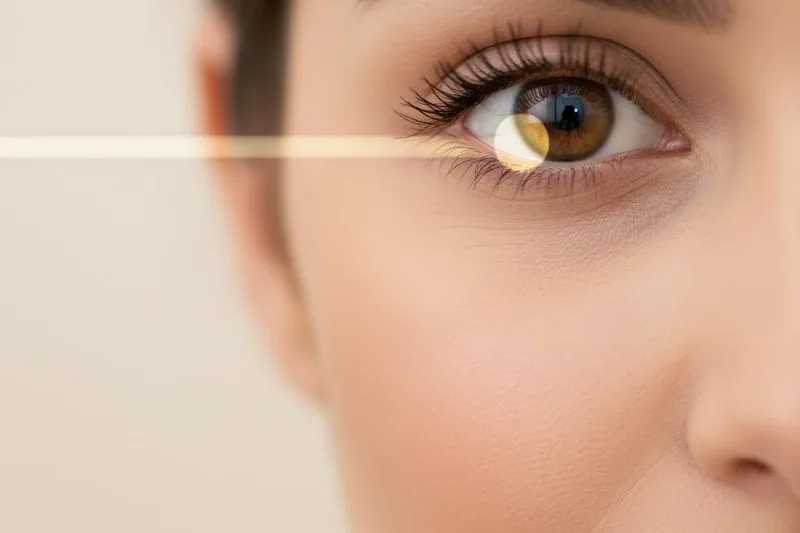
Have you ever seen a doctor shine a light into your eyes with a small flashlight? Or maybe you've seen the doctor do it when checking your baby's eyes. This is actually a very simple, but very important test. It basically checks whether your eyes are in the right position, that is, if they are aligned correctly. Today we're going to talk about this simple, but very important test.
What is Corneal Light Reflex Test?
Simply put, this is a test that checks whether your eyes are aligned by shining a light on the cornea of your eye and looking at the way the light reflects. All you need is a dark room and a small light, such as a penlight. It is also called the Hirschberg Test , in honor of the German ophthalmologist who first discovered it, Julius Hirschberg. It takes a short time to do and is painless.
This test is usually done on several occasions:
- During an eye exam: This is something that eye doctors (optometrists or ophthalmologists) usually do when they examine the eyes.
- When checking the development of young children: Pediatricians routinely do this when examining young babies and children in clinics, as it is the best way to detect conditions like strabismus or amblyopia or lazy eye early.
- During annual checkups for adults: Even general practitioners perform this simple test when performing physical health or neurological examinations.
How does this test work?
Imagine your eyes as two small, shiny spheres. What the doctor does is shine a small light into your eyes. The light then hits the cornea, the transparent part at the front of your eye, and reflects as a small dot.
If your eyes are perfectly aligned, that is, if the alignment is perfect, the little dot where the light is reflected should be visible in exactly the same place in both eyes.
The doctor looks at the position of that little dot. That can easily tell if there is a problem with the alignment of the eyes.
What happens during and after the test?
This is very simple.
During the test
First, the doctor dims the room a bit so that you can clearly see the light reflecting off your eyes. Then, you will be asked to sit in front of him and look straight into the small flashlight in his hand. While you are looking, the doctor will carefully observe where the light falls on your eyes.
After the test
Depending on the result, the doctor will do something:
1. If the position of the eyes is correct: then there is no problem. He will move on to the other parts of the examination.
2. If there seems to be a problem with the position of the eyes: If so, some simple tests will be done to further confirm it and measure the extent of the deviation. There is no need to worry about this, this is done to understand the situation exactly.
What do the results of this test say?
The doctor can tell whether or not you have a problem with the alignment of your eyes during or immediately after the examination.
If the position is normal:
Your medical record will note it as "symmetry" or "ortho." This means that light is reflected in the same place in both eyes.
Sometimes we are deceived!
This is called pseudostrabismus . Imagine that some babies have a slightly wider nose with skin on both sides. Then, when we look from the outside, our eyes may look a little inward. But there is actually nothing wrong with the eyes. This Corneal Light Reflex Test can accurately identify conditions like this that are not actually strabismus, but appear that way.
If the position is abnormal:
If the position of the eyes is indeed different, the doctor will also note what type it is. Here are a few main types.
| Misalignment Type | Simply put... (Simple Explanation) |
|---|---|
| Esotropia | One or both eyes turned inward (inward) toward the nose . |
| Exotropia | One or both eyes turned outward . |
| Hypertropia | One eye is positioned higher than the other. |
| Hypotropia | One eye is positioned lower than the other. |
If it is confirmed that there is a problem, what do you do next?
If a pediatrician or your family doctor diagnoses a problem with the position of your eyes, they will refer you to an ophthalmologist . Since they have specialist knowledge in the field of eyes, they can tell you exactly what is causing this and what treatments are available.
Sometimes, these changes in eye position can be caused by a brain problem, such as a stroke or a concussion. In such cases, treatment will depend on the underlying cause. Your doctor will explain this to you in detail.
When should we see a doctor about this?
This is a very important part.
- If you notice a gradual change:
- Children: If you notice a small deviation in your child's eyes that is gradually increasing, see a pediatrician immediately . Conditions like amblyopia can be completely cured if detected early. However, if treatment is delayed after they reach adulthood, it can lead to permanent vision loss. So, if you notice something like this, don't delay.
- Adults: If an adult's eyes are gradually changing position, it's best to see an ophthalmologist for an examination.
- If your eyes suddenly bulge (this is an emergency!):
- If the position of the eyes suddenly changes significantly within a few hours or minutes, it is a medical emergency .
- If you suddenly experience blurred vision, especially after a head injury or with symptoms of a stroke, you should waste no time and go to a hospital's Emergency Department (ETU) immediately.
Now you can see how much important information we can learn from this simple test. So if you have any doubts about this test, or about the position of your or your child's eyes, don't hesitate to talk to your doctor.
Take-Home Message
- The Corneal Light Reflex Test (Hirschberg Test) is a very simple, painless, and quick test that checks the alignment of the eyes.
- This is very important for early detection of conditions such as strabismus and amblyopia in young children.
- If you notice a gradual increase in the size of a child's eyes, seeking medical advice without delay can help prevent permanent vision impairment.
- Not every eye misalignment that appears on the outside may be a true misalignment. Sometimes it may be a false misalignment (pseudostrabismus). This test can confirm that.
- Sudden, sudden eye twitching, especially after a head injury or with symptoms of stroke, is an emergency that requires immediate treatment at a hospital's Emergency Department (ETU) .
- If you have any concerns about the position of your eyes, never hesitate to talk to your doctor.


💬 Comments (0)
No comments yet. Be the first to share your thoughts here.
Add Your Comment