

Have you ever had a stent placed in your heart because of a blocked artery? Many people get relief after having one. But sometimes, the artery starts to narrow again right where the stent was placed. It feels like the old disease is coming back. Today, we are going to talk about a slightly different, special treatment method that is used in such cases.
Simply put, what is Coronary Brachytherapy?
Although this is a somewhat complicated name, the story is very simple. Coronary brachytherapy is a special radiation treatment given to the coronary arteries of the heart.
Think of the arteries that supply blood to the heart as a tube. When plaque builds up inside these tubes and narrows, we call this coronary artery disease (CAD). As a treatment for this, doctors insert a stent, a small mesh tube, into the artery to widen it again.
But in some people, scar tissue starts to form around the stent. Just like a scar forms when we get an injury. This scar tissue causes the dilated artery to gradually narrow and become blocked again. In medical terms, we call this in-stent restenosis (ISR) .
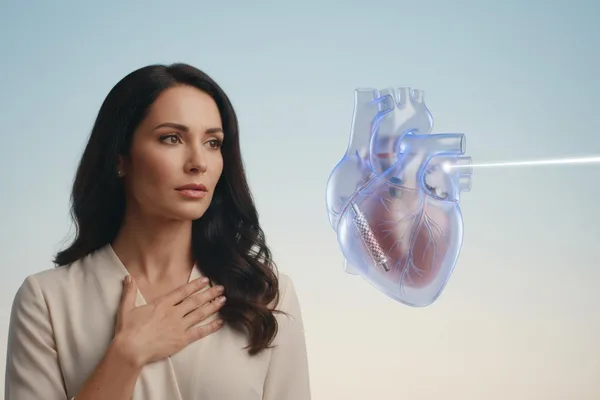
Similarly, coronary brachytherapy is used to prevent scar tissue from forming around a stent and causing the artery to narrow again. This involves directing a very small dose of radiation, in a very controlled manner, to the narrowed area, destroying the cells that are forming the scar tissue.
Who really needs this treatment?
This is not a treatment for everyone. Doctors only recommend it in a few specific cases. If you have had a stent placed and it gets blocked again (ISR), this treatment may be right for you.
See the table below to see who this is best suited for.
| People who may be suitable for brachytherapy | |
|---|---|
| Recurring stent occlusion (Recurring ISR) | If the site where a stent was placed repeatedly narrows. |
| Multiple stents or long stents | If you have multiple stents in your coronary arteries or if you have a very long stent. |
| Other diseases such as diabetes | For those who are at increased risk of complications during other treatments (e.g. bypass surgery) due to other medical conditions such as diabetes. |
| Small blood vessels | For those whose heart blood vessels are too small for other treatments. |
Are there people who should not have this treatment?
Yes, this is not suitable for everyone. For example, if you have previously had radiation therapy for breast cancer or another cancer in the chest area, this treatment is usually not done. Also, if the stent is blocked not because of scar tissue, but because of a problem with the balloon used to place the stent, this treatment is not necessary. Your cardiologist will make the best decision about this.
How the treatment works - step by step
This is not a major surgery. We call it a minimally invasive procedure. You won't feel much pain. The whole procedure usually takes about 10 minutes, but you will have to stay in the hospital for a few hours.
| Steps | What is happening? |
|---|---|
| 1. Preparation | Before treatment, the doctor will perform a scan, such as an intravascular ultrasound, to see exactly where the vein is narrowed. |
| 2. Anesthesia | You won't be completely unconscious. You'll be given medication to make you drowsy and numb. You'll be conscious, but you won't feel anything. |
| 3. Inserting the catheter | A very thin tube (catheter) is inserted through a large vein in the arm or leg, and with the help of X-rays, it is guided to the narrowed artery in the heart. |
| 4. Widening the balloon | A small balloon is inflated inside the artery, creating space for radiation therapy to be administered at the narrowed area. This is called balloon angioplasty. |
| 5. Giving radiation | Next, through that catheter, a well-controlled dose of radiation is directed to the narrowed area for a few minutes. This radiation destroys the cells that make up scar tissue. It does not affect other areas. |
| 6. Finishing | The radiation device and catheter are carefully removed. |
What are the benefits and risks of this treatment?
As with any medical treatment, there are benefits and minor risks.
Main advantages
- Recurrent stent occlusion (ISR) can be prevented.
- It reduces the chance of having a heart attack in the future.
- Symptoms such as recurrent chest pain (angina), shortness of breath (dyspnea), and dizziness can be eliminated.
- It is possible to get a solution without having to undergo major bypass surgery.
Possible risks
These risks are very low. These are common risks associated with any cardiac catheterization procedure.
- Heartbeat irregularities (Arrhythmia)
- Blood clots
- Pain or infection at the catheter insertion site
- Minor damage to a blood vessel
Most importantly, the radiation used in this treatment is very safe. It is delivered in a very controlled manner, only to the affected area, so it does not harm any other part of the body.
What happens after treatment? And when should I see a doctor?
Most people can go home the same day as the procedure. You may need to stay in the hospital overnight. It is important to avoid strenuous activity for a few days after you go home. Your doctor will prescribe medication to prevent blood clots.
It is your responsibility to maintain your heart health after treatment.
- Eat a low-fat, healthy diet.
- Stop smoking completely.
- Exercise regularly.
- Control your alcohol consumption.
If you experience any of the following symptoms, you should call your doctor immediately or go to the Emergency Department (ETU) of your nearest hospital.
- If you get a high fever.
- If you have severe pain in your chest, jaw, arms, or shoulders .
- If you have difficulty breathing.
- If there is pus coming out of the catheter insertion site, if it smells bad, or if it is swollen and red.
Although this treatment is not widely used anymore (because the new types of stents - drug-eluting stents - have greatly reduced the risk of reocclusion), it can be a very effective and valuable solution for patients with complex conditions who experience repeated stent occlusions.
Take-Home Message
- Coronary brachytherapy is a radiation treatment used to prevent scar tissue from forming around a stent and causing the blood vessel to narrow again (in-stent restenosis).
- This is not a treatment for everyone, but it is especially suitable for those who have recurrent stent blockages, other diseases such as diabetes, or complex heart conditions.
- This is not a major surgery, and a small tube (catheter) is inserted into the heart to deliver a controlled dose of radiation.
- The amount of radiation used is very small and safe, and it does not affect other parts of the body.
- It is very important to follow a heart-healthy lifestyle after treatment. Seek immediate medical attention if you experience warning signs such as chest pain or shortness of breath.




💬 Comments (0)
No comments yet. Be the first to share your thoughts here.
Add Your Comment