
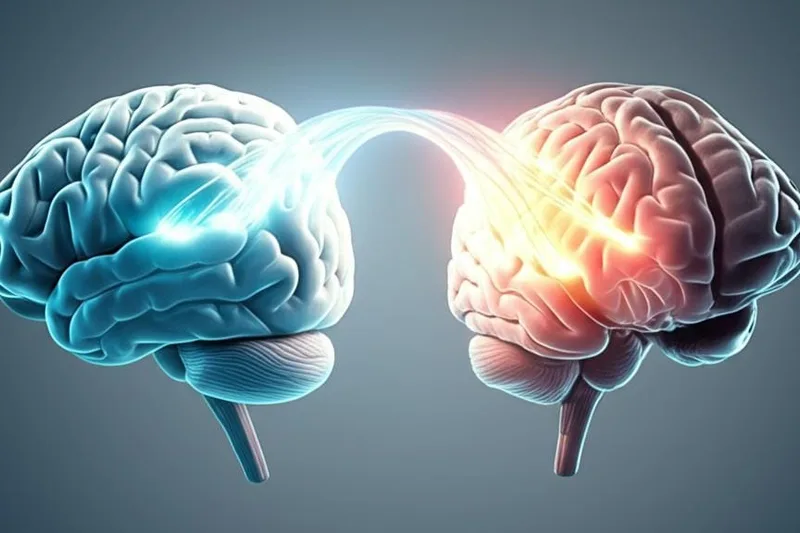
Have you ever wondered how the right and left sides of your brain work so well together? It's like talking, right? Actually, there's a special bridge inside our brains for that. That's what we're going to talk about today, and that's a part called the Corpus Callosum .
What is the Corpus Callosum?
Simply put, the corpus callosum is a thick tissue in the middle of your brain that connects the two hemispheres of your brain, the right and left sides. Think of it like a big, busy bridge connecting two cities. This "bridge" is made up of millions of nerve fibers . These nerve fibers help the right and left sides of your brain "talk" to each other, that is, send signals back and forth. They work like fast couriers carrying messages. This essential communication line is what allows you to coordinate many of the important tasks you do, think, and feel in your daily life.
What is the main function of this?
The main and most important function of the Corpus Callosum is to connect the left and right hemispheres of the brain, helping them communicate information quickly and efficiently. Think of it like a superhighway. This "highway" is where nerve signals travel back and forth. In other words, just like cars traveling down a highway, these nerve signals carry messages from one part of the brain to another. These messages are what allow you to do the following:
- Your senses: That is, your ability to see, hear, touch, taste, and smell things properly. Imagine you see a beautiful flower. This helps to send details about the flower’s color, shape, and smell from one side of your brain to the other, giving you a complete experience. Or, if you’re walking down the street and hear a car coming from one side, that information quickly travels to the other side of your brain, telling you to be careful. This type of coordination is also a result of this type of coordination.
- Movements: Command your muscles to move your arm, lift your leg, walk, run, etc. For example, when you play cricket and catch a ball, both hands need to be coordinated. This corpus callosum plays a big role in that. Or you need this coordination to do fine work like typing and writing.
- Cognitive function: This is essential for complex mental processes such as memory, understanding and speaking language, solving math problems, reasoning, and planning. When you're learning something new, or studying for an exam, both sides of the brain need to work together. That's what this "bridge" helps with.
Where is the Corpus Callosum located?
This corpus callosum is located deep inside your brain, right in the middle. That is, in a deep groove between the two hemispheres of the brain, called the longitudinal fissure . So think of it as if this bridge is built right where the brain divides into two, connecting the two sides. This is what allows the two sides of the brain to share their "work" and work together at the same time.
What are the parts of the Corpus Callosum?
The Corpus Callosum has four main parts. These names may sound a bit scientific, but let me simply explain what they are and where they are connected:
- Rostrum: This is the front part of the corpus callosum, towards the nose. It connects to the parts of the brain behind your eyes ( the orbital regions of the frontal lobe ).
- Genu: This is named for its bent shape, which resembles a knee. It is located behind the rostrum. It connects the left and right frontal lobes of the brain (the frontal lobes of the brain - important for thinking and planning).
- Body: This is the largest, central part of the corpus callosum. It is located right in the middle. It helps to communicate information between the frontal, parietal (touch, temperature, pain), temporal (hearing, memory, language comprehension), and occipital lobes (vision) on the left and right sides of the cerebral cortex (the outer, wavy layer of the brain).
- Splenium: This is the back, widest part. It is mainly connected to the occipital lobes (the parts of the brain that are related to vision, located at the back of the head). This means it is very important for processing visual information.
Now you may be thinking that remembering all these names is difficult. That's okay. The important thing is that all these structures come together, work as one team, and allow information to flow smoothly between the two sides of the brain.
What is this made of? How does it look?
The corpus callosum is made up mainly of nerve fibers . To be precise, it contains more than 200 million axons . These axons are long, thin fibers that carry electrochemical messages from nerve cells (neurons) to the outside world. These axons appear white because they are surrounded by a white, fatty sheath called myelin . That's why we also call it white matter . In fact, the corpus callosum is one of the largest white matter structures in your central nervous system .
In terms of appearance, it is usually about 10 centimeters (about 3.9 inches) long. It is shaped like a thick arch that bends downward, like the letter "C." It is located between the two sides of the brain, and through it, like a bridge, millions of nerve fibers run back and forth.
What are the common conditions that affect the Corpus Callosum?
If the function of the Corpus Callosum is disrupted, meaning one side of the brain cannot communicate properly with the other, a variety of problems can arise. Let's take a look at what these conditions are:
- Epilepsy: In some cases of epilepsy, abnormal electrical activity can start in one part of the brain and spread through the corpus callosum to the other side of the brain. In some severe cases, a surgical procedure called a corpus callosotomy is performed to stop this spread.
- Stroke: If a blood vessel that supplies blood to this part of the brain becomes blocked or bursts, which is called a stroke, the corpus callosum can be damaged.
- Infections: Some bacterial or viral infections that affect the brain (e.g. meningitis, encephalitis) can also damage this area.
- Tumors: Tumors, whether cancerous or noncancerous, that develop in or around this area of the brain can compress or damage the corpus callosum.
- Genetic conditions: Some congenital genetic conditions, such as Aicardi syndrome (a rare condition that mainly affects girls) and Trisomy 18 (also called Edwards syndrome), can cause serious problems with the development of the corpus callosum.
- Surgery: As mentioned earlier, some brain surgeries, especially as a treatment for severe epilepsy, sometimes involve removing part of the corpus callosum.
Another special condition is agenesis of the corpus callosum . This is a condition that is present at birth (congenital). What happens here is that the corpus callosum does not develop as expected during fetal development in the womb. Some children may not have the corpus callosum at all ( complete agenesis ), and there is no connection between the two hemispheres of the brain. Others may have only part of it developed, while the other parts do not develop ( partial agenesis ). Research suggests that genetic changes, certain infections that the mother has during pregnancy, or certain medications that the mother takes can cause this part of the brain to develop.
In addition, as we all age, the speed at which messages are sent from one side of the brain to the other naturally slows down. The efficiency of the nerve fibers in the corpus callosum can also gradually decrease. So as we age, our minds and bodies may not be as responsive, agile, or multitasking as they used to be. This is one way aging affects the brain.
What are the symptoms of problems with the Corpus Callosum?
Imagine what could happen if the "conversation" between the right and left sides of your brain wasn't happening properly? A variety of symptoms can occur. These symptoms can vary depending on the extent of damage to the corpus callosum, the exact location of the damage, and the age of the person. Common symptoms include:
- Developmental delays: Young children, especially those with conditions like agenesis of the corpus callosum, may be delayed in reaching developmental milestones such as talking, walking, and sitting.
- Seizures: Epilepsy-like conditions may occur or occur frequently.
- Vision, hearing, and speech difficulties: For example, difficulty finding words, difficulty understanding what is being said, and difficulty coordinating the eyes together.
- Intellectual disability: Learning disabilities, difficulty understanding things, and reduced problem-solving abilities can occur at varying levels.
- Movement and coordination challenges: This may include stumbling while walking, difficulty grasping objects, and difficulty performing fine motor tasks (e.g., buttoning, writing). Some may also have difficulty maintaining body balance.
- Social and behavioral problems: Some people may have difficulty forming social relationships and understanding the emotions of others.
The severity of these symptoms depends on the extent of damage to the corpus callosum. Also, the location of the damage is important. For example, if your corpus callosum is damaged, it may be difficult to:
- Threading a needle. (This requires fine coordination of both hands and good eyesight.)
- Catching an incoming ball. (Both hands must act quickly based on what is seen.)
- Riding a bicycle. (Body balance and limb movements must be in harmony.)
- Following a series of instructions with many steps. (Requires processing information from both sides of the brain.)
- Making a puzzle (requires visual information and spatial reasoning).
- Playing a musical instrument. (Both hands, and maybe even legs, need to be coordinated together.)
How to check the health of the Corpus Callosum?
If your doctor wants to know about the health of your corpus callosum, or suspects a problem with it, they may order brain imaging tests . The most important of these are:
- Computed Tomography (CT) scan: This uses X-rays to take cross-sectional images of the brain.
- Magnetic Resonance Imaging (MRI): This uses strong magnetic fields and radio waves to produce very clear, detailed images of the brain. MRI is important for diagnosing conditions such as agenesis of the corpus callosum .
These tests allow the doctor to see the inside of your brain in great detail. This can help determine if there is any damage to the structure of the brain, if a part is missing, or if there is a developmental problem.
What are the treatments for these conditions?
There are treatments that can help manage the symptoms of Corpus Callosum dysfunction. Importantly, these treatments may not be able to regenerate the lost parts of the corpus callosum or completely repair the damaged parts. However, they can help control symptoms and improve quality of life.
Some of the treatment methods are:
- Medications: For example, antiseizure medications .
- Special education programs in schools: To help children with learning disabilities develop their abilities to the fullest.
- Occupational therapy: Training to perform daily tasks (such as eating, dressing, and writing) independently.
- Physical therapy: Improve body movement, muscle strength, balance, and coordination.
- Speech therapy: Overcome speech difficulties and language comprehension problems.
- Visual therapy: For vision problems, improve eye coordination.
These treatments vary depending on your symptoms and what is causing them. Therefore, your doctor, neurologist, or rehabilitation team can give you the most accurate information about which treatments are right for your situation and what to expect.
How do we keep our Corpus Callosum healthy?
Now you know that this part of your brain called the Corpus Callosum is very important for it to function properly. So to keep it healthy, the best thing to do is to keep your whole body, especially your brain, healthy. See if you can incorporate these things into your life:
- Exercise your brain: Doing puzzles, crosswords, playing games like chess, reading books, and learning new things (like a language or a musical instrument) strengthens the connections (synapses) between brain cells and creates new connections. It's like "use it or lose it."
- Engage in physical activity: Exercising for at least 30 minutes every day, such as brisk walking, running, or swimming, helps the brain get good blood flow, which means it gets more oxygen and nutrients.
- Eat a balanced, nutritious diet: Fresh vegetables, fruits, legumes, oily fish (rich in omega-3), nuts, and clean water provide the brain with the nutrients it needs. Reduce processed foods, foods high in sugar, and foods containing trans fats as much as possible.
- Follow good hygiene practices: Things like washing your hands frequently and covering your mouth when sneezing can help prevent infections that can affect the brain.
- Get proper sleep: Getting 7-8 hours of good sleep per night is very important for brain function and memory.
- Manage stress: Things like yoga, meditation, and breathing exercises can help reduce stress. Excessive stress is harmful to the brain.
Talk to your doctor about what else you can do to keep your mind and body healthy. They can give you specific advice that will suit you and your lifestyle.
Finally, remember this !
It's hard to imagine how we ever talked to someone on the other side of the world without a phone, isn't it? But today, thanks to a phone, we can communicate with anyone, anytime, anywhere. In the same way, this amazing structure called the Corpus Callosum helps different parts of your brain "talk" to each other and exchange information. Without you even having to think about it, one side of your brain sends signals (messages) to the other. This is why you can do a thousand and one things, like ride a bike, remember someone's name, follow a complex set of instructions, and think creatively.
Sometimes, conditions can affect the way this part of the brain develops or functions. However, there are treatments and therapies that can help manage the symptoms of Corpus Callosum dysfunction. Early recognition and appropriate intervention are important.
Remember, your brain is the most amazing and complex machine in the world. It is your responsibility to take good care of it, giving it the nutrition and exercise it needs!
To learn more about your Corpus Callosum, what you can do to keep it healthy, or if you have any concerns about it, be sure to talk to your doctor.
` Brain, corpus callosum, nervous system, brain function, brain health, neuroscience, brain structure


💬 Comments (0)
No comments yet. Be the first to share your thoughts here.
Add Your Comment