

If you have an elderly parent, grandparent, or someone with Alzheimer's disease at home, we know how much dedication and patience it takes to take care of them. Along with food and medicine, one of the most important things we sometimes forget is their dental and oral health . As memory fades over time, you may forget to brush your teeth. Or you may not remember how to use a toothbrush or toothpaste. The scariest thing of all is that they may not be able to tell us if they have a toothache or a sore gum. So, how do we take care of this? Let's talk about this in detail.
Emergencies and situations where medical advice should be sought
Some dental problems can be emergencies . If you have any of these symptoms, take your loved one to a doctor as soon as possible or take them to the nearest hospital's Emergency Department (ETU).
- If the face or jaw area swells as soon as you get a fever.
- If you find it difficult to breathe or swallow.
Symptoms like these indicate that an infection in the root of a tooth can spread throughout the body. So don't ignore this.
Other cases:
- If only one tooth is darker than the others.
- If you feel pain when eating or when you press your finger on the tooth.
At a time like this, it's best to call a dentist for advice.
How do we recognize that there is pain?
A person with Alzheimer 's may not be able to say, "My tooth hurts." But we can tell by their behavior. Pay close attention to the following signs. If you notice these, it could be a dental problem.
| Characteristic of pain | Description |
|---|---|
| Making a sour face while eating | Facial expressions change due to pain while chewing food. |
| Refusing hot or cold foods | These foods may be difficult to eat due to increased tooth sensitivity. |
| Biting the inside of the cheek or lip | It could be due to pain or swelling. |
| Drooling | It could be due to difficulty swallowing or a mouth infection. |
| Being aggressive or trying to bite | When you can't bear the pain, this is how you release it. |
| White coating on the tongue | A fungal infection in the mouth or a sign of poor oral health. |
| Bad breath | If you smell bad even between your teeth, it could be due to an infection in the roots of your teeth. |
| A swelling or pimple on the gum | This may be a sign of an abscess at the root of a tooth. |
| Not allowing the mouth to be seen or cleaned | Because there is pain inside the mouth, they may be afraid of being touched by someone. |
What to do if a tooth breaks? – First aid
If you break a tooth due to a fall or something else, don't panic and do these things.
1. Mouthwash: If possible, rinse your mouth with lukewarm water.
2. Stop the bleeding : If the bleeding is coming and he understands what you are saying, have him suck on a clean piece of gauze or a wet tea bag for about 10 minutes. Never put your fingers inside his mouth.
3. Reduce swelling: Place an ice pack on the cheek where the broken tooth is.
4. Painkillers : If there is pain, give a paracetamol ( Acetaminophen ) tablet. Never give ibuprofen or aspirin . These can increase bleeding and bruising. Ask your doctor about this and confirm.
Common dental problems and their effects
Maintaining good oral health not only keeps your mouth healthy, but it also helps reduce the risk of serious infections like pneumonia in Alzheimer's patients. Some studies have shown that up to half of people in nursing homes develop pneumonia due to poor dental health.
Common dental problems:
- Cavities: Food particles and bacteria that get stuck between the teeth combine to dissolve the enamel that covers the outside of the tooth. This causes cavities to form in the teeth. When these cavities get deeper, toothaches occur.
- Tooth Cracks: If the enamel of the tooth is just slightly broken, it's not a big deal. But if the crack goes all the way to the inside of the tooth, you should see a dentist within a few days. Otherwise, you could develop an infection at the root of the tooth.
- Abscessed tooth: This is an infection of the pulp, the part of the tooth that contains the nerves and blood vessels. It is very painful. This condition can occur if a tooth that has been eaten by worms is left untreated.
- Dry mouth: This condition occurs when the production of saliva in the mouth decreases. Some medications used to treat conditions such as Alzheimer's, high blood pressure, and depression can also cause dry mouth. If left untreated, this can lead to an increase in mouth ulcers and tooth decay.
- Bad breath: This can be caused by many things, such as poor oral health, mouth infections, and dry mouth.
How can we help maintain oral health?
How you help your loved one will depend on the stage of their illness.
In the early stages
In the early stages of the disease, most people can brush their teeth on their own while you watch. All you have to do is watch them do it properly.
Later on
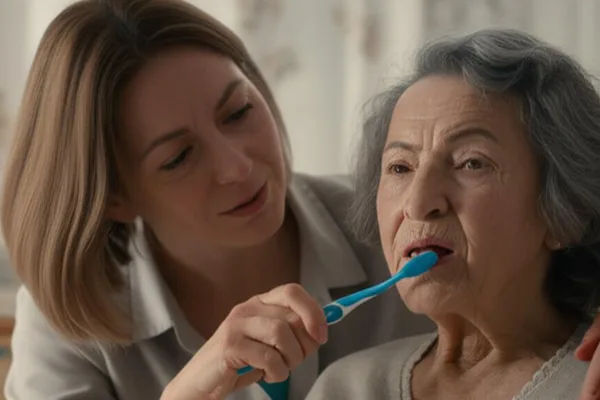
When the disease is severe, they definitely need your help. At this time, they may be afraid, uncooperative, and aggressive. But you can make this task easier by using these strategies.
- Start slowly and gently: Before you help them, talk for a while. Speak slowly, look them in the eye, and explain what you are going to do. Say, “I won’t hurt you. If it hurts, tell me and I will stop right away.”
- If your child doesn't open their mouth: Don't force them to say, "Open your mouth." Try gently touching the toothbrush near their lips. Gently touch their jaw or cheek to signal them to open their mouth. Saying, "Smile nicely" is also a good idea. When they open their mouth, brush the back teeth that are harder to clean first.
- Distract them: Put on a song they like, put on a TV show they like.
- Create a daily routine: Make it a habit to brush your teeth at the same time every day. Then they will get used to it. If they don't like it, try again in a while. If they still don't succeed, skip that day, but try again the next day.
- Cleaning dentures: If they wear dentures, they should be removed for at least 4 hours a day. Never use toothpaste when cleaning them. Instead, rinse them under running water and brush them with a damp toothbrush. After removing them, place them in a cup filled with water.
Take-Home Message
- Alzheimer's patients may not be able to express their dental pain, so be on the lookout for signs like changes in eating habits and aggressive behavior.
- Fever with facial swelling is an emergency. See your doctor immediately or go to the hospital's Emergency Department (ETU).
- Make it a habit to clean your mouth at the same time every day, gently and patiently.
- Never use toothpaste to clean dentures. Clean them separately and leave them out for a few hours each day.
- If you have any doubts or concerns, never hesitate to discuss them with your family doctor.
Alzheimer's, dental health, oral health, elder care, toothache, tooth decay, bad breath




💬 Comments (0)
No comments yet. Be the first to share your thoughts here.
Add Your Comment