
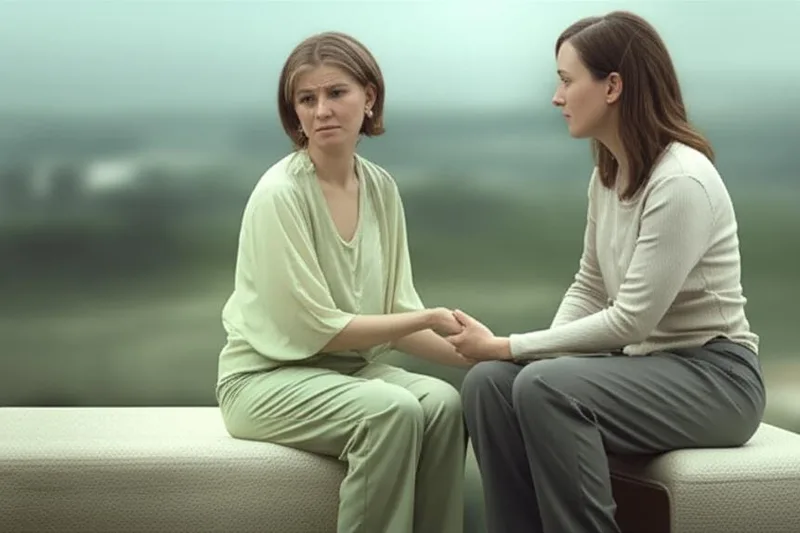
Our lives are not always the same. It's normal to feel sad, anxious, and helpless at times. It's a part of life. But if you're constantly feeling sad and empty, to the point where you can't even function properly, it could be something more. It could be depression. Or it could be PTSD (Post-Traumatic Stress Disorder).
Some of the symptoms of both conditions are very similar. Things like insomnia, getting angry over small things, and losing interest in things you used to enjoy are common in both. Sometimes, both conditions can coexist. The important thing is to understand that both are medically treatable conditions. So let's talk about this in a little more depth.
Let's first look at what depression is.
Depression is not a simple sadness that can be cured by someone telling you to "please calm down." It is a medical condition that is caused by chemical changes in the brain and requires treatment. Some people may only experience depression once in their lifetime. But for most people, it affects them throughout their lives, with occasional flare-ups and remissions.
Sometimes depression can occur for no apparent reason. But more often, it can be triggered by a major life event, such as a breakup or a stressful event (such as a breakup of a marriage, the loss of a job, or the death of a loved one). If these symptoms affect you for more than two weeks, or for a significant amount of time during the day, you should be concerned.
The most important thing is to understand that this is not your weakness. This is a situation that can happen to anyone.
See if you have any of these characteristics.
| Characteristic | A simple explanation |
|---|---|
| Feeling sad or hopeless all the time | You feel sad for no reason and can't think of anything good for the future. |
| Lack of pleasure in things you used to enjoy | Even things like talking to friends, listening to a song, or watching a movie feel meaningless now. |
| Sleep changes | Either you sleep for hours, or you don't fall asleep at night. You wake up in the middle of the night and can't go back to sleep. |
| Feeling tired and lacking energy in the body | I don't even feel like getting out of bed in the morning. I feel so tired even doing small tasks. |
| Changes in diet | You lose your appetite completely, or you eat too much. |
| Difficulty concentrating | I can't concentrate on things like reading a book, watching TV, or making a decision. |
| Feeling guilty about oneself | Thoughts like "I am useless" and "I am responsible for everything" often come to mind. |
| Thoughts about ending your life | Feeling like there is no point in living, constantly thinking about death ( this is a very dangerous symptom ). |
So what is PTSD?
The full name of this condition, which we all know by the acronym PTSD, is Post-Traumatic Stress Disorder . Simply put, this is a severe psychological state that occurs after experiencing a life-threatening, traumatic event.
Imagine experiencing a serious car accident, a natural disaster (we had a good experience with the tsunami in Sri Lanka), war, sexual assault, domestic violence, etc. Or, you could even witness something terrible happen to someone else right in front of your eyes. People who work with traumatic events regularly, such as doctors, police officers, and military personnel, are also at higher risk of developing PTSD.
Symptoms can begin within a month of the event. Sometimes, they can appear years later. PTSD symptoms can be divided into several main categories.
| PTSD symptom categories | |
|---|---|
| 1. Unwanted Memories | |
| |
| 2. Avoidance | |
| |
| 3. Negative Thoughts and Moods | |
| |
| 4. Changes in Physical and Emotional Responses | |
|
How can I get help? This is not something you can solve alone!
If you think you have depression, PTSD, or both, the most important and first step is to seek medical advice. This is not something you can fix on your own. And it is not something that is just a personality flaw.
- First, see your family doctor. He or she will examine you and determine if there is another physical cause for these symptoms.
- He or she will then talk to you about your thoughts, feelings, and experiences. If necessary, he or she will refer you to a specialist, such as a psychiatrist or counselor.
- There are treatments. Medication and talk therapy (psychotherapy) are both very effective. Sometimes these methods are used together. These treatments change your negative thought patterns and help you face life positively again.
Very important - emergency!
If you are having suicidal thoughts, consider it a medical emergency . Please do not suffer alone. Talk to someone you trust immediately . At the same time, go to the Emergency Treatment Unit (ETU) of the nearest hospital . Asking for help is a sign of strength, not weakness.
Take-Home Message
- Depression and PTSD are not your weaknesses, they are real conditions that can be treated.
- The symptoms of both can be similar, but PTSD is always related to a traumatic event.
- You don't have to suffer alone. There are very effective treatments available.
- If you or someone you know has these symptoms, the first step is to see a doctor.
- Suicidal thoughts are a medical emergency that requires immediate medical attention. Please go to the nearest hospital Emergency Department (ETU) immediately.


💬 Comments (0)
No comments yet. Be the first to share your thoughts here.
Add Your Comment