
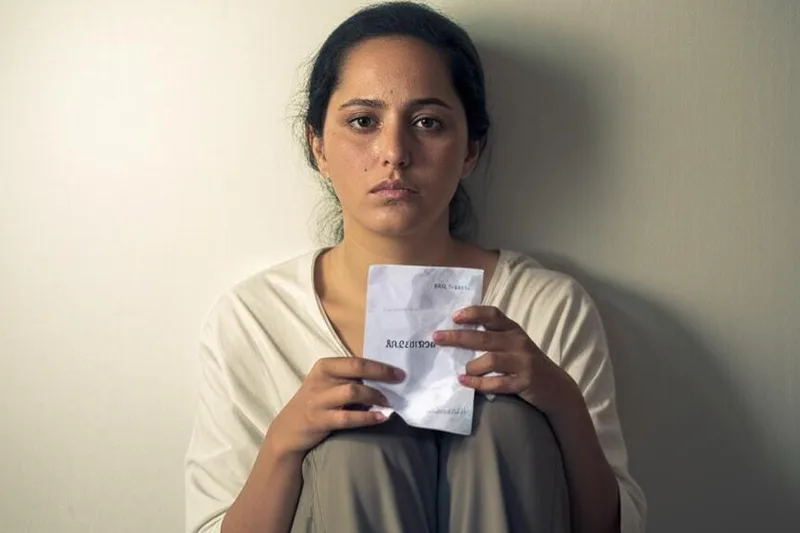
Are you suffering from depression? Even after seeing a doctor and taking the prescribed medication exactly, you still feel no improvement or change? Are you filled with questions like, "Why is this happening to me alone? Doesn't the medication work? Isn't this illness only for me?" If so, you are not alone. This is a condition that affects many people. Today we are going to talk about this. In medical terms, this is called Treatment-Resistant Depression .
Let's try to understand this story through the experience of a young woman named Imade. Imade is a talented, educated young woman. After graduating from a prestigious university, she worked hard to find a good job. But it was not easy for her. When she kept trying but could not find a job, she began to feel a lot of pressure and a breakdown. "The fact that I did not have a job, the feeling that I was a failure in life, increased my mental problems," she says. Unable to bear this pressure, she even tried to commit suicide. It was at that time that doctors diagnosed her with Major Depressive Disorder .
"It was only after I attempted suicide that I realized that none of the three medications I was taking were working," says Imade. Have you had a similar experience? So let's see what might be causing this.
What exactly is treatment-resistant depression?
Although the name may sound a little scary, it's very simple to understand.
Simply put, Treatment-Resistant Depression (TRD) is when a person with Major Depressive Disorder does not experience satisfactory relief of their symptoms despite taking at least two different types of antidepressants, at the correct dosage and for the correct period of time.
Think of it this way. Our brains are like complex electronic circuits. Depression is a state where some of the switches in that circuit have been turned off. The medications the doctor prescribes are like keys that turn those switches back on. Sometimes you can't open a door with one key, you have to try another. TRD is like that. One medicine may not work. Maybe two medicines may not work. It's not your fault. It's just a biological response of the body.
Remember, it's not your fault or your weakness that the medication isn't working. This is a medical condition.
Let's look at this table to explain this a little more.
| Status | Simply put... |
|---|---|
| Major Depressive Disorder | Feelings of prolonged sadness, loss of interest in anything, changes in sleep and eating patterns, and boredom with life. |
| Treatment-resistant depression (TRD) | The above condition has not been cured despite the administration of at least two different types of antidepressants, in the correct dosage and for the right duration. |
| What is the reason for this? | Everyone's body and brain are different. The same medicine doesn't work the same for everyone. Sometimes other undiagnosed medical conditions or mental health issues can contribute to this. |
Not just depression... do other mental problems also affect it?
Yes. This is a very important point. Sometimes the reason why medication for depression doesn't work is because there may be another underlying mental condition.
Let's go back to Imade's story. After years of treatment for depression with no relief, doctors tested her further. That's when they discovered that she also had a condition called Borderline Personality Disorder (BPD) .
What is borderline personality disorder (BPD)?
What happens in this is that a person's emotions change very quickly and intensely.
- Loss of mental stability.
- Constant fear of being abandoned by others.
- Becoming very angry or very sad over even the smallest things.
- Working recklessly and without thinking.
When Imade lost her job and was rejected, she developed these BPD symptoms. This means that there was another strong reason behind her depression.
In addition, she has had severe anxiety. "When I'm bored with life, I don't have time to think, 'Do I have anxiety?'" she says. Later, after receiving treatment for anxiety, she found great peace of mind.
Does this make us understand that sometimes when we are looking for an answer to one question, the reason for it may be another question hidden underneath. Just like an onion. When you peel off the top layer, there is another layer. That is why accurate diagnosis is very important.
If the medicine doesn't work, what do I do?
This is the most important thing. If you feel that you are not getting better after taking the medicine, never stop taking the medicine or change the dosage on your own. This will only make the situation worse. The first and best thing you should do is to talk to your doctor about this openly.
"Doctor, I've been taking this medicine for months now, but I don't feel any difference," you can honestly say. That's your right.
Then your doctor may refer to solutions like these:
- Switching: A different type of antidepressant may be given instead of the current medication.
- Augmentation: Along with the medication currently being used, another type of medication can be added that increases its effectiveness.
- Dose Adjustment: Sometimes the dose you need may not be enough. Therefore, the dose can be changed.
- Other treatments: In addition to medication, psychotherapy can be used. Dialectical Behavioral Therapy (DBT) is one such treatment that helped Imade recover.
- Checking for other medical conditions: Sometimes depression can be caused by other physical conditions, such as thyroid hormone problems. So the doctor will check for those as well.
See? There are many ways to help you. The most important thing is to not give up hope and work with your doctor to find the treatment that works best for you. There is no one-size-fits-all solution. The solution lies in a personalized treatment plan that is specific to you.
Take-Home Message
- Treatment-Resistant Depression is a real, recognized medical condition. It's not something you've imagined.
- It's not your fault or weakness that your antidepressant isn't working. There are biological reasons for it.
- If you are not feeling well with your medication, the most important thing to do is to let your doctor know. Never stop or change your medication on your own.
- Sometimes depression can be accompanied by other conditions, such as anxiety or borderline personality disorder (BPD). An accurate diagnosis is important.
- Don't give up hope if the first one or two medications don't work. There are many different treatments available, including psychotherapy and other medications. There is definitely a way to recover.




💬 Comments (0)
No comments yet. Be the first to share your thoughts here.
Add Your Comment