

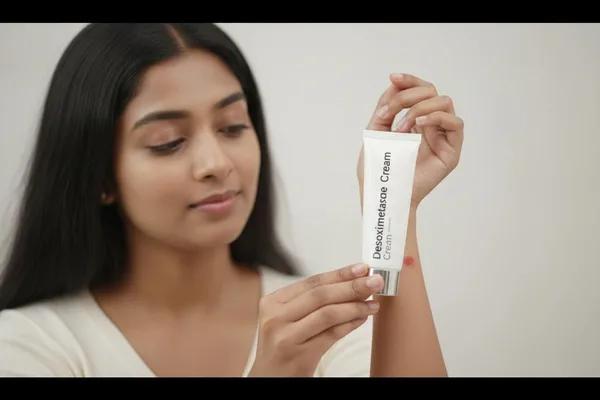
Has your skin suddenly become red, swollen, and unbearably itchy? It could be eczema, or it could be an allergic reaction. When we see a doctor at times like these, they may prescribe a cream, gel, or ointment to treat the skin. Desoximetasone is one such medication. So if your doctor has prescribed this medication for you, it is very important to know exactly what it is and use it correctly. Let's talk about this in detail.
What is Desoximetasone?
Simply put, Desoximetasone is a powerful steroid . Now, the word steroid may scare some people. But this is not the kind of steroid that bodybuilders use. These are medically known as ``Corticosteroids''. Their main function is to control inflammation in our body.
Imagine, when your skin gets an allergic reaction, the area becomes red, swollen, and itchy as a response from our body's immune system. What this medicine, Desoximetasone, does is temporarily control that reaction and quickly reduce the swelling, redness, and unbearable itching of the skin. That's why doctors prescribe this medicine for skin diseases like eczema, psoriasis, and various allergies. Popular brand names for it are `(Topicort)` and `(Topicort LP)`.
Things to tell your doctor before using this medicine
Before your doctor prescribes this medicine, it is very important to know the complete details of your health condition. Because this is a strong medicine, it is not good to use it in some cases. Therefore, if you have any of the following, be sure to tell your doctor about it.
- Burned or damaged skin: If a large area of your skin is burned or injured.
- Skin infections: If you have a bacterial, fungal, or viral skin infection (e.g., chickenpox, herpes). Steroids can make these infections worse.
- Allergies: If you have previously had an allergy to Desoximetasone or any other steroid, medicine, food, or dye.
- Pregnancy: If you are pregnant or are expecting to become pregnant soon.
- If you are a breastfeeding mother: If you are a breastfeeding mother.
Giving this information to your doctor will help him or her decide exactly whether or not this medication is right for you, and how to use it.
How exactly do you use this?
This is the most important part. To get the full benefit of the medicine and minimize side effects, you need to use it exactly as directed.
Most importantly: This medicine is for external use only. Do not take it orally for any reason.
1. Wash your hands: Wash your hands thoroughly with soap and water before and after applying the medicine. However, if you are applying the medicine to both hands, wash them only before applying.
2. Apply a thin layer: Do not apply too much of the medicine. Apply a very thin layer only to the affected area of skin. Then gently massage it into the skin until it is absorbed.
3. Do not apply to healthy skin: Do not apply this medicine to healthy, unproblematic skin.
4. Be careful with your eyes: Do not let the medicine get into your eyes, nose, or mouth. If it accidentally gets into your eyes, immediately wash the area with plenty of clean water.
5. Take it on time: Always take it as often as your doctor tells you, at the exact time. Do not use more than you need or for longer than the doctor tells you.
6. Do not bandage: Unless specifically instructed to do so by your doctor, do not cover the area where the medication was applied with bandages, plasters, or other pressure-sensitive materials. Doing so can increase the amount of medication absorbed through the skin, which can lead to serious side effects.
Be especially careful when using on small children and the nappy area!
- For children: In some cases, this medicine is prescribed to children on the advice of a doctor. However, since children's skin is thinner than that of adults, the medicine can be absorbed more easily by the body. Therefore, never use it in more quantity or for longer than the doctor recommends .
- Diaper Area: Do not use this medicine for a diaper rash on your baby's diaper area without your doctor's approval . If you are told to use it, do not apply the medicine and wear a tight diaper or plastic pants. This will act like a bandage and may cause more medication to be absorbed.
What to do if you miss a dose or overdose?
- If you miss a dose: If you forget to take a dose, take it as soon as you remember. But if it is almost time for your next dose, skip the missed dose. Take your next dose at the usual time. Never take a double dose.
- If you accidentally take too much of this medicine: If you use too much of this medicine or if someone accidentally takes it, immediately call the National Poisons Information Centre at the Colombo National Hospital . Or go to the Emergency Treatment Unit (ETU) of the nearest hospital.
Possible side effects when using the medicine
Like any medicine, this medicine can cause some side effects. However, not everyone gets them. The table below will give you a clear picture of these.
| Possible side effects of using Desoximetasone | |
|---|---|
| 🚨 Side effects that you should report to your doctor immediately | |
| Allergic reactions | Skin rash , itching, hives, swelling of the face, lips, or tongue. |
| Severe changes at the injection site | Inflammation, severe itching, peeling or crusting of the skin. |
| Increased blood sugar levels | Frequent hunger, excessive thirst, frequent urination, unusual tiredness, blurred vision. |
| Decreased function of the adrenal gland | Nausea, vomiting, loss of appetite, unusual fatigue, dizziness, low blood pressure. |
| Thinning of the skin | Thinning of the skin, wrinkles, and small blood vessels starting to appear on the surface of the skin. |
| 🙂 If it persists or is bothersome, tell your doctor. | |
| Minor skin changes | Dry skin, minor inflammation, redness, or itching. |
How do you store and dispose of the medicine?
- Storage: Keep the medicine tube out of the reach of children and pets . Ideally, store at room temperature (between 20-25 degrees Celsius). Protect from extreme heat and extreme cold.
- Disposal: Do not use medication after its expiration date. The best way to dispose of expired or unwanted medication is to ask your doctor about it. Some pharmacies may have programs that will accept these. If that is not possible, it is best to remove the medication from the tube, mix it with something like used tea leaves, coffee grounds, or soil, and place it in a tightly sealed bag and dispose of it in the trash. Never flush it down the toilet.
Take-Home Message
- Desoximetasone is a strong steroid medication, so only use it if prescribed by your doctor, and only as directed .
- The medicine should be applied in a very thin layer , only to the affected skin area.
- Do not cover the area where the medication was applied with a bandage or plaster without special advice from your doctor.
- If you experience severe side effects (such as facial swelling, severe inflammation, blurred vision), inform your doctor before stopping the medication immediately.
- This medicine is for you only. Do not give it to anyone else or use it for any other skin condition.




💬 Comments (0)
No comments yet. Be the first to share your thoughts here.
Add Your Comment