

Do you remember when you were a child, when you were stung by a wasp or a hornet, your mother would come running and apply some medicine? Or when you went to the beach and got sunburned and your skin turned red and inflamed, you would apply a cream? A key ingredient in many of the medicines we use at times like these is what we are going to talk about: diphenhydramine. This can come in the form of a cream, gel, or spray.
What exactly is Diphenhydramine?
Simply put, this is a medicine that belongs to a group of drugs that are used to treat allergies. In medical terms, we call these antihistamines .
Imagine, when our body is allergic to something, for example, when we are bitten by an insect, the venom of that animal enters the body. At this time, a chemical called histamine is released from the cells of our body. This histamine is what causes the skin to itch, redden, swell, and hurt .
So what this Diphenhydramine cream does is block the action of histamine at the skin level. Then those allergic symptoms gradually decrease. This is used not only for insect bites, but also for sunburn and minor skin rashes.
Things to tell your doctor before using this medicine
Even though this is a medicine that can be purchased at a pharmacy, it is very important to inform your doctor of these facts.
- If you have had chicken pox or measles: You should ask your doctor about using this cream during these illnesses.
- If you have allergies to diphenhydramine or other medicines, foods, or dyes: This is very important because you may also have an allergy to this medicine.
- If you are pregnant or trying to get pregnant: It is essential to consult your doctor before using any medication during this time.
- If you are a breastfeeding mother: Some medications can pass into breast milk, so be sure to tell your doctor about this as well.
How exactly do you use this medicine?
This is very simple, but it needs to be done properly.
The most important thing is that this is only for external use . It is not recommended to put it in your mouth or drink it for any reason.
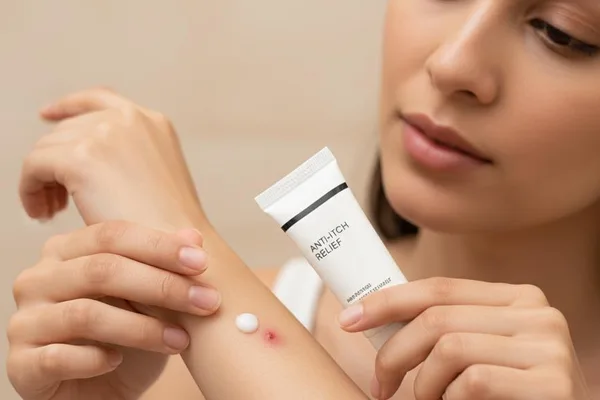
1. Wash your hands thoroughly with soap before and after applying the medicine.
2. Clean the area where you want to apply the medicine (e.g., the area where the insect bit you) and let it dry.
3. Apply a very thin layer only to the affected area. Do not apply too thickly.
4. Do not use the medicine more often than directed on the package or as directed by your doctor.
Use for young children
Although this medicine can usually be used in children over 2 years of age, you should definitely ask your doctor about it. There are some special considerations when using it in children.
Overdosage
Just remember that if you or a small person in your household accidentally applies too much of this medicine to your skin or drinks it by mistake, it can be dangerous. If this happens, do not panic and immediately call the National Poisons Information Centre at the Colombo National Hospital . Or go to the nearest hospital Emergency Department (ETU) immediately.
Things to consider when taking medication and side effects
There are a few things we need to be aware of and possible side effects when using this medication. Let's look at them clearly in a table.
| Point to note | Description and what to do |
|---|---|
| Symptoms not improving | If you don't feel any better after using the medicine for about 7 days, or if your condition gets worse, you may have something else, such as a skin infection. See a doctor immediately. |
| Flooding over a large area | Do not apply this to large areas of the body. Also, do not use it with other products (e.g., pills) that contain diphenhydramine. Doing so may cause more of the medicine to be absorbed into the body and increase the risk of side effects. |
| Eye contact | Be careful not to get this in your eyes. If you accidentally get it in your eyes, don't panic and rinse your eyes thoroughly with clean water for several minutes. |
| Side effects that should be reported to the doctor immediately | |
| Severe Allergic Reactions | If you experience skin rash, severe itching, difficulty breathing, or swelling of the face, lips, tongue, or throat shortly after applying the medicine, it could be a severe allergic reaction. This is an emergency. Go to a hospital immediately. |
| Other skin changes | If the skin feels like it is burning where you applied the medicine, if the dry skin peels off, or if it looks like a wound, stop using the medicine and talk to your doctor. |
How do you keep this medicine safe?
Just as it is important to use medicine correctly, it is also important to store it safely.
- Keep it out of reach of children and pets, high up or in a locked cupboard.
- Store at normal room temperature (between 20-25 degrees Celsius). Do not store in high humidity areas such as the bathroom.
- Never put it in the fridge and freeze it.
- Some creams/sprays may contain alcohol, which can be flammable. Therefore , do not use them while smoking or near open flames or high heat.
- Discard any medicine that has passed its expiration date.
Take-Home Message
- Diphenhydramine cream, gel, or spray is a topical medication only. Avoid putting it in your mouth or swallowing it.
- Avoid applying to large areas of the body at once and using it together with other tablets containing diphenhydramine.
- If symptoms do not improve after 7 days or if they worsen, see your doctor immediately.
- In case of accidental ingestion, immediately go to the National Poisons Information Centre or the nearest hospital Emergency Department (ETU).
- Always keep medicines safely out of the reach of small children and pets.




💬 Comments (0)
No comments yet. Be the first to share your thoughts here.
Add Your Comment