
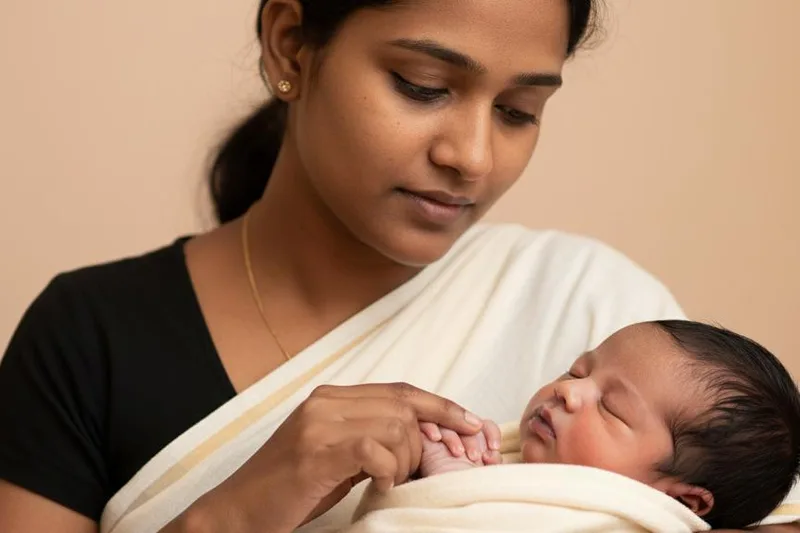
Is your newborn turning blue? Is he having trouble breastfeeding? Is he having trouble breathing? These can sometimes be signs of a congenital heart condition. It's normal for a mother or father to be very scared when they see something like this. Today we're talking about a very rare, but very important heart condition to be aware of. That's a condition called Double Inlet Left Ventricle.
What is Double Inlet Left Ventricle (DILV)?
Simply put, this is a rare congenital heart defect that is present at birth. To understand this, let's first take a look at how a healthy heart works.
Imagine that our heart is like a house with four rooms. There are two rooms upstairs and two rooms downstairs.
- The upper two chambers (Atria): This is where the blood from the body comes in and collects. The right chamber (Right Atrium) receives "dirty" blood that has been used by the body and is low in oxygen. The left chamber (Left Atrium) receives "clean" blood that is full of oxygen from the lungs.
- The two lower chambers (ventricles): These are the two main pumps in the heart. The right ventricle pumps the oxygen-poor blood to the lungs to pick up oxygen. The left ventricle pumps the oxygen-rich blood from the lungs to the rest of the body.
Now, look at what happens in the heart of a baby with Double Inlet Left Ventricle (DILV). In these babies, only one lower chamber (ventricle) works well. That's the left ventricle . The right ventricle is often too small to function.
The biggest problem is that blood from the two upper chambers (right and left atria) comes together in the only working lower chamber (Left Ventricle). This means that both oxygen-poor blood and oxygen-rich blood mix together . Then this mixed blood is pumped to the baby's body and lungs. This is why many problems occur.
What are the symptoms of this condition?
These symptoms usually appear within a few days or weeks after the baby is born. As a mother, it is very important for you to be aware of these things.
| Symptom | A simple explanation |
|---|---|
| Blueness of the skin and lips (Cyanosis) | The baby's skin, lips, and fingernails appear blue because of the oxygen-poor blood circulating throughout the body. This is one of the main symptoms. Some people also call it a "blue baby." |
| Poor feeding | When the baby sucks milk, he feels tired and has difficulty breathing. So he drinks a little and stops. |
| Difficulty breathing | The baby is breathing rapidly. It may seem like it's going into the chest. |
| Not gaining weight | The baby won't gain weight properly because he can't get enough energy from drinking enough milk. |
| Sweating | Especially when drinking milk, you sweat around your forehead because your heart has to work harder. |
| Abnormal heartbeat | The heart may beat rapidly or have an irregular rhythm. A doctor may hear an extra sound (heart murmur) during an examination. |
Why is this happening? What is the reason for this?
The exact cause of this is not yet known . It often occurs during the early weeks of pregnancy, when the baby's heart is developing. It is not the fault of either the mother or the father.
Often, DILV is accompanied by several other heart problems, which further interfere with blood flow.
- Aortic coarctation: Narrowing of the main blood vessel (aorta) that carries blood from the heart to the body.
- Pulmonary atresia: The pulmonary valve that carries blood to the lungs is not properly formed.
- Pulmonary valve stenosis: Narrowing of the valve that carries blood to the lungs.
How do doctors diagnose this disease?
There are several ways to diagnose this disease.
During pregnancy
Sometimes this can be detected while the baby is still in the womb. If your doctor finds any abnormalities in the heart during your routine scan (ultrasound), he or she will refer you to a special scan. It is called a Fetal Echocardiogram . This can provide a detailed look at the structure and function of the baby's heart.
After the baby is born
Often the disease is diagnosed after the baby is born.
- Pulse Oximetry test: This test is now performed on newborn babies in almost every hospital in Sri Lanka. This measures the oxygen level in the baby's blood. If the oxygen level is low, it could be a sign of a heart condition.
- Medical examination: If the doctor hears an unusual sound (murmur) when listening to the baby's heart, or if the skin is blue, he may be suspicious.
Then, several more tests are done to confirm the disease.
| Test | What do you do with this? |
|---|---|
| Chest X-ray | A chest X-ray. This can give an idea of the size of the heart and the amount of blood flowing to the lungs. |
| Electrocardiogram (ECG) | A test that measures the electrical activity of the heart. It can detect problems with heart rhythm. |
| Echocardiogram (Echo) | This is the most important test. It's like a scan. It can clearly see the chambers of the heart, the valves, and the way the blood flows. |
| Cardiac Catheterization | A complex test that measures the pressure and oxygen levels inside the heart by passing a very thin tube through a blood vessel in the baby's groin. |
What are the treatments for this?
This condition cannot be completely cured with medication. The main treatment is a series of surgeries . This does not create two chambers in the baby's heart. Instead, it uses the single ventricle to pump blood through the body as efficiently as possible.
This is not a one-time surgery. This series of surgeries is performed in several stages, depending on the age of the baby.
| Stages of surgery | Age (approximate) | What happens after the surgery? |
|---|---|---|
| First stage: Blalock-Taussig (BT) Shunt | Within the first few days or weeks after birth | If there is insufficient blood flow to the lungs, this surgery involves inserting a small tube (shunt) to allow sufficient blood flow to the lungs. |
| Second stage: Glenn Shunt Procedure | 4 - 6 months | The oxygen-poor blood coming from the baby's upper body is directed directly to the lungs, bypassing the heart. This reduces the workload on the heart. |
| Stage Three: Fontan Procedure | 2 - 3 years | This is the final surgery. The deoxygenated blood from the lower body is also connected directly to the lungs. After this surgery, the mixing of deoxygenated and oxygenated blood almost completely stops. |
In addition to surgery, the doctor may also prescribe certain medications for the baby.
- Digoxin: Strengthen the contraction of the heart.
- ACE inhibitors: Lower blood pressure.
- Anticoagulants: Prevent blood clotting.
- Diuretics: Remove unnecessary water from the body.
In the most severe cases, if these surgeries are not possible, a heart transplant may be considered.
What will the future hold? Can we have hope?
It's understandable to be scared when you hear about a disease like this. But the most important thing you need to know is that with the advancement of medical science, these babies now have the opportunity to live a much better life . The 10-year survival rate after surgery is as high as 70% - 80%. Many children even reach adulthood.
But these children need lifelong supervision by a cardiologist . It is essential to go to clinics and have tests done on time. Some complications may occur.
- Ingrown toenails and enlarged fingertips (clubbing).
- Frequent lung infections such as pneumonia.
- Heart rhythm problems.
Also, these children may have some limitations on running, jumping, and playing like other children. All of this should be discussed and decided with your doctor.
Take-Home Message
- Double Inlet Left Ventricle (DILV) is a rare, serious, but treatable, congenital heart disease.
- If a newborn baby's skin turns blue (cyanosis), has difficulty feeding, or has difficulty breathing, do not delay and take him to a doctor immediately.
- The treatment involves a series of complex surgeries performed in several stages depending on the baby's age.
- Although this journey is challenging, thanks to advances in medical science, many of these children can now live to adulthood.
- Lifelong supervision and proper follow-up by a cardiologist is very important.


💬 Comments (0)
No comments yet. Be the first to share your thoughts here.
Add Your Comment