Severe pain after a tooth extraction? It could be a Dry Socket''!

Severe pain after a tooth extraction? It could be a Dry Socket''!

Have you ever had a tooth pulled? Sometimes, after a tooth extraction, you can feel unbearable pain. While it is normal to have some mild pain for a couple of days, some people experience severe, stabbing pain that can upset the entire mouth. That is often the reason for this condition we are going to talk about, called ``Dry Socket''. Let's take a look at what it is, why it happens, how to recognize it, and how to avoid it.

What is `(Dry Socket)`? Let's understand it simply!

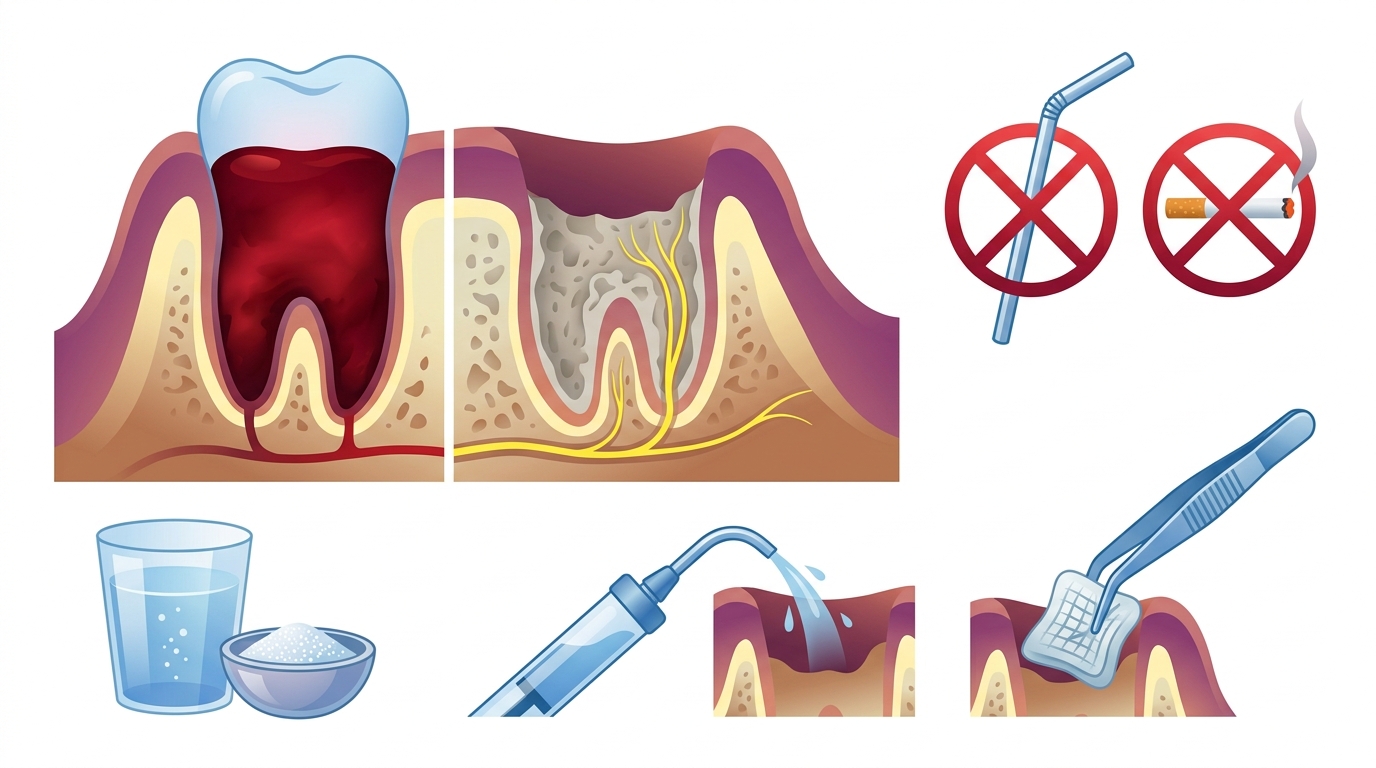
Okay, now let's see what exactly this `(Dry Socket)` is. When you have a tooth pulled, there is a kind of empty hole where the tooth used to be. Doctors call it a `(Socket).` What usually happens is that a blood clot forms in that empty space. This blood clot is like a plaster. It protects the jawbone and the delicate nerves underneath. This blood clot also helps the wound heal quickly.

However, sometimes if the blood clot does not form properly, or if the blood clot that has formed leaves the socket prematurely, the jawbone and nerves underneath are exposed . That's when the unbearable pain starts. This is what is called `(Alveolar Osteitis)` in medical terms. But among us it is known as `(Dry Socket)`. Due to this condition, the healing of the wound is also delayed.

Not everyone who has their teeth extracted develops this condition. Roughly speaking, between 2% and 5% of people who have their teeth extracted develop this ``Dry Socket'' condition. However, it is said that this risk is slightly higher when wisdom teeth are extracted.

How do I know for sure if I have a `(Dry Socket)`?

How can you tell if you have a ``Dry Socket''? The main thing is the unbearable, stabbing pain . If this pain increases two or three days after the tooth is extracted, it's a bit suspicious.

Plus, if you look in the mirror, the tooth will look like an empty hole where it was pulled out. You might see a white layer underneath that hole. That white layer is nothing but your jawbone that's coming out. That's why it hurts so much.

Normally, when a tooth is pulled, there should be a dark, dark red blood clot visible in the socket. It's like a scab forming over a wound. If it's there, it's a good sign. Don't touch it or try to pick it off. But if you don't see a blood clot, or if it looks like white bone, then there's a good chance it's a ``Dry Socket''.

What are the main symptoms of this?

Okay, now let's look at the most common symptoms of a `(Dry Socket)`:

  • Severe pain in the mouth and face: This is the main symptom. The pain may start at the site of the tooth extraction and spread down the jaw, towards the ear, and sometimes to the neck. It may feel like an electric shock running through a vein.
  • Infection of the tooth or gum: Sometimes pus can enter.
  • An unpleasant taste in the mouth and bad breath: This is also a problem that many people have.
  • Some people may experience a fever- like feeling.

If you have one or more of these symptoms, you should definitely see a doctor a few days after your tooth is extracted.

Why do we get `(Dry Socket)`? What are the causes?

To be honest, doctors still haven't figured out exactly why some people get dry socket and others don't. But they have found several risk factors that may contribute to it.

Simply put, a ``Dry Socket'' occurs when the aforementioned blood clot breaks prematurely, dissolves, or doesn't form properly . This blood clot protects the underlying bone and nerves until the wound heals. When it's lost, all the problems begin.

Am I at risk for ``Dry Socket''? What are the risk factors?

Now let's see what factors increase the risk of developing ``Dry Socket''. If you take care of these things, you can largely avoid this condition.

  • Use of hormonal birth control pills: The hormone ``(Estrogen)`` found in some birth control pills can slow down the healing process of wounds. Therefore, the chances of developing ``(Dry Socket)`` are higher. If you are taking birth control pills, it is a good idea to tell your doctor about it before having a tooth extracted.
  • Poor oral hygiene: If your mouth is not kept clean, bacterial infections can develop and cause ``Dry Socket''. It is very important to keep your mouth clean, as your doctor recommends, even after your tooth is extracted.
  • Smoking: This is one of the biggest risk factors for developing ``Dry Socket''. Smokers are found to be three times more likely to develop this condition than non-smokers. Smoking delays the healing of mouth sores. The suction created by inhaling smoke can also dislodge blood clots.
  • Drinking through a straw: When you drink through a straw, the suction created inside your mouth can dislodge the blood clot. So, avoid using a straw for at least a week after a tooth extraction.
  • Vigorous rinsing: After the tooth is extracted, your doctor may give you a mouthwash. But when using it, swish it around your mouth and don't swish it around too much. Doing so can dislodge the blood clot. If your doctor advises you to do so, tilt your head to the side and let the liquid soak into the wound.

If you pay attention to these points, you can greatly reduce the risk of developing a ``Dry Socket''.

How do doctors figure this out exactly?

Usually, when someone comes in with severe pain a few days after a tooth extraction, doctors suspect a ``Dry Socket.'' This is confirmed by examining the empty socket (``socket``) where the tooth was extracted. Then, as I mentioned earlier, they can see if there is any blood clot and the bone is exposed.

Sometimes, the doctor may also take an X-ray to check if any small pieces of the tooth are still inside the jawbone.

What are the treatments for a ``Dry Socket''?

If it is confirmed that you have a ``Dry Socket'', your doctor will begin the necessary treatment. The main goal of this treatment is to reduce pain and help the wound heal quickly.

  • Cleaning the cavity (`(Irrigation)`): First, the doctor will thoroughly clean the empty cavity. You can use salt water or an antibacterial mouthwash for this. This is done to remove any food particles and dirt that may be stuck there and to prevent infection.
  • Medicated dressings: Next, the doctor may put a medication into the hole to help reduce pain and help the wound heal. This may include medications containing things like Lidocaine (a numbing agent) or Eugenol (a component of clove oil that has antiseptic and analgesic properties). This medication is applied and applied like a small bandage. This may need to be left on for a few days, and may need to be changed every few days.
  • Pain medicine: Your doctor may prescribe painkillers to help you manage your pain at home. You can use over-the-counter painkillers like acetaminophen (e.g. Panadol®) or ibuprofen (e.g. Brufen®). However, you should only take the medicine as directed by your doctor and in the amount prescribed.
  • Antibiotics: If your doctor thinks you may have an infection, he or she will probably start you on some antibiotics.

With this treatment, the pain gradually subsides and the wound begins to heal.

How long does it take to heal?

With proper treatment and care, a ``Dry Socket'' usually heals in 7 to 10 days . During this time, new tissue begins to form and cover the exposed bone.

It is very important to keep your mouth clean during this time. Be careful when brushing your teeth and rinsing your mouth. This will further reduce the risk of infection.

When should I see a doctor?

After a tooth is pulled, if you have any of these symptoms, be sure to see a doctor:

  • If you have severe pain that keeps you awake at night.
  • If the pain doesn't subside after taking medication, or if it seems to be getting worse.
  • If there is a bad smell coming from the mouth, if it looks like pus, if there is a fever.

If you can't find the doctor who extracted your tooth, go to the emergency room of the nearest government hospital or the emergency department of a private hospital. Don't hold back the pain.

Are there ways to prevent the formation of `(Dry Socket)`?

Although it is impossible to completely prevent the development of ``Dry Socket'', there are things we can do to reduce the risk. Take care of these things after a tooth extraction:

  • Avoid smoking and using tobacco products, at least until the wound heals.
  • Avoid drinking hot drinks and fizzy drinks until the wound heals.
  • Do not drink beverages through a straw. The pulling force can dislodge the blood clot.
  • When eating, eat only soft foods. Things like rice, chutney, rice pudding, soups, mashed potatoes, and yogurt are good. Avoid eating hard, crunchy, chewy foods. For example, don't eat things like peanuts, biscuits, and chips.
  • Follow your doctor's post-op instructions exactly. Rinse your mouth, take your medicine, and rest as he or she tells you.

If you follow these steps, your mouth sores can heal quickly and minimize pain.

What happens if I have a `(Dry Socket)`? Is it something to worry about?

Most of the time, a dry socket will heal on its own. However, the pain it causes can be very severe. So if you are experiencing unbearable pain, it is best to see a doctor. Getting treatment early can help reduce the pain and speed up the healing process.

A ``Dry Socket'' usually develops within the first three days after a tooth is extracted. If you don't experience any unusual symptoms after about five days, you can probably assume that you don't have a ``Dry Socket''.

Remember, if you recently had a tooth extracted and are now in severe pain, it could be a ``Dry Socket''. ``Dry Socket'' is a very painful condition, so don't wait. See your doctor as soon as you feel a problem. The good news is, it usually resolves within a week. In the meantime, your doctor can help you manage the pain and make you comfortable while you heal.

Finally, the most important things to remember

Okay, we've talked a lot about this `(Dry Socket)` now. Finally, here are the most important things you need to remember:

  • ``Dry Socket'' is a condition that can cause severe pain after a tooth is extracted.
  • This happens because the blood clot that forms at the site of the tooth extraction is missing or does not form properly .
  • People who smoke, have poor oral health, and take certain hormone pills are at higher risk of developing this.
  • If you have symptoms such as severe pain, bad breath, or white bone in the cavity, see a doctor immediately .
  • If you follow the treatment given by the doctor properly, you can recover from this in about a week or ten .
  • You can reduce the risk of developing a ``Dry Socket'' by following your doctor's instructions after a tooth is extracted and avoiding certain risk factors.

So, even though having a tooth extracted may seem like a small thing, if you don't take proper care of it afterwards, problems like these can arise. So always follow your doctor's instructions and let them know as soon as you have any problems. Then you can get well soon and stay healthy!


` Tooth extraction, dry socket, toothache, oral health, blood clot, dental treatment, alveolar osteitis

💬 අදහස් (0)

තවමත් කිසිදු අදහසක් පළ කර නොමැත. ඔබේ අදහස පළමු වරට මෙහි එක් කරන්න.

ඔබේ අදහස එක් කරන්න

කරුණාකර ගණනය කරන්න: 1 + 2 =