
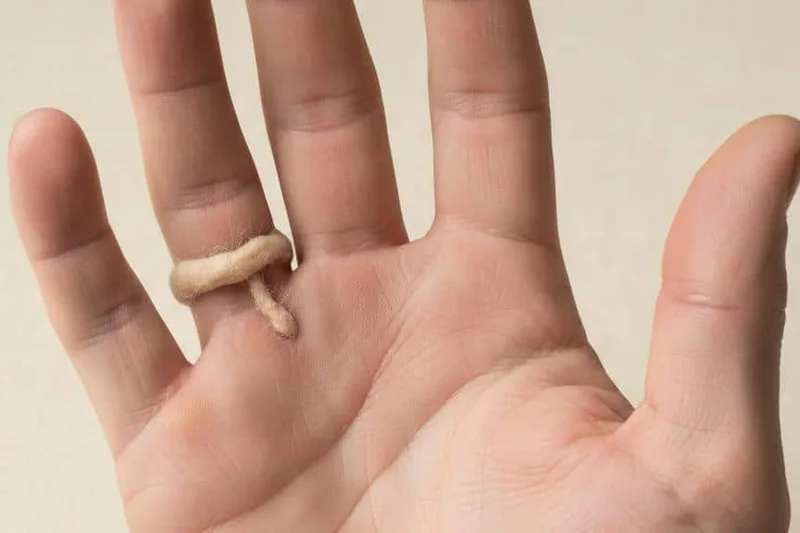
Take a look at your palm. Sometimes you can feel something like a small lump under the skin of your palm. At first, it may not seem like much, but over time, this causes your fingers to curl inward, as if you are clenching your fist. Do you find it difficult to straighten your hand, put it in your pocket, or even shake someone's hand? This condition is what we medically call Dupuytren's Disease or Dupuytren's contracture. Let's talk about this simply and clearly.
What is Dupuytren's Disease?
Simply put, there is a layer of tissue under the skin of our hands. We call this fascia . This is usually very loose and flexible. It is the flexibility of this tissue that allows us to bend and extend our hands in any way we want.
However, in Dupuytren's disease, this tissue called `fascia` gradually thickens and begins to tighten for no apparent reason.
Imagine, inside this tissue there are fibers that are like ropes. In this disease, these fibers gradually tighten and begin to contract. That's when the fingers gradually start to pull in towards the palm. Most often, this condition affects the pinkie finger and ring finger . Sometimes, both of your hands can be affected. But usually, one hand is more affected than the other. In severe cases, the hand can become completely paralyzed and deformed.
What are the symptoms of this disease? How to recognize it?
The symptoms of Dupuytren's contracture don't come on suddenly. They usually appear gradually, over time. Let's take a look at what those stages are.
| Phase of the symptom | What Happens & How It Feels |
|---|---|
| Nodules | This is the first symptom that many people experience. It looks like small, hard lumps under the skin of the palm. At first, these lumps may be a little painful and sensitive to the touch. However, over time, the pain and sensitivity usually go away. |
| Cords | Over time, these lumps begin to form tight, rope-like bands under the skin. These are not flexible. These tight, rope-like bands are what cause the fingers to gradually bend and pull toward the wrist. |
| Contracture | When the finger flexion becomes severe, it becomes impossible to straighten them completely. This makes it very difficult to perform everyday tasks such as picking up large objects, reaching into a pocket for money or an ID, straightening a hand on a table, putting on gloves, or shaking hands with someone. |
What are the causes and risk factors for this?
The exact cause of this disease is still unknown, but scientists believe that several biochemical factors that affect the connective tissue in the hand are involved.
The important thing is that it is not caused by injury or overuse of the hand. Nor is it a disease that affects the tendons that help move the hand.
However, several factors have been identified that increase the risk of developing this disease. They are:
- Excessive alcohol consumption: But remember, not everyone with this disease is addicted to alcohol.
- Having diabetes.
- Having diseases that cause seizures, such as epilepsy.
- Smoking.
- Having this disease in someone in the family: This means there may be some hereditary link to it.
- Being a man over the age of 40: This disease is more common in men than women.
- Having Northern European (English, Irish, Scottish, French, Dutch) or Scandinavian (Swedish, Norwegian, Finnish) ancestry: This is not a very relevant issue for people in our country, but it's good to know.
How does the doctor diagnose this? (Diagnosis)
When you go to see a doctor, he will first ask you about your symptoms, your health history and that of your family, and then carefully examine your hands, wrists, and fingers.
In this test, the palm is examined for lumps and how many there are. Also, the main test that is usually done is to see if the hand can be placed flat on a table (tabletop test). A person with this disease usually cannot keep their hand completely flat on a table.
In addition, the doctor may check things like:
- It will see how well you can handle things.
- It shows how to pinch small objects with your fingers.
- The sensation in the thumb and other fingers is measured.
- The range of motion of the fingers is checked to see if they can be fully straightened.
The doctor may also take pictures of your hand to see if the condition changes over time.
What are the treatments for this?
The first thing to say is that there is no cure for this disease. But don't worry, it is not a life-threatening disease. Some people can live with it for years without any problems. Sometimes, they may never need treatment.
However, if the lumps are causing pain, or if the finger twitching is interfering with your daily activities, there are treatments that can be done.
Important: Splints will not help with this condition. In fact, if you try to forcefully straighten your finger, it can make it sprain even faster. So don't do such things without consulting a doctor.
Non-surgical treatment
- Steroid injection: If a lump is very painful, your doctor may prescribe a corticosteroid injection. This is a strong anti-inflammatory drug. It reduces swelling and pain. It can sometimes stop a finger from getting worse. However, this injection will not straighten a finger that is already bent.
- Enzyme injection: If your fingers are already bent, your doctor may inject you with an enzyme mixture called `collagenase` (Xiaflex). These enzymes help dissolve the thickened, stiff tissue. This weakens the tight, rope-like bands, allowing the doctor to manipulate your fingers a little.
Surgical treatment
If the condition continues to worsen and severely interferes with hand function, the doctor may recommend surgery.
- Fasciotomy: This surgery involves cutting and separating the thick, cord-like tissue. This allows the finger to move freely. The doctor numbs the area and makes a small incision in the palm.
- Subtotal palmar fasciectomy: In this, as much of the thickened tissue and cord-like structures as possible are removed. This allows the finger to straighten. This usually involves making a "zig-zag" incision in the palm. This is a bit more complicated than other surgeries. It also takes longer to heal. Physical therapy and sometimes even a skin graft may be needed after surgery.
There may be swelling and some pain in the hand after surgery. Keeping the hand above the level of the heart and flexing and extending the fingers can help reduce swelling and pain and help the healing process go faster.
When should you see a doctor?
Although Dupuytren's disease is not a dangerous condition, it can be disabling if it becomes severe. Therefore, if you have the following symptoms, do not delay seeing a doctor.
| If you have these symptoms, definitely see a doctor. |
|---|
| If you have one or more lumps on your palm (whether painful or not). |
| If you have difficulty straightening your fingers. |
| If you have difficulty holding large or small items. |
| If you can't place your hand flat on a table or put your hand in a pocket. |
Take-Home Message
- Dupuytren's disease is a condition in which the tissue under the skin of the hand thickens and the fingers curl inward. It is not a life-threatening condition.
- The main symptoms are lumps in the palm, difficulty straightening the fingers, and difficulty performing daily tasks.
- Although there is no specific cause for this, diabetes, smoking, and genetic factors increase the risk.
- Treatment is only necessary if symptoms interfere with daily life. There are various treatments available, such as injections and surgery.
- If you have these symptoms, don't panic and see a doctor as soon as possible for advice. That's the best thing to do.




💬 Comments (0)
No comments yet. Be the first to share your thoughts here.
Add Your Comment