
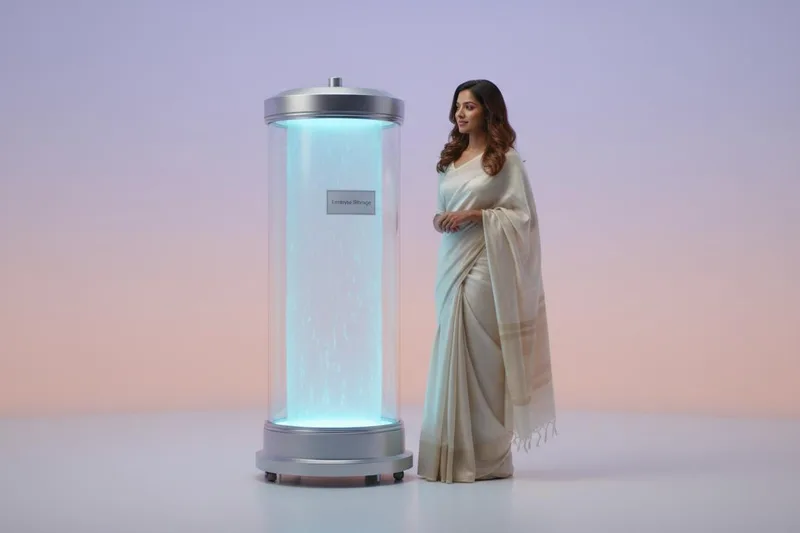
Dreaming of becoming a mother or father is one of the biggest hopes in life for almost everyone. But sometimes, due to educational activities, busy work, various health problems, or other personal reasons, this dream has to be postponed. So, it is normal to have a fear in the corner of your mind, "Will the ability to have a child decrease with age?" But today's advanced medical science has good solutions for this too. One such solution is embryo freezing, or as we say in English, `Embryo Freezing`.
Simply put, what is embryo freezing?
This is a very simple concept. An embryo is an egg that has been fertilized by a sperm. Embryo freezing, or in medical terms ``Cryopreservation,'' is the process of storing these embryos in a very cold place without damaging them, so that they can be used at a later date.
This method is usually used among those who are undergoing treatment for infertility. For example, in vitro fertilization (IVF) or intracytoplasmic sperm injection (ICSI) treatments, usually several embryos are created. So, at that time, the required number of embryos can be transferred to the uterus, and the remaining embryos in good condition can be frozen in this way.
So, who wants to do something like this?
There are several reasons why you might want to consider this method:
- Embryos left over after IVF treatment: As mentioned earlier, good quality embryos left over after IVF treatment can be stored in this way for use in the future if you want to adopt another child.
- If treatment needs to be postponed: Sometimes, if there is a reason why the fertilized embryo cannot be transferred to the uterus right away (e.g., a problem with the uterus), it can be frozen in this way and used later.
- Fertility Preservation: This is a very important issue. For example, a woman who is undergoing chemotherapy or radiation therapy for a condition like cancer may have an impact on her ability to have children in the future. In such cases, embryos can be created from her own eggs and her partner's sperm before treatment begins, and they can be frozen.
- Personal reasons: Some people postpone having children for reasons such as their education or career goals. Since fertility declines with age, they may decide to freeze and store embryos in advance.
The most important thing is that this is a very personal decision. It is essential to discuss everything openly with yourself, your partner, and your doctor before making this decision.
What is the difference between Egg Freezing and Embryo Freezing?
These two are something that many people confuse.
- Embryo Freezing: This involves freezing an egg (embryo) that has already been fertilized by a sperm .
- Egg Freezing: This involves freezing unfertilized eggs . These can be combined with a sperm at a later date to create an embryo.
How does this process happen?
Before going through this process, you and your partner must provide written consent. The documents provided should clearly state the following:
- Number of embryos to be frozen.
- How long have they been stored (usually about 10 years).
- What to do when that time expires.
- What to do with the embryos if something happens to you (such as death) during the storage period.
- What they can be used for (whether for your own treatment only, or whether you allow them to be donated to another couple or for research).
Then, the doctor decides at what stage of development the embryo will be frozen. There are two main stages for this:
1. Cleavage stage: About 72 hours after fertilization, the single cell has divided into 4-8 cells.
2. Blastocyst stage: 5-7 days after fertilization, when 200-300 cells have divided.
There are two main methods for this process. Let's look at both of them in this table.
| Methodology | How it happens |
|---|---|
| Vitrification (The most commonly used method today) | Here, a special liquid called ``cryoprotective agent (CPA)`` is added to the embryos to prevent damage, and they are immediately placed in liquid nitrogen and stored at a very low temperature of -196°C. This is a very fast process. |
| Slow Freezing (A method not widely used now) | Here, a small amount of CPA is added, the temperature is slowly lowered over a period of about two hours using a special machine, and then stored in liquid nitrogen. |
Regardless of the method, the embryos are stored in very small straw-like containers, labeled with your unique information.
What's really amazing is that when you freeze an embryo, the biological age of that embryo stops. That means, if you freeze an embryo at age 35 and use it at age 50, that embryo is still 35 years old!
What are the risks of this?
As with any medical procedure, there are some risks, but research has shown that a baby born from a frozen embryo is not at increased risk of birth defects or health problems .
The main risks are:
- Embryos can be damaged during freezing or thawing. Not all embryos survive this process.
- Pregnancy does not occur after the frozen embryo is placed back into the uterus.
- According to some studies, pregnancies resulting from frozen embryos may have a slightly increased risk of developing conditions such as preeclampsia in the mother.
- If more than one embryo is implanted in the uterus, there is a possibility of having twins or triplets .
Your doctor will inform you well about all of this.
What happens if I change my mind?
You or your partner have the right to change your mind at any time during this process. If one of the parents does not want to, the embryos cannot legally be used. If this happens with embryos that have already been frozen, the clinic will give you a certain amount of time, but if the decision does not change, the embryos will be removed from storage and destroyed.
What do I do with the embryos I don't use?
If you don't want the remaining embryos, you have several options:
- You can request that they be destroyed .
- You can donate to another couple who is suffering from childlessness.
- You can donate to medical research .
- Donations can be made for educational purposes (e.g., to train future doctors).
All of this should be clearly stated in the consent form you sign first.
Take-Home Message
- Embryo Freezing is an advanced medical technique that can provide hope for adopting a child in the future.
- This is a very personal decision involving costs, risks, and a lot of personal emotion.
- Before making a decision like this, it is essential that you and your partner talk carefully with your doctor and get all the information.
- The success of this process depends on many factors, so don't expect it to be 100% successful.
- Please read and understand all the documents provided before the process, and give your consent.


💬 Comments (0)
No comments yet. Be the first to share your thoughts here.
Add Your Comment