
Your doctor may have ordered an endoscopy or ultrasound scan for your stomach ache or other medical condition. But sometimes, there are things that can't be found with either of these tests and need to be looked at more deeply. That's when doctors refer you to a special test called an "endoscopic ultrasound." Hearing this name may sound a little scary, but it's not as difficult as you might think. Let's talk about everything in simple terms today.
Simply put, what is endoscopic ultrasound (EUS)?
This is actually a combination of two technologies. That is, an endoscopy and an ultrasound scan .
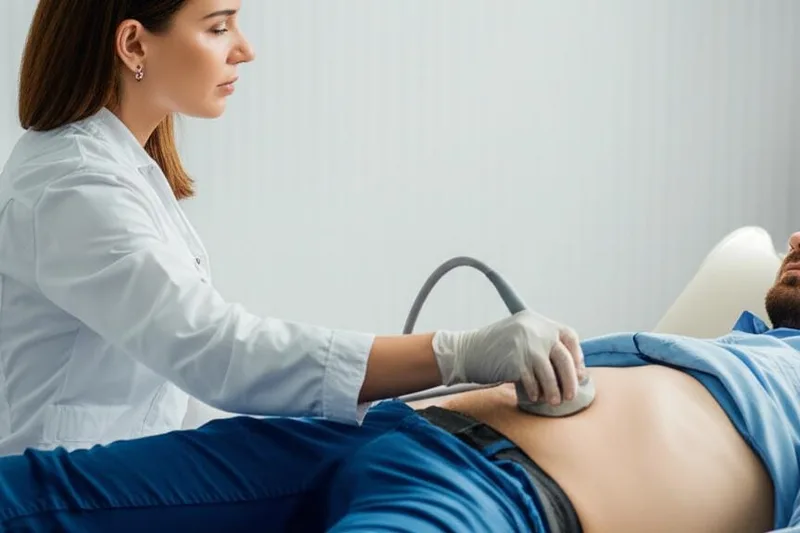
Imagine, during a regular ultrasound scan, the doctor places a small instrument on your abdomen and looks at the organs inside your body. It's like shining a flashlight into a room. You can see some things, but not everything is clear.
But in this endoscopic ultrasound (EUS) , a thin, flexible tube with a camera attached (we call this ``Endoscope'') is inserted through the mouth or rectum, and a small ultrasound device at the end of the tube is used to look at the organs inside the body. Simply put, it's like taking that torch into the room and looking. Then we can get very close to the organ we want to examine, so the images we get are very clear and detailed.
This method is very helpful in accurately detecting very small tumors, changes in glands, and even the early stages of cancer that are not detected by a regular scan.
Under what circumstances would a doctor ask you to do this test?
EUS testing is not usually done for everyone. It is used in special cases where other tests cannot provide a clear conclusion and require in-depth study.
| Checking status | A simple explanation |
|---|---|
| Stage and spread of cancer | This helps to see very accurately how deep a cancer tumor in the esophagus, pancreas, or lungs has gone and whether it has spread to nearby lymph nodes. This is very important for planning treatment. |
| Pancreatic Diseases | EUS is used to study conditions such as chronic pancreatitis , tumors, or small fluid-filled sacs (cysts) in the pancreas. |
| Ulcers in the digestive tract | This is used to find out exactly what small lumps (nodules) or tumors are on the wall of the digestive tract, whether they are dangerous or not, and to take a small part of it for examination (biopsy) if necessary. |
| Gallbladder and liver problems | This helps to get a clear picture of conditions such as gallstones, bile duct blockages, or some tumors in the liver. |
| Difficulty controlling bowel movements | Some people experience fecal incontinence without even realizing it. EUS is used to determine the cause of this and to check for any weakness or dysfunction in the muscles around the anus. |
Okay, now let's see how this test is actually done.
The biggest question you may have about this test is whether it hurts or is uncomfortable. The answer is, you won't feel any pain or discomfort . This is because you will be anesthetized and will feel a little sedated.
Before the test
Your doctor will advise you on how many hours you should fast before the test. Usually, you will need to abstain from eating or drinking for about 6-8 hours. It is very important to inform your doctor about any other medications you are taking.
During the test
1. Anesthesia: First, you will be given an anesthetic drug through an injection into a vein. This will put you in a light sleep-like state. So you won't feel or remember anything.
2. Insertion of the endoscope: Next, the doctor carefully inserts the EUS instrument (a thin, flexible tube) through your mouth (looking at the upper part of the esophagus) or through your rectum (looking at the lower part of the esophagus).
3. Examination: Once the device is inserted, the doctor views the camera images on one monitor and the ultrasound images on another. This way, the walls of the digestive tract, pancreas, and surrounding organs, such as the gallbladder, are examined very clearly.
4. Biopsy: If there is any suspicious area, a very small needle can be passed through the EUS device and a small piece of tissue can be taken from that area for examination. This is called `(Fine-Needle Aspiration)`. You will not feel this at all.
This entire test can usually take between 30 and 90 minutes .
After the test
After the test, you will be kept in a recovery room for an hour or two while the anesthesia wears off. You may feel a little sleepy. So you will definitely need someone to take you home. You can usually go home the same day. If the test was done through the mouth, you may have a slight scratchy feeling in your throat for a day or two, which is normal.
Is there a risk in this?
EUS is a very safe procedure . Complications are rare. If they do occur, they can include:
- Allergy to anesthetic drugs.
- If a biopsy is taken, there may be slight bleeding from the site.
- There is a very rare chance of infection.
But remember, these are very unlikely to happen . Your doctor is trained to manage all of these. If you have severe stomach pain, fever, vomiting, or heavy bleeding after the test, you should call your doctor right away.
Take-Home Message
- Endoscopic ultrasound (EUS) is a special test that provides much clearer and more detailed images than a regular scan.
- This is done under anesthesia, so you won't feel any pain or discomfort.
- This is a great help in diagnosing complex diseases of the digestive tract, pancreas, and surrounding organs.
- This is a very safe test. The risk of complications is very low.
- If you have any further questions about this test, don't hesitate to ask your doctor.


💬 Comments (0)
No comments yet. Be the first to share your thoughts here.
Add Your Comment