
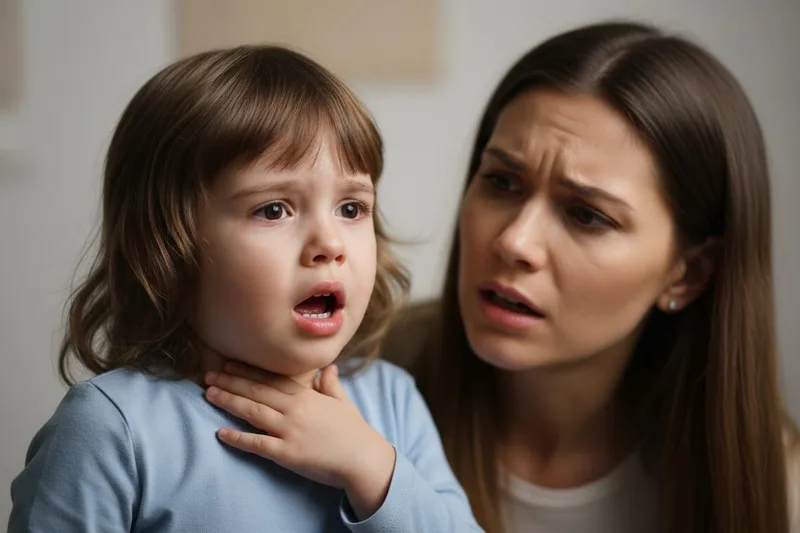
Imagine your little one playing nicely and suddenly having trouble breathing, saliva starts coming out of his mouth, and his voice changes when he speaks. Or an adult suddenly has a severe sore throat for two or three days and can't breathe. This is never something to be trifled with. This dangerous, emergency condition could be caused by a condition called Epiglottitis. This can be life-threatening, so let's be aware of this.
What is Epiglottitis? Let's understand it simply.
Simply put, there is a small flap of cartilage in our throat, just behind the tongue. This is what we medically call the epiglottis . Its main function is to prevent food and drink from going straight into our windpipe (trachea) and into our esophagus. It works like a lever that switches tracks on a road.
So, Epiglottitis is when the epiglottis suddenly becomes swollen, red, and inflamed, either due to an infection or some other reason.
Now imagine, what happens if this flap over the airway swells up? The airway, the trachea , becomes completely blocked. Then you can't breathe. Since the airways of young children are very narrow anyway, this swelling is very dangerous for them. That's why it's considered a medical emergency.
The most important thing is, if you have these symptoms, don't even think about boiling coriander leaves at home or trying other home remedies. You should take the person to a hospital's Emergency Treatment Unit (ETU) as soon as possible.
How common is this condition?
Epiglottitis is not a very common disease, but it can occur in people of any age.
In the past, that is, before 1985, this disease mostly occurred in children between the ages of 3 and 5. The main cause of this was the bacterium Haemophilus influenzae type b (Hib) . But now the Hib vaccine has been included in the national vaccination program given to children at an early age in our country. You may remember the pentavalent vaccine given to children at 2, 4, and 6 months. That also provides protection against this Hib infection. That is why this disease is now very rarely seen among children.
But surprisingly, this condition is now being seen more frequently among adults. It is not caused by the Hib bacteria, but by other types of bacteria, such as Streptococcus pneumoniae and Staphylococcus .
What are the symptoms of epiglottitis? How to get rid of it?
These symptoms often come on suddenly and can become severe very quickly within a few hours. Young children, especially, can develop these symptoms without warning because their airways are very narrow. Adults may have symptoms that last for a day or two, such as a sore throat, and then become severe.
There are 4 main symptoms that doctors use to diagnose this disease. These are also known as the "4 D's".
| The "D" Symptom | Simply meaning |
|---|---|
| Dysphagia | Difficulty swallowing: This is not like a normal sore throat. It feels so painful that you can't even swallow a drop of saliva. |
| Dysphonia | Voice changes: The voice becomes hoarse, or very soft, like speaking in a whisper. Some people call this a "hot potato voice," as if you are speaking with a hot potato in your mouth. |
| Drooling | Drooling: The severe pain in the throat makes it impossible to swallow saliva, so saliva inadvertently escapes from the mouth. |
| Distress | Difficulty breathing: Difficulty breathing, feeling suffocated. Chest pulls in when breathing. Patient appears very agitated. |
In addition to these main features, several other features can be seen:
- An unimaginably severe sore throat .
- Fever greater than 38 degrees Celsius (100.4 Fahrenheit).
- A low, high-pitched sound, like a 'whoosh', is heard when breathing.
- Young children, especially, tend to open their mouths, lean forward, and place their hands on their knees to help them breathe. We call this the 'tripod position'. This is a very important characteristic.
- The child is very restless and agitated .
These symptoms can sometimes be similar to other illnesses, such as croup. However, croup usually involves a cough, and croup is not always this serious. Therefore, it is important to see a doctor immediately to properly differentiate and treat the two.
What causes epiglottitis?
The main cause of this is bacterial infection, but there may be other causes as well.
- Bacterial infections: As we discussed earlier, this can be caused by Hib bacteria in children, and other types of bacteria in adults.
- Viral infections: Sometimes, when we have viral infections like chickenpox (varicella-zoster virus) and herpes (herpes simplex virus), our immunity is weakened and a bacterial infection can easily enter through it.
- Fungal infections: People with very weak immune systems (e.g., HIV-infected people, patients undergoing cancer treatment) are also more likely to develop this condition due to fungal infections such as Candida.
- Throat damage: This condition can be caused by a hard blow to the throat, choking on something sharp (like a fish bone), or suddenly drinking a very hot liquid, like a cup of tea.
- Smoking: Regular smoking, vaping, or inhaling drug smoke such as crack cocaine can also be a cause.
- Chemicals: This condition can occur after drinking a toxic chemical (e.g., acid) that burns the throat.
Is this disease contagious?
Epiglottitis is not spread directly from person to person. However, the bacteria or virus that causes it can be spread. The germs are spread through droplets that enter the air when someone coughs or sneezes. However, you don't necessarily have the germs when you develop epiglottitis. It only happens if the germs get into your epiglottis and cause an infection.
How is diagnosis and treatment done in the hospital?
Since this is an emergency, the first thing doctors will do when you are brought to the ETU is to stabilize your breathing rather than to find out what the illness is. Because saving your life is the first priority. Once your breathing is stabilized, the following tests may be done to help diagnose the condition:
- Throat examination: A specialist doctor uses a thin tube with a camera (laryngoscopy) to examine the inside of the throat and directly check for swelling of the epiglottis.
- X-rays: On an X-ray of the side of the neck, the swollen epiglottis looks like a thumbprint sign .
- Blood and throat swab tests: Blood tests are used to check for infection in the body. A throat swab is also sent to a laboratory to identify the exact bacteria or virus causing the infection.
Three main steps are followed during treatment.
| Treatment steps | What is being done |
|---|---|
| 1. Securing the airway | First, an oxygen mask is put on and extra oxygen is given. If the airway is severely blocked, a tube is inserted through the mouth into the windpipe (intubation) with the help of an anesthesiologist. If this is not possible even in an emergency, a small incision is made in the neck and a tube is inserted into the windpipe. This is called a tracheostomy. But this is not often necessary. |
| 2. Giving saline and fluids | Fever and difficulty swallowing can cause dehydration. To prevent this, saline is given into a vein (IV drip). |
| 3. Antibiotics | The main reason for this is a bacterial infection, so the right antibiotics are injected into the vein. Based on the test results, the medicine that is suitable for the exact bacteria that caused the infection is given. |
How long does it take to heal and how can I protect myself?
It usually takes about a week to fully recover. You will have to stay in the hospital for about three to five days. Even if a tube is inserted to help with breathing, it will be removed after two to three days when the swelling has gone down and you will be able to breathe on your own.
The most important thing is that you must complete the full course of antibiotics prescribed by your doctor (usually 7 days). It is not a good idea to stop taking them halfway just because the pain has subsided. Doing so can cause the infection to come back.
Although it is not possible to completely protect yourself from this condition, you can do the following to reduce your risk:
- Vaccination: Make sure your child gets the five-component vaccine, including the Hib vaccine, at the appropriate time. It is the best way to protect children.
- Good hygiene: Wash your hands thoroughly with soap and water regularly. Avoid touching your eyes, nose, and mouth unnecessarily.
- Protect yourself from infections: Stay as far away from people who are coughing and sneezing as possible.
- Avoiding things that can damage your throat: Avoid things that can damage your throat, such as drinking very hot things and smoking.
Take-Home Message
- Epiglottitis is a life-threatening medical emergency in which the epiglottis, a part of the throat, suddenly swells and blocks breathing.
- Difficulty swallowing, voice changes, drooling, and difficulty breathing are the main symptoms.
- If you notice one or more of these symptoms, take the patient to a hospital's Emergency Treatment Unit (ETU) without delay. Do not attempt to treat at home.
- The Hib vaccine given to children has largely prevented the occurrence of this disease among children.
- No matter how serious this condition is, most people make a full recovery if they receive timely and proper treatment . The most important thing is to act quickly.




💬 Comments (0)
No comments yet. Be the first to share your thoughts here.
Add Your Comment