

Have you ever noticed that your legs, especially the ankles, have red, painful, and small bumps that appear on them? Sometimes, these can come with a fever and a feeling of weakness. This is the skin condition we are going to talk about today called `(Erythema Nodosum)`. There is nothing to be afraid of, once you know about this properly, a lot of things will become clear.
So what is this `(Erythema Nodosum)`?
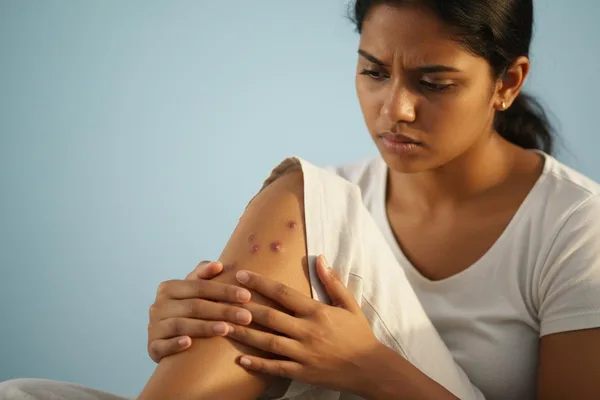
Simply put, `(Erythema Nodosum)` is an inflammation of the fat layer under our skin. Think of it like something inside our skin is swelling. What happens in this is that red, slightly warm, and tender nodules appear on your legs, especially on the shins below the knees. These nodules can appear not just one or two, but sometimes several at once. The most important thing is that this is not a disease that just happens. Most of the time, it occurs as a `reactive process` to some other disease, infection, or medication in the body. In other words, these nodules can be an outward sign of some other problem inside the body.
Who can develop this `(Erythema Nodosum)`?
In fact, this condition can occur at any age, in anyone. However, studies have shown that women are more likely to develop it. Among them, it is most common among young women between the ages of 20 and 30. However, it is not impossible for men, children, and the elderly to develop it.
Now you may be wondering, 'Will this happen to me too?' Here are some people who are at a slightly higher risk of developing it. For example:
- If you have an infection (e.g., a sore throat, a chest infection).
- If you have a condition like Inflammatory Bowel Disease (IBD).
- If you are taking certain medications (we will talk about this in more detail later).
In such cases, the possibility of developing `(Erythema Nodosum)` is relatively high.
How common is this?
Actually, `(Erythema Nodosum)` is not a very common disease. According to statistics, it is estimated that between one (1) and five (5) people out of a hundred thousand develop it. This means that not everyone around you will experience it. However, it is not good to ignore it because there may be another reason behind it.
How does Erythema Nodosum affect my body?
The main thing that happens is that your skin develops lumps (`nodules`). These lumps are tender to the touch, and sometimes painful to just hold. They also feel a little warm to the touch. This can make the area where the lumps are located very uncomfortable. Imagine how painful it would be if it hurt so much that you couldn't even put your foot down.
Another thing is that as these bumps heal, you may notice that they change color . They may start out red, then turn purple, and then brown. It looks like a bruise. Eventually, your skin will return to its normal color. This color change is normal, so don't worry about it.
What are the symptoms of `(Erythema Nodosum)`?
These symptoms can vary from person to person. Some may feel it very strongly, while others may feel it a little less.
The main symptoms are those that are visible on the skin:
- The appearance of skin lumps (`nodules`): These are the main symptom.
- Lumps become warm and change color: Warm to the touch. Red at first, then turns purple, like a bruise.
- The lumps are painful: They hurt when touched or just when you are there.
- Flattening and changing color as the bumps heal: Over a few weeks, these bumps gradually flatten out, turning from purple to brown, and then disappear completely.
In addition to this, other symptoms may appear:
- Fever: You can get a fever due to the body getting hot.
- Malaise: A feeling of weakness and discomfort, as if you are about to get sick.
- Fatigue: Just feeling tired, to the point of not being able to do anything.
- Joint pain: Joint pain can occur in the limbs. Think about it, it's not just a joint pain, it can also make it difficult to walk. For example, some people have pain in places like their knees and ankles.
Important: If you have one or more of these symptoms, it's best to seek medical advice. Don't just stay home.
Which part of the body do these symptoms affect the most?
Most often, `(Erythema Nodosum)` bumps are seen on the front of the legs (shins) below the knees. That is, in the area of your shins. But, that's not all. Sometimes these bumps can appear on other parts of the body as well. For example:
- Other parts of the legs (Legs)
- Buttocks
- Calves
- Ankles
- Thighs
Therefore, you should be careful if you notice bumps like this not only on your legs, but also in the other places mentioned.
What are the causes of `(Erythema Nodosum)`?
In fact, it is sometimes difficult to say exactly what causes `(Erythema Nodosum)`. However, most of the time, it appears as a reaction of the body to something else. That is, it may not be the main cause, but rather a consequence .
Sometimes, no matter how much testing is done, no cause can be found. In medicine, we call such cases ``idiopathic.'' That means that no cause can be identified .
However, in most cases, there are several things that can cause this:
1. Infections
Erythema Nodosum can be caused by a variety of infections. Some of the most common types of infections are:
- Streptococcus infections: These are the bacteria that cause sore throats and swollen tonsils. Sometimes, after an infection like this has healed, Erythema Nodosum can develop. Imagine your child has a sore throat and a few days later develops red bumps on their legs.
- Viral upper respiratory infections: Viral infections like the common cold and flu.
- Tuberculosis (TB): This can also be a cause of Erythema Nodosum.
- Hepatitis B: A viral infection that affects the liver.
- Coccidioidomycosis: This is a fungal infection that is not very common in Sri Lanka.
- Bacterial gastroenteritis: Like stomach flu.
2. Other underlying medical conditions
Sometimes, `(Erythema Nodosum)` appears as a symptom of another disease in the body. Some such diseases are:
- Ulcerative colitis and Crohn's disease: Both belong to the category of inflammatory bowel disease (IBD) . These are long-term inflammatory conditions that affect the large intestine and small intestine.
- Sarcoidosis: This causes small collections of inflammatory cells (granulomas) to form in various organs of the body.
- Rheumatic fever: A condition that can occur after a streptococcus infection and affects the heart, joints, brain, and skin.
- Behçet's disease: This can cause mouth sores, genital sores, skin problems, and eye inflammation.
- Sweet's syndrome: A rare condition that causes fever and painful skin lesions.
- Pregnancy: Don't be surprised, some pregnant mothers can also experience this condition.
- Leukemia and Lymphoma: These are types of cancer.
3. As a side effect of some medications
Some medications you take can also cause `(Erythema Nodosum)`. Some such medications include:
- Antibiotics: Especially sulfonamides and penicillins.
- Birth control pills.
Very important: If you think this condition is caused by a medication you are taking, do not stop taking it without talking to your doctor. Stopping the medication suddenly can cause other problems.
Is Erythema Nodosum an autoimmune disease?
This is a problem that many people have. `(Erythema Nodosum)` is not an `autoimmune condition`.
Simply put, an autoimmune disease is when our own immune system - the system that protects us from disease - mistakenly starts attacking our own healthy cells and tissues. It's like attacking our own home.
However, this is not the case with `(Erythema Nodosum)`. What happens in this case is that the body's reaction to another cause (an infection, another disease, a medication) causes inflammation in the fatty layer under the skin. Therefore, do not confuse the two.
How to recognize `(Erythema Nodosum)`?
If you have symptoms like these, the first thing a doctor will do when you see a doctor is to do a physical exam . He or she will ask about your symptoms, how they started, any other medical conditions you have, and any medications you take.
Most of the time, the doctor can diagnose Erythema Nodosum based on the appearance of these bumps and the details you provide.
However, sometimes certain tests may be needed to confirm the diagnosis and find the underlying cause . Such tests include:
- Culture tests or blood tests: These can help determine if there is an infection. For example, a strep throat infection or other bacterial or viral infections.
- Chest X-ray: This can help check for lung infections such as tuberculosis. It may also show signs of conditions such as sarcoidosis.
- Skin biopsy: This involves taking a very small piece of skin from the area of the lump and examining it under a microscope. Not everyone needs this. This test is done if there is doubt about the diagnosis, or if it is necessary to differentiate it from another skin disease.
How to treat `(Erythema Nodosum)`?
The treatment for this can vary from person to person, mainly because it depends on the cause of your symptoms.
There are several possible treatment options:
- Treating the underlying condition or infection: For example, if you have Erythema Nodosum due to a streptococcal infection, you will need to be given antibiotics for that infection. If you have tuberculosis, you will need to start treatment for that. If you have inflammatory bowel disease (IBD), you will need to be given medication to control it. When the underlying cause is treated, Erythema Nodosum often resolves.
- Stopping the medication that caused the symptoms (only on medical advice!): Sometimes, if these lumps are caused by a medication you're taking, your doctor may stop the medication or switch you to a different medication. However, never stop taking your medication without your doctor's advice.
- Taking medication to reduce symptoms: Medication can be given to reduce pain and swelling (we'll talk about this in a bit).
- Elevating the affected body part: For example, if you have a lump in your leg, prop your leg up on a pillow while you lie down. This will help reduce swelling.
- Rest and avoid strenuous activities: It is very important to give your body rest. Stay away from running, jumping, and heavy lifting for a while.
Good news! In most cases, Erythema Nodosum will resolve on its own within a few weeks or months without any specific treatment. However, if there is an underlying cause, it is essential to treat it.
What are the medications given to control the symptoms of `(Erythema Nodosum)`?
While treating the underlying cause, doctors also prescribe medications to control symptoms such as pain and swelling caused by these lumps.
- Nonsteroidal anti-inflammatory drugs (NSAIDs): These are the most commonly used medications to reduce swelling and pain. Examples include ibuprofen and naproxen. However, these should only be taken as directed by your doctor and in the recommended dosage.
- Anti-inflammatory medications (e.g., corticosteroids): If the swelling is very high and the pain is severe, sometimes corticosteroids (e.g., prednisolone) can be given for a short period of time. These quickly reduce inflammation.
- Potassium iodide solution: This is another medicine used to reduce inflammation. It is not given to everyone, only if the doctor thinks it is necessary.
- Analgesics: You can use something like paracetamol for minor pain. However, if you are being given NSAIDs, these may not be necessary.
Again, please use all of these medications only under the advice and supervision of a doctor.
Are there any foods and drinks that should be avoided when you have `(Erythema Nodosum)`?
This is still in the research stage. That is, there is not yet enough evidence to say for sure that eating junk food will reduce this disease, or that eating junk food will increase it.
However, doctors generally recommend eating a healthy, well-balanced diet . That means including plenty of vegetables, fruits, and clean water in your diet. It is good for the body to reduce processed foods that contain artificial flavors, colors, and preservatives as much as possible.
If you feel like your symptoms are getting worse when you eat a certain food, it's a good idea to talk to your doctor about it.
How soon will I feel better after starting treatment?
Once you start treatment, the pain and swelling you feel will gradually start to decrease. That's a good sign.
However, the nodules and their appearance do not disappear overnight. They can remain on the skin for several weeks, perhaps even a month or two. During this time, as we have already discussed, the skin color may change. From red to purple, then brown, and finally your skin returns to its normal color. This is normal, and do not worry about it. These marks will fade with time.
Can the development of `(Erythema Nodosum)` be prevented?
To be honest, Erythema Nodosum is not always preventable, as it can sometimes be idiopathic or a result of another disease.
However, there are several things we can do to reduce the risk of a flare-up of symptoms :
- Avoiding medications known to cause Erythema Nodosum: If you have previously been exposed to a medication that has caused this condition, inform your doctor about that medication and avoid that medication if possible.
- Properly treating and controlling underlying medical conditions: For example, if you have IBD, it is important to get the right treatment and keep the disease under control.
- Stay away from people with viral or bacterial infections: As much as possible, minimize close contact with people who have contagious illnesses like fever, cold, and sore throat. This is a good practice for all illnesses.
What should someone with `(Erythema Nodosum)` expect?
The condition `(Erythema Nodosum)`, once it has developed and healed, can recur throughout life. That means it has the potential to return.
However, if you have these bumps due to an underlying medical condition, treating and controlling that condition properly, or if it is due to a medication, stopping that medication (as directed by your doctor) can greatly reduce the risk of Erythema Nodosum recurring.
Things you can do at home are:
- You can take painkillers such as NSAIDs (e.g. ibuprofen) as prescribed by your doctor (over-the-counter types available at the pharmacy).
- Keep the affected body part elevated. For example, if you have a lump on your leg, keep your leg elevated on a pillow while lying down. This will help reduce swelling.
- Relax.
Important: If your symptoms are severe , meaning they are so painful that you can't even do your daily activities, definitely talk to your doctor. Don't just stay home and suffer.
Is Erythema Nodosum a life-threatening condition?
This is also something that many people are afraid of. No, Erythema Nodosum is not a life-threatening condition. The bumps that appear on your skin and the associated symptoms (pain, swelling) usually go away in a few weeks or months.
But, there's something else here. If Erythema Nodosum is a symptom of another underlying condition, that underlying condition may be life-threatening. For example, tuberculosis, some types of cancer, etc.
However, the bumps on the skin are only a temporary symptom of the underlying disease. Therefore, do not be afraid of `(Erythema Nodosum)` bumps, but the most important thing is to find the cause and treat it.
When should I see a doctor?
If you think you have symptoms of Erythema Nodosum (those red, painful bumps), be sure to see a doctor.
In particular,
- If there is a fever along with skin rashes,
- If you feel very uncomfortable (malaise),
Seek medical advice immediately.
The doctor is the one who accurately diagnoses your condition, finds the cause, and provides the treatment you need to get well soon.
What questions should you ask the doctor?
When you go to see the doctor, it is very important to ask and find out clearly about these things:
- "Doctor, what is causing these symptoms? "
- "If you take medication like `NSAIDs` for pain, how often and how much should you take it? "
- "If I have these lumps because of another illness, how can I control the underlying condition? What should I do about it?"
- "What should I do to prevent this situation from happening again ?"
Ask questions like these and gain a better understanding of your situation. Then you too will feel at ease.
So, what are the things we need to remember from all of this? (Take-Home Message)
The symptoms of Erythema Nodosum, especially those lumps on the legs, can be very painful and interfere with daily activities. They can last from a few weeks to a few months.
During this time, you can:
- Rest well.
- Keep the affected body part (usually the leg) elevated by placing something like a pillow on top of it. This will reduce swelling.
- Take painkillers as directed by your doctor.
Most importantly: Don't just assume "it's okay" when you see these symptoms. Sometimes, Erythema Nodosum can be a sign of another underlying condition that needs to be treated.
So, if you have these symptoms, especially if they are accompanied by fever and body aches, see a doctor as soon as possible. Only then can you find the real cause, get the right treatment, and get well soon. Don't panic, but be careful!
` Erythema Nodosum, skin lumps, leg lumps, skin diseases, inflammation, infections, pain




💬 Comments (0)
No comments yet. Be the first to share your thoughts here.
Add Your Comment