
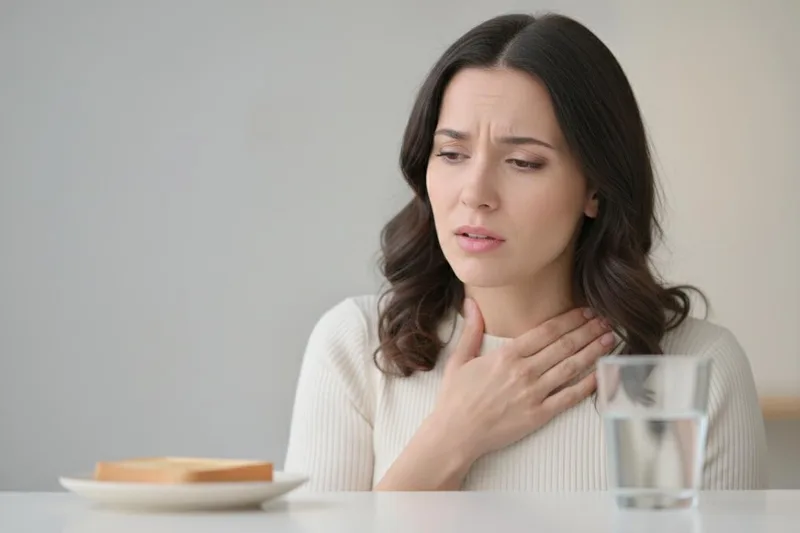
Have you ever had a sudden, sharp pain in your chest, like someone squeezing your throat, while eating or drinking? It feels like food is stuck in your throat? Many people fear that this is a heart attack, but that is not always the case. This could be caused by an abnormal spasm of the muscles in your esophagus. Today, we will talk about esophageal spasms, or ``Esophageal Spasms'', in a simple way that you can understand.
What are esophageal spasms?
Simply put, our esophagus is a tube made of muscles that carries the food we swallow from our throat to our stomach. Normally, when we swallow something, the muscles in this tube contract in a rhythmic manner, like a wave, to push the food down into our stomach. In medicine, we call this process ``peristalsis``.
However, if you have a condition called ``Esophageal Spasms'', the rhythm of these muscle contractions becomes erratic. They either spasm randomly and without any connection, or they spasm excessively and forcefully. Think of it like a water pipe suddenly getting blocked in one place.
When the muscles become stiff and tense, food and drink cannot easily go down. This is when you have difficulty swallowing and feel chest pain. Sometimes, swallowed food can come back up (regurgitate).
Are there main types of this condition?
Yes, there are two main types. It is important to understand these.
| Type of Spasm | Simply put, what happens? |
|---|---|
| Distal (or diffuse) esophageal spasm | In this, the muscles in the lower part of the esophagus mainly contract in a chaotic and uncoordinated manner. This is why it is common to see swallowed food trying to come back up into the throat. |
| Hypercontractile (nutcracker or jackhammer) esophagus | In this case, although the rhythm of the muscle contractions is correct, the contractions occur more forcefully and loudly than usual. Like being hit with a hammer. This can cause severe pain when swallowing and a feeling of tightness in the chest. |
What are the symptoms? How does it feel?
The two main and most common symptoms of this condition are difficulty swallowing (dysphagia) and noncardiac chest pain . However, some people can have this condition without any symptoms.
Very important: The scary thing here is that this chest pain can sometimes feel exactly like a heart attack. So if you have severe, unexplained chest pain that lasts more than five minutes, don't just assume it's something else. Go to a hospital's Emergency Department (ETU) immediately. It's important to first make sure it's not something serious like a heart attack.
Symptoms can be mild, but sometimes severe. For some people, they only occur after eating. For others, they come on suddenly for no apparent reason. They can last for a few minutes or even an hour or more.
| How you feel | Description |
|---|---|
| Chest feels tight/tight | It may feel like someone is pressing down on the middle of the chest, just below the sternum, like a weight is being placed on it. |
| Heartburn | You may feel a burning sensation in your chest. |
| Spreading pain | The pain, which starts in the center of the chest, may sometimes be felt as if it travels to the neck, left arm, or back. |
| Difficulty swallowing (Dysphagia) |
|
Why is this happening? What are the reasons?
In fact, doctors still don't know the exact cause of this. However, it is generally believed that it is caused by a malfunction in the nerves that control the muscles of the esophagus. Like a short in an electrical circuit, the signals from the nerves to the muscles are disrupted.
There are several other factors that can affect this:
- GERD condition: Often, people with this condition also have GERD (Gastroesophageal Reflux Disease). It is believed that prolonged exposure to this acid can damage the nerves in the esophagus.
- Certain medications: New research has found that people who use strong painkillers like opioids for more than three months are also more likely to develop this condition.
Triggers for this rash
For some people, these symptoms are triggered by certain things. You might also be a little concerned about these things.
- When eating or drinking, whether it's very hot or very cold .
- During times of severe stress or anxiety .
- Sometimes when exercising .
But this pain can occur at any time, for no reason.
How do you find this, Doctor?
Because these symptoms are similar to those of many other diseases, it can be a bit complicated to diagnose what exactly is ``Esophageal Spasms''.
1. Making sure you don't have heart disease: When you go to the doctor with chest pain, the first thing the doctor will do is make sure you don't have something serious like a heart attack. For that, they will do tests like an ECG (Electrocardiogram) .
2. Ruling out other common causes: Next, several tests will be performed to make sure there are no other common conditions that could be causing these symptoms.
- Upper Endoscopy: In this, a small, flexible tube with a camera attached is inserted through the mouth and into the esophagus and stomach to look inside. This helps to see if there are any changes, structural defects, or blockages.
- Esophagram (Barium Swallow): In this, you are given a liquid called barium to drink and X-ray images are taken. This allows you to clearly see if there is any blockage or narrowing (stricture) anywhere in the esophagus.
3. Specialized tests: If the cause cannot be found from the above, these tests are performed to determine if this is the exact disease.
- Esophageal Manometry: This is the best and most reliable test (gold-standard) to diagnose this condition. In this test, a very thin tube is passed through your nose and down your esophagus. You are then asked to swallow a small amount of water, and the pressure in the muscles of your esophagus changes as you swallow, and the pattern of contractions is measured. If you have many, unusual contractions that occur at the same time, this is a key sign of this condition.
What are the treatments for this?
The main goal of treatment is to relax the muscles in the urethra and reduce symptoms. If you have no symptoms, you may not need any treatment.
Things you can do at home
Research has shown that peppermint oil can relax the smooth muscles of the esophagus. Adding a few drops of peppermint oil to a glass of water and drinking it may help relieve some minor symptoms. It can also be helpful to find out when and what foods trigger your heartburn and avoid those foods.
Medication
Your doctor may prescribe medications such as these to control symptoms:
- Calcium channel blockers: These are actually medications for high blood pressure. When taken before meals, they relax the muscles in the esophagus, making it easier to swallow.
- Nitrates: Help reduce chest pain.
- Tricyclic antidepressants: When given in low doses, these help reduce pain by controlling pain-sensitive nerves.
Botulinum toxin (Botox®) injections
If other treatments are not successful, a tube is inserted, similar to an endoscopy, and Botox is injected into the muscles of the esophagus. This temporarily deactivates those muscles. Then the spasm stops. However, the effect of this only lasts for about 6 months.
Surgery
This is only done in very severe cases where no other treatment has worked. This surgery is called a ``Myotomy.'' The doctor makes a small cut in the muscles at the bottom of the esophagus. Then, the muscles lose their ability to contract. Then, gravity allows the food to move down.
When should I see a doctor?
This is very important because the symptoms can be similar to a heart attack.
| If you have these symptoms, go to a hospital's Emergency Treatment Unit (ETU) immediately! | |
|---|---|
| |
| If these symptoms persist for more than two weeks, see a doctor. | |
If symptoms such as chest pain or difficulty swallowing persist, do not ignore it as normal and talk to your doctor about it. |
Take-Home Message
- Esophageal Spasms are a condition that causes chest pain and tightness when swallowing food, which can interfere with daily life.
- This chest pain can sometimes feel like a heart attack. Therefore, if you experience sudden, unexplained chest pain, go to a hospital's Emergency Department (ETU) immediately without thinking about anything else.
- Although the exact cause of this is unknown, GERD and certain medications may play a role.
- There are good treatments to control this condition, so if you have symptoms, don't just ignore them and talk to your doctor.
- This is not a serious disease that is life-threatening or causes serious illnesses like cancer. So don't be unnecessarily afraid.


💬 Comments (0)
No comments yet. Be the first to share your thoughts here.
Add Your Comment