
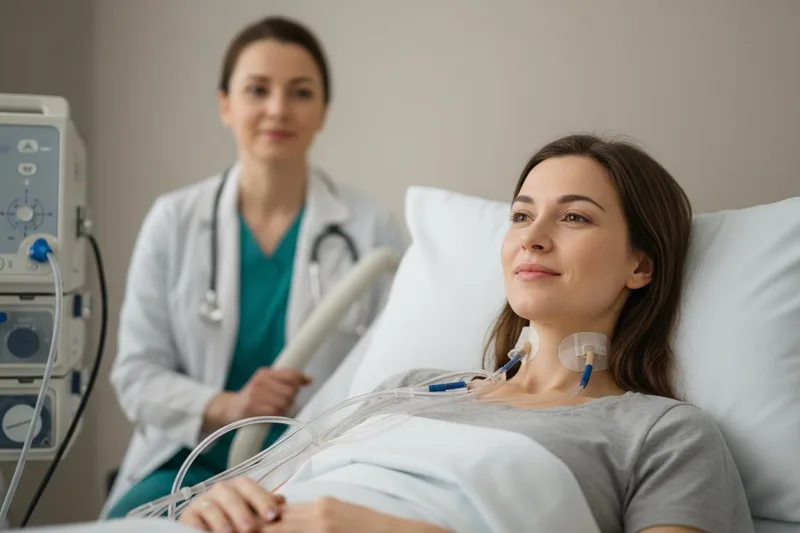
You've probably heard someone in the intensive care unit (ICU) say "they're hooked up to a machine." Most often, this refers to ventilators, but there is a special machine that is used in even more complex, very serious cases. That's what's called ECMO. Okay, let's talk about this today, what exactly it is, how it works, and who is suitable for it.
What is ECMO? How does it work?
Simply put, ECMO (Extracorporeal Membrane Oxygenation) is an artificial life support system outside the body that helps a person's heart and lungs rest and recover when both are not working properly.
Think about it, our lungs add oxygen to the blood and remove unwanted carbon dioxide. Our heart pumps this oxygenated blood throughout the body. Now, if both of these are not working properly, our lives are at great risk.
This is what the ECMO machine does:
1. A tube (cannula) is inserted into a large blood vessel in your neck, chest, or groin, and blood is gradually withdrawn from your body through it.
2. This blood is sent through a pump to a special machine. This machine is like an artificial lung. It adds oxygen to the blood and removes carbon dioxide.
3. Then the clean, oxygenated blood is pumped back into your body through another tube.
In this way, the ECMO machine temporarily takes over the work of the heart and lungs. This means that the sick and tired heart and lungs are given time to rest and heal without any burden. This is like putting a plaster on a broken leg and giving it rest.
ECMO is much more complex than a regular ventilator. A ventilator simply pumps air into the lungs, but ECMO can add oxygen directly to the blood.
When is ECMO treatment necessary?
ECMO is a last resort, used only for very serious, life-threatening patients. Doctors usually consider ECMO in these situations.
| Medical condition | Description |
|---|---|
| Acute respiratory distress syndrome (ARDS) |
|
| Heart damage | |
| Newborn babies | |
| Surgery and organ transplantation |
What are the benefits and risks of ECMO treatment?
Although ECMO is an amazing life-saving device, it also has some risks and complications. It's important to be aware of both.
Main advantages of ECMO
- Rest for the organs: It gives the ailing heart and lungs the rest and time they need to heal.
- Life support: Helps keep the patient alive until something like an organ transplant can be done.
- Newborn Support: Babies with congenital heart or lung problems are given a chance to recover.
Risks and complications of ECMO
Patients receiving ECMO treatment are under constant supervision by specialist doctors and nursing staff in the intensive care unit because of the potential risks involved.
- Bleeding: Bleeding can occur because tubes are inserted into large blood vessels. Also, the risk of bleeding is increased due to medications given to prevent blood clots.
- Clotting: Blood clots can form inside the ECMO machine's tubing. If this clot travels to the brain, it can cause a serious condition such as a stroke.
- Infection: Since the tube is inserted through a puncture in the skin, germs can enter the body and cause serious infections.
- Machine malfunctions: The ECMO machine is a complex device. If there is a technical malfunction, it can be life-threatening for the patient.
- Stroke: There is a risk of stroke due to a change in blood flow to the brain or a blood clot.
How long have you been connected to ECMO?
The length of time someone is connected to an ECMO machine varies from patient to patient. It depends on the medical condition that led to the need for ECMO. Some people may need to be on ECMO for a few days, while others may need to be on ECMO for weeks.
Doctors regularly check the patient's heart and lung function. When the organs show signs of healing, they slowly begin weaning the patient off the ECMO machine. This process usually takes two to five days.
The important thing is that ECMO is not a treatment for someone who has no hope of recovery. It is for someone who has the potential to recover, but needs time and support.
Are there any situations where ECMO cannot be used?
Yes. ECMO treatment is not suitable for everyone. In some cases, the risks may outweigh the benefits of ECMO. ECMO is not usually used in such cases.
- For those with heart or lung diseases that cannot be cured or transplanted.
- If there is irreversible damage to the brain or other major organs, such as the liver.
- If you have metastatic cancer that has spread throughout the body.
- If there is uncontrolled bleeding inside the body, especially bleeding inside the head.
This type of decision is made by a team of specialist doctors after carefully studying the patient's condition. If a loved one has this condition, it is best to ask the treating doctor or physician for detailed information.
Take-Home Message
- ECMO is a life-saving system that works like an artificial heart and lung outside the body.
- This is only used for very serious patients whose heart and lungs have temporarily failed.
- The ECMO machine gives diseased organs a rest, giving them time and opportunity to heal.
- Although this is a very useful treatment, it also carries serious risks such as bleeding, blood clots, and infection.
- Any decisions regarding ECMO treatment are made by specialist doctors. If you have any concerns, talk openly with your doctor.




💬 Comments (0)
No comments yet. Be the first to share your thoughts here.
Add Your Comment