

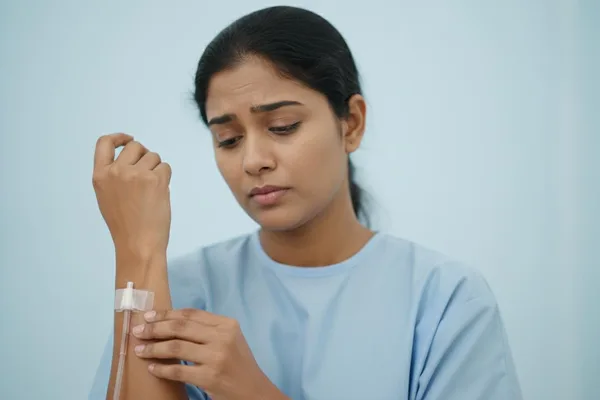
Imagine that you have been given a saline solution for cancer treatment (Chemotherapy). The medicine is gradually going into your body. But suddenly you feel a slight pain and discomfort in the hand where the saline solution was injected, where the needle was inserted. After a while, that area turns red and starts to swell. This is what we call extravasation in medicine. Simply put, the medicine that is supposed to go into the vein leaks out of the vein and into the tissues. This can be a bit of a scary experience for someone undergoing cancer treatment. But don't worry, we will talk about everything clearly and simply.
What is Extravasation? Let's understand exactly.
When you have cancer treatment, or chemotherapy, the medicine is given directly into your vein. We use an IV line, or a small plastic tube (cannula) that is put into a vein in your arm. These medicines are very powerful because they work to kill rapidly dividing cancer cells.
Now imagine what happens if a water pipe gets punctured in a small place? The water leaks out, right? That's what happens here too. For some reason, the medicine given intravenously, instead of traveling inside the vein, leaks out of the vein, into the surrounding tissues like skin, fat, and muscle. This is what we call extravasation .
These drugs, which are powerful enough to kill cancer cells, can damage healthy tissue when they enter it. That's why we need to be concerned about this situation.
But the most important thing to remember is that the entire team, including doctors and nurses, who are treating you are well-trained to prevent this kind of situation from happening and to treat it quickly if it does happen.
What are the symptoms of an extravasation?
These symptoms may appear right after the medication is given. Or they may appear a few days later. Doctors divide this condition into four stages (grades) depending on the severity. It is very important for you to be aware of these symptoms.
| Grade | Symptoms you feel and see |
|---|---|
| Grade 1 | There may be some discomfort and slight swelling at the site of the sting. |
| Grade 2 | Along with discomfort or pain, there may be swelling, redness, and possibly small blisters. |
| Grade 3 | Along with a burning or stinging pain, there is severe swelling, redness, skin discoloration, and blistering. |
| Grade 4 | Severe pain, accompanied by skin lesions, blisters, white or black discoloration of the skin (this indicates tissue damage), and a feeling of coldness when touched. |
Very important: If you experience any of these symptoms while you are being given medication, tell the nurse or doctor treating you immediately. Don't just ignore it. If you experience any of these symptoms after you go home, you should go to the hospital's Emergency Department (ETU) immediately.
Why is this happening? What are the reasons?
Extravasation can occur for several reasons.
- Vein rupture: A weakened vein can burst during the administration of the medication.
- Equipment defects: A leak may occur due to a defect in the IV line or cannula used to administer medication.
- Mistakes in administering medication: Sometimes this condition can occur due to things like the needle not going into the vein properly, or the medication being administered too quickly.
Who is at increased risk for this?
Some people are more likely to develop this condition.
- If you have a condition that weakens your veins (such as Peripheral Artery Disease).
- If the veins have become thick and stiff due to cancer treatment.
- If your veins are very small and delicate.
- If the veins move back and forth when the needle is inserted.
What happens if this condition is not treated quickly?
If an extravasation occurs and treatment is delayed, serious problems can occur. As we discussed earlier, drugs that kill cancer cells also damage healthy tissue. Therefore,
- There may be severe pain.
- Permanent damage to the skin and underlying tissues can occur.
- In some severe cases, the function of that arm or leg may even be affected.
But such serious situations are rare. Because your medical team acts quickly when they suspect something like this, it is your responsibility to alert them to any potential complications.
How do doctors manage this?
The doctors and nurses who give you chemotherapy are specially trained to prevent this condition and to treat it if it occurs. They will take the following steps if they see something like this.
1. Stopping the medication immediately: The medication through the IV line is stopped immediately.
2. Trying to remove the leaked medication: Using a syringe, withdraw as much of the medication that has leaked out of the vein as possible.
3. Give an antidote: If there is an antidote for the type of medication that was spilled, it will be given through the IV line.
4. Removing the IV line: Only then is the IV needle removed and removed.
5. Elevate the affected arm: It is advised to keep the arm elevated, as if on a pillow, to reduce swelling.
6. Applying ointments: You can apply a suitable cream to reduce pain and other symptoms.
7. Cold or hot frying: This is a very important step.
- Cold Compress: Many chemotherapy drugs involve applying cold water. The cold causes the blood vessels to contract, which stops the drug from spreading further.
- Warm Compress: Warm compresses are used only for certain types of medications. The heat increases blood flow to the area, helping the medication to drain out more quickly.
How long will it take to heal?
The time it takes for this to happen varies from person to person. It depends on the type of medication that leaked, its concentration, and how much was released. Your doctor will tell you what to do at home.
- Keep your hand as high as possible.
- Apply cold or hot compresses as directed by your doctor. Usually, they recommend applying the compresses four to five times a day for about 15-20 minutes.
What is the difference between Extravasation and Infiltration?
You've probably heard the word "infiltration." Both refer to the leakage of fluid from a vein. But there's a slight difference.
- Extravasation: This is the leakage of a vesicant (a drug that can damage tissue) , such as chemotherapy drugs. These can cause blistering and tissue death (necrosis).
- Infiltration: This is a non-vesicant or irritant fluid that does not cause significant tissue damage or inflammation . For example, normal saline or some antibiotics. This only causes redness, warmth, and pain in the area. The tissue does not die.
Simply put, Extravasation is the most serious case of Infiltration.
Take-Home Message
- Although extravasation can occur during cancer treatment, it is very rare.
- Your medical team is trying their best to prevent this.
- If you feel any pain, burning, swelling, or any other discomfort at the injection site while the medication is being given, do not hesitate to tell the nurse or doctor right away.
- Almost all serious damage can be prevented with early notification and prompt treatment.
- Your safety is the medical team's first priority, so please discuss any questions or concerns you may have about your treatment with them.




💬 Comments (0)
No comments yet. Be the first to share your thoughts here.
Add Your Comment