

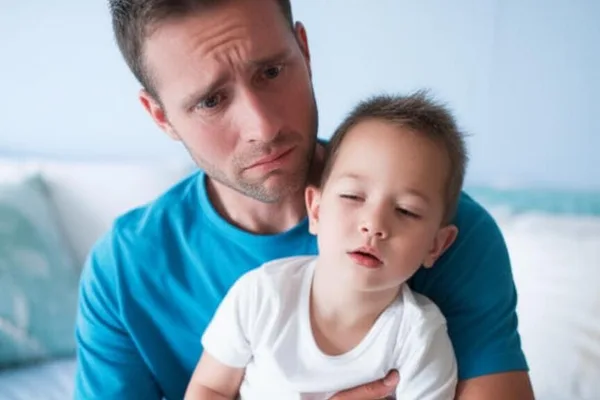
Imagine your little one playing and suddenly starting to shake, his eyes widen, his whole body stiffening... At that moment, when you touch his body, it feels like fire. That means he has a fever. As a mother or father, the fear you feel when you see something like this is indescribable. This is what we call a "febrile seizure" or, in medical terms, a febrile seizure . Although this is a very scary sight to see, the good news is that most of the time, it does not cause any long-term harm to the child. So, let's not panic and be aware of this.
Why do these febrile seizures occur?
Doctors are still not 100% sure what causes this. But it is generally believed that this condition can occur when a child's body temperature rises above 38 degrees Celsius (100.4 Fahrenheit). Sometimes, rather than the temperature itself, a sudden rapid increase in fever (fever spike) can cause this. In many cases, parents may not even know that their child has a fever. They only realize that their child has a fever when they touch their body after the seizure suddenly occurs.
Who are the children most likely to develop febrile seizures?
This condition can usually occur in children between the ages of 3 months and 6 years. However, it is most common in children between the ages of 12 and 18 months . In most children, this condition goes away on its own by the time they are about 6 years old.
And there are a few more things:
- Family history: If someone else in your family, whether you, your partner, or another child, has had febrile seizures as a child, your child is slightly more likely to develop them too.
- Second time: If a child has had a febrile seizure once, there is a chance that they will have another one.
What is the nature of a febrile seizure?
There are two main types of this. Let's see what the difference is between the two.
| Characteristic | Simple Febrile Seizure | Complex Febrile Seizure |
|---|---|---|
| Time | This is the most common type. It usually lasts for a short time, about a minute or two. But it can sometimes last up to 15 minutes. | This is a bit rare. Lasts more than 15 minutes. |
| Effect on the body | The whole body convulses at once (unilateral convulsions). | Only one part of the body (e.g., one arm or leg) may be affected. |
| Frequency | It will not recur within 24 hours. | It can occur more than once within 24 hours. |
| After the seizure | The child may feel sleepy, irritable, or confused for a few hours. | After a seizure, the arm or leg on the affected side of the body may feel numb for a while. |
A complex febrile seizure is a condition that requires a little more attention. At such times, the doctor may decide to further examine the child. This may include blood tests, scans (`imaging`), examination of the fluid around the brain (`spinal tap`), or even hospitalization for treatment.
What are the causes of fever?
For a child to have a febrile seizure, they must first develop a fever. There are two main reasons why young children develop a fever.
1. Infections: A bacterial or viral infection can cause a fever. Roseola ( also known as sixth disease) is a viral infection that can cause a sudden, high fever, which can lead to febrile seizures.
2. Vaccination: Children can still get a fever after receiving some vaccines. Especially the MMR vaccine for measles, mumps, and rubella, which can cause a fever between 8 and 14 days after being given.
What should I do if my child has a seizure?
This is the most important part. It is very important for the child's safety that you do not panic at this time, but act quickly and correctly.
The most important thing is to stay calm . Only if you are calm can you help your child.
Here's exactly how to do these things.
| ✔️ Things to do | ❌ What not to do |
|---|---|
| Take the child off the bed or chair and have them lie down on a safe surface (e.g. the floor). This will reduce the chance of them falling. | Do not put anything in the child's mouth (no spoons, keys, fingers). |
| Turn the child onto their back immediately. This way, any saliva or vomit that collects in the mouth will not get stuck in the airway. | Do not hold or restrain your child tightly to stop a seizure. |
After the seizure stops, if the child is breathing normally and is stable, be sure to see your doctor . It is very important to find out what is causing the fever. Especially if something like this happens to a baby under 12 months old, the doctor may do some tests to rule out a dangerous infection like meningitis.
When should I take my child to the Emergency Treatment Unit (ETU)?
There are times when it is not best to stay at home. In such cases, you should immediately take your child to the nearest hospital Emergency Department (ETU) . Or call the 1990 ambulance service.
- If the seizure lasts more than 5 minutes.
- If the child is having difficulty breathing or is turning blue .
- If only one part of the body twitches (a sign of a complex seizure).
- If the child's behavior is abnormal even after more than an hour after the seizure has stopped.
- If the child appears dehydrated (dry mouth and lips, sunken eyes, decreased urine output).
- If a seizure occurs again within 24 hours .
Will this happen again? Is there any treatment?
About 30% to 35% of children who have had a febrile seizure will have another one within the next year or two. This is especially true if the child is under 15 months old when they first have one. However, this does not mean that every time a child has a fever, they will have a seizure.
Usually, a simple febrile seizure does not require long-term treatment. However, if the seizure is complex or occurs frequently, the doctor may prescribe a medication to control the seizure. Sometimes, if the seizure lasts more than 5 minutes, the doctor may recommend something like a rectal `Diazepam` gel to stop it. But remember, even if such a medication is given, you should take your child to the hospital immediately.
Will my child have other problems because of febrile seizures?
This is the biggest fear in every parent's mind.
A simple febrile seizure will not cause any damage to a child's brain, nor will it affect a child's learning ability or intelligence.
Febrile seizures are not a condition called epilepsy. Epilepsy is the occurrence of two or more seizures without a fever. A child who has had a febrile seizure has a very small (about 2%) increased risk of developing epilepsy later in life. This means that 98% of children will not develop the problem.
So, after a simple febrile seizure, your child will develop completely normally. Don't worry about it.
Take-Home Message
- Although a febrile seizure can be very frightening, it usually does not cause long-term harm to the child.
- This is caused by a fever, not a brain disease.
- If your child has a seizure, stay calm, turn the child on their side in a safe place, and wait without giving anything by mouth.
- If you have a seizure for the first time, be sure to see a doctor after the seizure stops to find the cause of the fever.
- If the seizure lasts more than 5 minutes and you have difficulty breathing, go to the hospital's Emergency Department (ETU) immediately.
- Febrile seizures are not epilepsy, so don't be unnecessarily afraid of them.




💬 Comments (0)
No comments yet. Be the first to share your thoughts here.
Add Your Comment