
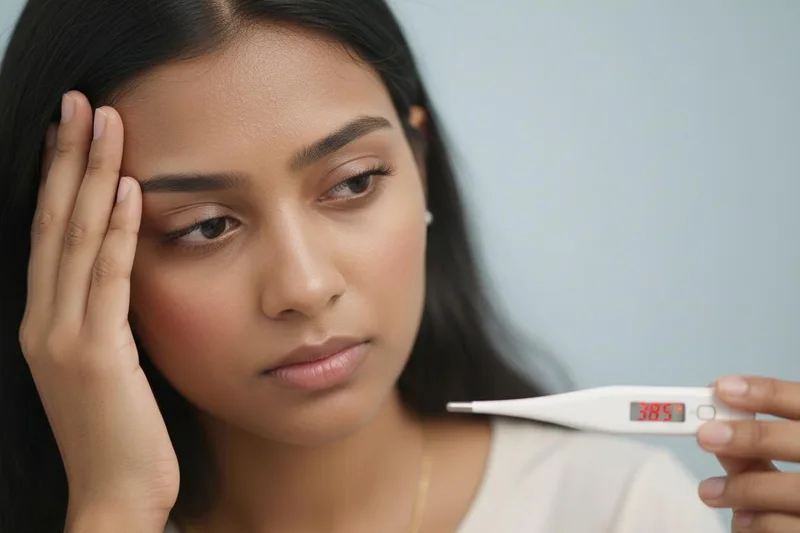
When we feel a little unwell or hot, the first thing we all think is, "I don't know if I have a fever." Is this fever really an illness? Or is it a signal that something is wrong with our body? Although many people are afraid of fever, fever is often the best evidence that our body's defense system is working well. So, today we will talk clearly about this fever, its symptoms, what we can do at home, and when it is time to see a doctor.
What exactly is a fever?
Simply put, a fever is a higher than normal body temperature. It is not a disease in itself. Rather, a fever is a symptom of another health condition. Just like an alarm goes off when a burglar breaks into our house, a fever is the alarm our immune system uses to let us know when an infection or germ enters our body.
When our body temperature rises slightly, germs like bacteria and viruses that have entered our bodies become less able to survive and spread. That means a fever is a good sign that our body is fighting off illness.
What temperature exactly do we call a 'fever'?
We've all heard that a healthy person's body temperature is 37 degrees Celsius (98.6 degrees Fahrenheit). But it's not the same for everyone. Your normal temperature can be a little higher or lower than that. And this temperature changes throughout the day. It's a little lower in the morning, a little higher in the evening. A woman's temperature also rises during certain days of her menstrual cycle and when she exercises.
The important thing is that babies and young children naturally have a slightly higher body temperature than adults, so the temperature they consider a fever is also slightly higher than ours.
Although the amount considered a fever varies depending on the method of measuring fever, the time of day, and the individual, most doctors accept that an oral temperature of 38 degrees Celsius (100.4 degrees Fahrenheit) or higher is considered a fever.
| Temperature measurement point | Different from oral measurement |
|---|---|
| Rectal and Ear | Usually shows about 0.6 degrees C (1.0 degrees F) higher. (This is more accurate) |
| Forehead and Armpit | Usually shows about 0.6 degrees C (1.0 degrees F) less. (This is the least accurate method) |
What is a low-grade fever?
This refers to a slight increase in body temperature above normal. Typically, a temperature between 37.5 and 37.9 degrees Celsius (99.5 - 100.3 Fahrenheit) is considered a fever. It means that the immune system is slightly activated by something.
What other symptoms come with a fever?
In addition to feeling hot, you may also experience these symptoms.
| Common symptoms | |
|---|---|
| Chills, shivering | Body aches and headaches |
| Feeling very tired (Fatigue) | Intermittent or continuous sweating |
| Redness of the face or hot skin | Heart palpitations |
| Specific features for babies and young children | |
| Anorexia (decreased appetite) | Earache or earache |
| Loud crying, irritability | Paleness or redness |
| Feeling thirstier than usual | Decreased urination |
What are the main causes of fever?
Fever is a symptom of any illness, so there can be many causes. But the most common causes are:
- Viral infections: For example, things like influenza, colds, dengue, and COVID-19.
- Bacterial infections: Things like throat infections, urinary tract infections (UTIs), and skin infections.
- Gastrointestinal infections: Fever accompanied by stomach pain, vomiting, and diarrhea.
- Skin infections: Things like a wound festering.
In addition to this,
- As a reaction to some medications.
- After receiving vaccinations.
- Due to some autoimmune disorders.
- Fever can also be caused by serious medical conditions such as cancer.
What can you do to reduce fever at home?
If your fever is not too severe, that is, less than 38.3 Celsius (101 Fahrenheit), you can often get better with these things without medication.
- Drink plenty of water and fluids: When you have a fever, your body loses a lot of water through sweat, making it easy to become dehydrated. So drink plenty of water, porridge, soup, juice, and orange juice.
- Get plenty of rest: Your body needs energy to fight the disease. So get plenty of sleep and rest.
- Wash your body with lukewarm water: It is not good to bathe in cold water when you have a fever. However, washing or wiping your body with lukewarm water (about 36.7 Celsius / 98 Fahrenheit) can help reduce body temperature.
- Medication: If the fever is higher than 38.3 Celsius (101 Fahrenheit) and you are feeling very uncomfortable, you can take a medicine such as Paracetamol as directed by your doctor.
Very important: Never give aspirin to children under the age of 17. Giving aspirin to children can cause Reye's syndrome, a condition that affects the liver and brain and can be fatal. So always ask your doctor about the appropriate medication for your child.
When should I see a doctor?
Although fever is common, it can sometimes be a sign of something serious. So, in such cases, it is important to seek medical advice.
| For whom? | When to see a doctor |
|---|---|
| Adults |
|
| Children |
|
In what cases should you go to the hospital (ETU) urgently?
If you have any of the warning signs below along with a fever, it could be a sign of a serious medical condition. So go to the nearest hospital's Emergency Department (ETU) immediately.
| Warning signs that require immediate ETU visit | |
|---|---|
| Common characteristics for both adults and children | |
| Severe headache and neck stiffness | Difficulty breathing |
| Chest pain | Severe confusion or unusual behavior |
| Having a fit (convulsions or seizures) | Red or purple spots on the skin (fever rash) |
| Severe stomach pain, persistent vomiting | Difficulty looking at light (Photophobia) |
| Features especially relevant to young children and babies | |
| If a baby under 3 months old has a fever, take him to the hospital immediately, even if there are no other symptoms. | If the child is excessively sleepy or lethargic. |
| If they are not eating or drinking anything, or are showing signs of dehydration. | If you cry non-stop. |
Other conditions that can be caused by fever
- Febrile Seizure: Some children under the age of 5 may have a seizure-like condition when their fever rises. This can be very frightening for parents, but most of the time it does not cause brain damage. If this happens, turn the child on their side and do not put anything in their mouth. If the seizure lasts more than 5 minutes, take them to the hospital immediately.
- Recurrent Fever: Some children may have a fever for a few days without any apparent cause, then get better for a few days, then get a fever again. This may be a sign of a condition called periodic fever syndromes. If this continues, seek medical advice.
Take-Home Message
- A fever is not an illness, but a signal that our body is fighting an infection. So don't be afraid of a little fever.
- It is very important to drink plenty of fluids, such as water, and rest when you have a fever.
- Never give aspirin to a child under the age of 17. Always give a safer medicine like paracetamol under medical advice.
- If a baby under 3 months old has a fever, even if there are no other symptoms, see a doctor immediately.
- If you have any of the warning signs, such as severe headache, stiff neck, difficulty breathing, or a fit, along with a fever, go to a hospital's Emergency Department (ETU) immediately.
- If you have any doubts or fears about the flu, it is best to visit your family doctor for advice rather than guessing.


💬 Comments (0)
No comments yet. Be the first to share your thoughts here.
Add Your Comment