

Have you ever noticed that your mother, father, grandmother, or grandfather's memory is gradually decreasing as they get older? Sometimes, even forgetting names and not being able to find their way home can be very scary and worrying, right? When you think that this is the beginning of a disease like Alzheimer's, and when you think about the tests you have to go to the hospital to confirm it, it feels heavy. But imagine how convenient it would be if there was a way to take a small drop of blood from your finger at home and learn important information about this disease from it. That's what we are talking about today, a new research that gives us hope.
What is this latest blood test?
In simple terms, it's a very simple method, like taking a drop of blood from your fingertip to test for diabetes. In diagnosing Alzheimer's disease, we look for certain types of proteins (for example , amyloid ) that are deposited in the brain. We call these biomarkers . Currently, even though we take a blood sample to measure these biomarkers, it's a very complex process.
The current method requires blood to be drawn from a vein, transported to the laboratory under special temperature control, and within a specified time. The blood sample must also be spun at high speed (centrifugation) to separate the components and stored in freezers. This requires special equipment, trained staff, and a high cost. This makes these tests difficult for many people to perform.
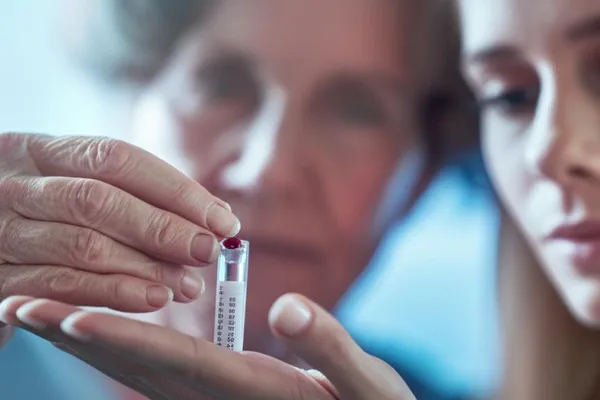
But this new research has found that, without any of this complexity, a small drop of blood taken from a fingertip can be smeared on a special card (blood spot card), left to dry at room temperature, and sent to the laboratory by regular mail. What a difference, isn't it?
How accurate is this test?
The main question we face with any new test is, "How reliable is this?" To find out, researchers used 77 volunteers who came to a memory clinic in Spain.
They took blood samples from each of these people in two ways:
1. Traditional method: Taking blood from a vein.
2. New method: Take a drop of blood from your fingertip.
Going even deeper, 28 of these people also had cerebrospinal fluid samples taken from the brain and spinal cord. This test is considered the "gold standard" for diagnosing Alzheimer's disease. That is, it is the best measure of whether the results are accurate.
The fingerstick blood sample taken in this way was sent to a research laboratory in Sweden overnight, without any refrigeration.
The results are truly amazing. They have confirmed that there is a very high level of agreement between the information obtained from the traditional method of taking blood from a vein and the information obtained from a simple drop of blood taken from a fingertip.
Simply put, this research has shown that the same amount of information that can be obtained through that complex, costly process can be obtained through this simple, easy method.
Let's look at the difference between these two methods in a table.
| Characteristic | The existing traditional method | Proposed new fingerprint test |
|---|---|---|
| Blood collection point | Through a vein (Vein) | Fingertip |
| Required location | A hospital or laboratory | Anywhere (even at home) |
| Storage and transportation | Freezer/temperature control is essential. | At room temperature, on a dry card |
| Complexity | Very high (requires special equipment and training) | Very low (even the patient can do it themselves) |
What are the main advantages of this method?
If this test is confirmed by further research, and comes to our clinics in the future, the benefits it will bring are unimaginable.
- Early detection of the disease: A person with memory problems can quickly get a simple test like this without having to go to the hospital and wait for complex tests. The sooner a disease is detected, the greater the chance of successful treatment.
- Remote testing capability: Imagine if your doctor gave you an online memory test and at the same time asked you to complete and mail this blood collection card that would be sent home? How convenient would this be for those living in remote areas who have difficulty getting to hospitals?
- Monitoring response to treatment: This is the most important thing. New types of drugs that can control the progression of Alzheimer's disease are now being introduced to the world. A person taking such a drug can do this test at home, even weekly, without having to wait to come to the clinic every 6 months, and the doctor can observe how the drug is affecting the body. Accordingly, there is an opportunity to change the treatment to suit each patient (personalized medicine).
- Improved diagnostics: Sometimes, diagnosing a disease based on symptoms alone can be misleading. But accurate biomarker testing like this allows doctors to more accurately diagnose the disease and prescribe the most appropriate treatment .
Are there any things we still need to be concerned about?
With all this good news, we need to remember one thing. This is still a pilot study . While the results are very encouraging, they need to be replicated in larger studies before this method can be used as a standard test worldwide.
Also, when a patient performs this test on their own at home, it can be somewhat challenging to ensure that it is done correctly.
So, while this is something that gives us great hope for the future, it is not a test that is already available in our hospitals.
Take-Home Message
- Research is underway on a new test that uses a simple drop of blood taken from a fingertip to detect Alzheimer's disease.
- This method is much easier than the current complex, expensive method, and does not require special refrigeration facilities.
- If this test is successful, it will be a great help in early detection of the disease, remote monitoring of patients, and measuring the success of treatments.
- This is still in the research stage, and it will take some time before it reaches general use.
- If you or someone close to you is having memory problems, the most important thing to do is to see your doctor immediately to discuss the matter. He or she can guide you to the most appropriate tests and treatments available.




💬 Comments (0)
No comments yet. Be the first to share your thoughts here.
Add Your Comment