
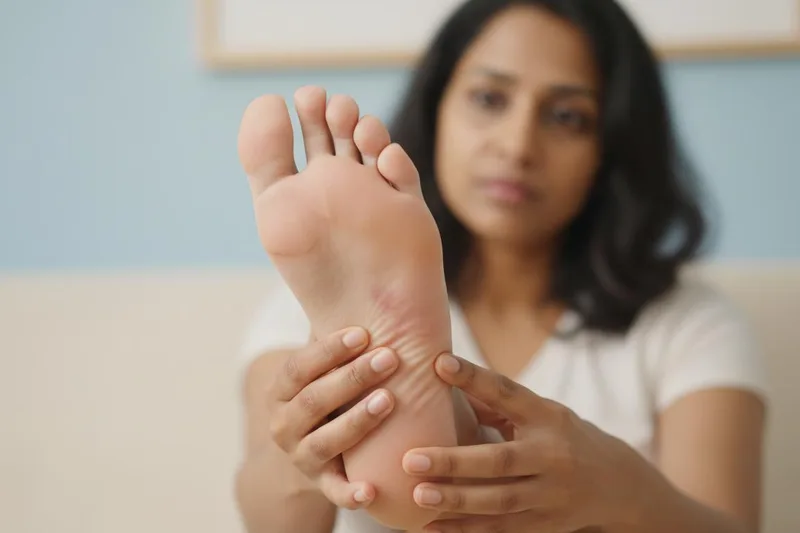
Do you have a small wound or scrape on your leg that is not healing and is still there? Maybe it is oozing fluid? Or is the skin on your leg changing color and smelling bad? These are not normal wounds. In medical terms, we call these ulcers. Especially if you have diabetes, you should think twice about this. Because if this condition is not taken care of properly, it has a high chance of becoming serious. So, let's talk about it all today.
Simply put, what are foot ulcers?
A foot ulcer is simply an open sore on your skin, especially on your feet or toes, that doesn't heal, persists, or recurs.
This condition is often associated with diabetes. Neuropathy, a complication of diabetes, can cause loss of sensation in the feet. Then, you may not even notice a small scrape or cut on your foot. Even though you may not feel it, this small wound is what gradually grows larger and deeper and becomes an ulcer.
These ulcers are very susceptible to infection. Sometimes these infections can be so severe that amputation of a part of the foot or toe may be necessary.
Consider this: About 15% of people with diabetes will develop a foot ulcer during their lifetime. And, unfortunately, between 14% and 24% of those who develop one will have to have part of their foot removed. So this is not something to be taken lightly.
Who is most likely to experience this condition?
Although anyone can develop foot ulcers, some people are at higher risk. It's important to be extra vigilant if you have any of the following conditions:
- Diabetes: This is the main risk factor.
- Circulatory problems: If blood flow to the legs is poor, wounds take longer to heal.
- Heart Disease: Heart disease also affects blood circulation.
- Obesity: As body weight increases, the pressure on the feet also increases.
- Kidney Disease.
- Foot deformities: For example, conditions like bunion or hammertoe.
- Tobacco and alcohol use: These habits also increase the risk.
What does this ulcer look like and what are its stages?
Foot ulcers can come in many shapes and colors. They usually have a deep, crater-like appearance.
Appearance and color of the ulcer
These lesions can be yellow, pink, red, gray, or black.If your wound is black, it means that the tissue cells in that area have died (Necrosis or Gangrene). This is a very serious condition.
The size and depth of the ulcer
These can start as small as a small bone and, if not treated properly, can grow to cover the entire foot. The depth of the wound also increases gradually. Doctors use different methods to measure this depth. For example, there are 6 stages according to the Wagner classification.
| Grade | Simple description of the condition |
|---|---|
| Stage 0 | The skin is not damaged, but it is risky. |
| Stage 1 | A shallow wound that is only in the surface layer of the skin. |
| Stage 2 | The wound is deep, possibly extending to the tendons. |
| Stage 3 | The wound has gone deep down to the bone, and the bone is visible. |
| Stage 4 | Tissue death in the front of the foot (Gangrene). |
| Stage 5 | The tissue of the entire foot has died (Gangrene). |
What are the early signs that an ulcer is forming?
As an ulcer begins to develop, you may notice changes in the skin on your foot like these:
- Dry, cracked skin
- Skin becoming like coral
- Skin redness
- Rash-like appearance
When the injury is more severe, symptoms such as:
- Thickening of the skin around the wound (like a callus)
- Fluid or pus-like discharge from the wound (may be on your sock)
- Brown spots on the skin
- A strong, foul odor
There are two main types of these foot ulcers:
There are two main types of ulcers that can affect your feet. Knowing the difference between the two is very important for treatment.
| Characteristic | Neurotrophic Ulcers | Arterial Ulcers |
|---|---|---|
| Main reason | Neuropathy due to diabetes. | Reduced blood flow due to narrowing of blood vessels (Peripheral Arterial Disease). |
| Pain | Usually there is no pain. | There is severe pain , especially at night. |
| Location | Often on the soles of the feet, where the body's weight falls the most. | Heels, toes, between toes, and in places where shoes pinch. |
| Appearance | Pink/red in color. The edges of the wound are raised. | Yellow, gray, or black. Usually no bleeding. |
How is this treated?
The main goals of treatment are to heal the wound, reduce pain, and prevent it from recurring. The treatment plan will vary depending on the type of ulcer you have and the cause.
Nonsurgical Treatments
This treatment can be successful for ulcers in the early stages.
- Topical wound care: Wounds heal faster when they are kept moist and covered.
- Antibiotics: If there is an infection.
- Off-loading: The injury is relieved of weight by using special shoes, a cast, or perhaps a wheelchair.
- Keeping the foot elevated.
Surgical Treatments
If the ulcer is severe, especially if it is infected, surgery may be necessary.
- Debridement: Removal of infected or dead tissue.
- Skin grafts: Skin grafts are used to cover wounds.
- Removing or adjusting parts of the bones if necessary.
What can I do to reduce the risk?
This is the most important part. By following these habits, you can prevent these ulcers from forming, and even if they do form, they can stop them from coming back.
The most important thing is, if you have diabetes, make it a habit to check your feet every day.
- Check your feet daily: After bathing and before putting on shoes, look carefully at the soles of your feet, between your toes, and around your nails. Look for blisters, cuts, cracks, redness, or swelling. Use a mirror to look at your feet. If you can't, ask a family member to do so.
- Manage your diabetes well: Follow your doctor's instructions exactly.
- Never walk barefoot, even inside the house.
- Wear shoes that fit you well and are comfortable. Shoes should not be too tight or too big.
- Be careful when cutting your nails: Cut your nails straight across when they are soft after bathing.
- Avoid smoking completely.
- Control blood pressure and cholesterol levels.
- Maintain a healthy weight.
- If you notice even the slightest problem, see your doctor immediately.
Take-Home Message
- If you have diabetes, it's more important than ever to check your feet daily.Definitely do it. Make this a lifelong habit.
- If you notice a non-healing wound, redness, swelling, a bad odor, or a change in color on your leg or toes , see a doctor immediately .
- Avoid walking barefoot, even at home. Even a minor injury to your feet can be serious.
- Smoking can worsen this condition because it interferes with blood circulation. Therefore, it is very important to avoid smoking.
- Don't be afraid of this condition. If it is diagnosed early and treated properly, it can be managed well without serious complications.
👩🏽⚕️ Additional questions (FAQs)
💬 Isradipine (Isradipine / DynaCirc) capsules/tablets are used for what disease?
This is a highly effective blood pressure pill (Calcium Channel Blocker - CCB) designed to control 'High Blood Pressure'! This medicine not only reduces blood pressure, but also does not affect the heart rate, so doctors use it as a safe medicine.
💬 How does taking this blood pressure pill (Isradipine) instantly lower our blood pressure?
For a blood vessel to contract/contract and the pressure to rise, 'Calcium' particles must definitely enter the blood vessel's muscle! As soon as this medicine enters the blood, it blocks/closes and locks all the calcium gates (L-type calcium channels) in those blood vessels 100%! Since calcium does not enter, the blood vessel does not contract and becomes very loose (Vasodilation). Then the blood flows easily like a river and the pressure drops.
💬 What are the annoying side effects of taking this medicine (Isradipine)?
The biggest and most annoying side effects of this are that some people may experience 'headaches' and 'flushing' (due to the dilation of blood vessels). Also, like other CCB pills, there is a risk of ankle/leg swelling (peripheral edema) and sudden rapid heartbeat (palpitations) (reflex tachycardia).




💬 Comments (0)
No comments yet. Be the first to share your thoughts here.
Add Your Comment