
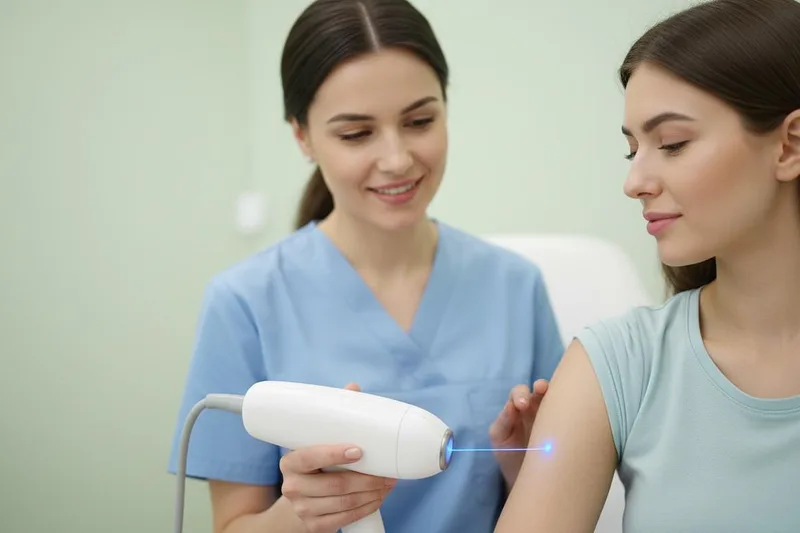
When your doctor tells you about a treatment called 'Fulguration', you may feel a little strange, maybe even scared, right? Who wouldn't be scared when they say 'electrical shock'? But it's actually not as scary as we think. It's a very safe and effective treatment method used for many diseases. Today, let's talk about exactly what Fulguration is and what happens with it.
Simply put, what is Fulguration?
Imagine that instead of cutting the skin with a surgical knife, we use electricity to remove unwanted parts of the body. That's what happens here. Fulguration is a type of treatment called electrosurgery. It uses a high-frequency electrical current to heat and destroy unwanted or abnormal cells in our body.
The doctor uses a small probe-like device. It has an electrode at the end. When this device directs electrical energy to the area where the cells are located, a small spark is created. The excessive heat generated by that spark destroys the unwanted cells. Sometimes this device may have a small wire loop at the end. The electric current is sent through that. The device used will vary depending on the type of treatment you are receiving.
Simply put, this is a method of removing abnormal cells using electrical heat, without making an incision with a surgical knife.
What conditions is Fulguration therapy used for?
This treatment is used in several areas for a variety of conditions. It is very effective in destroying benign tumors, precancerous cells, and some cancer cells. It is also sometimes used to stop bleeding after routine surgery.
| Medical field | Conditions treated |
|---|---|
| Urinary tract and bladder diseases | To treat early stage bladder cancer and to stop bleeding after a biopsy. |
| Gynecological diseases (women's diseases) | To destroy the growths that cause endometriosis. To prevent cervical cancer, to destroy pre-cancerous cells such as cervical dysplasia. |
| Dermatology (skin diseases) | To remove harmless skin tags, genital warts, etc. To treat pre-cancerous conditions such as actinic keratosis (which, if left untreated, can develop into skin cancer (Squamous Cell Carcinoma). |
How should I prepare before this treatment?
How you prepare for this will vary depending on the treatment you are having. So the most important thing is to follow your doctor's instructions exactly. Typically, he or she will tell you about the following:
- Fasting: Should I stop eating and drinking before treatment, and if so, for how long?
- Medication: Do you need to temporarily stop taking any medications you normally take?
- Returning home: Can I go home the same day as the treatment, or will I need to stay in the hospital?
- Driving: Whether you need someone to drive you home (this depends on the type of anesthesia you are given).
What happens during treatment?
Although what happens varies slightly depending on the treatment, these are the general steps.
1. Preparing you: The doctor will position you on an examination table and clean and prepare the area to be treated.
2. Anesthesia: You will be given local, regional, or general anesthesia so that you will not feel any pain.
3. Cell removal: Next, the doctor turns on a machine called an electrosurgical generator. This is what generates a high-frequency electrical current. Then, using the probe we talked about earlier, he directs a spark at the target cells, burning and destroying that cell tissue.
Fulguration (TURBT) for bladder cancer
During surgery for bladder cancer, doctors use this technique as part of a procedure called Transurethral Resection of Bladder Tumor (TURBT) . In this procedure, the tumor in the bladder is cut out using an instrument called a resectoscope. Then, Fulguration is used to completely destroy any remaining cancer cells and stop the bleeding.
Fulguration (LEEP) for cervical problems
Fulguration is used to treat conditions such as cervical dysplasia during a procedure called Loop Electrosurgical Excision Procedure (LEEP) . In this procedure, a speculum is inserted into the vagina to examine the cervix. After the cervix is numbed, a small, electrically conductive loop is passed over the surface of the cervix, cutting away a thin layer of abnormal cells.
What are the benefits and risks of this treatment?
Like any medical treatment, this one has benefits and some risks.
Advantages
- This is a minimally invasive treatment that does not require large incisions.
- Skin tumors and warts can often be permanently removed .
- For those who suffer from frequent urinary tract infections or endometriosis, it can provide relief by destroying the tissue that is causing the symptoms.
- Early stages of bladder cancer can be cured. (However, sometimes the tumors can come back.)
Risks
It is important to remember that these risks are very rare and that doctors are trained to prevent them.
- Delayed bleeding: If a skin wound starts to bleed, your doctor may recommend applying pressure for about 20 minutes. It is normal to have some blood in your urine after a bladder treatment and some vaginal bleeding after a cervical treatment.
- Electric shock or fire: This risk exists if the device comes into contact with a flammable substance. Doctors are very concerned about this.
- Burns: The medical staff will make sure that your body does not come into contact with anything metal during treatment.
- Infections: There is a risk of spreading germs through surgical smoke. However, this can be prevented by using smoke-evacuation systems, face masks, and eye shields.
When should you see a doctor?
If you experience any of the following symptoms after treatment, call your doctor immediately or, if necessary, go to the nearest hospital Emergency Department (ETU) .
- A fever of more than 101 degrees Fahrenheit (38.3 Celsius).
- Excessive or unusual bleeding from the treated area.
- Severe stomach pain.
Take-Home Message
- Fulguration is a very safe and widely used medical treatment that uses electricity to destroy abnormal cells.
- It is used for many things, such as skin diseases (itches), bladder problems, and pre-cancerous conditions of the cervix.
- This is a minimally invasive procedure that allows for a quick recovery. You can often go home the same day as your treatment.
- Before treatment, talk carefully with your doctor about its benefits, risks, and how to prepare.
- If you develop a fever, heavy bleeding, or severe pain after treatment, seek medical advice immediately.


💬 Comments (0)
No comments yet. Be the first to share your thoughts here.
Add Your Comment