
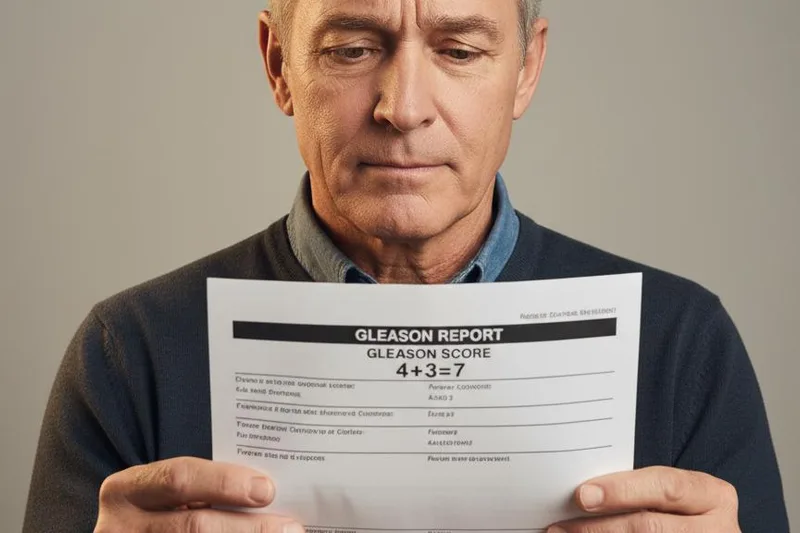
When the doctor told you that you had prostate cancer, there was a number on your report called 'Gleason Score', right? You may have felt a little scared when you saw this. You may have wondered what this number was, what it meant, whether it was a good or bad score. Don't worry, it's normal for you to feel that way. Today, we're going to talk about what this Gleason Score is and what it really means in a very simple way that you can understand.
Simply put, what is this Gleason Score?
The Gleason Score is a scoring system used to classify prostate cancer, that is, to understand its nature. It's like giving grades on an exam in school. But this one is a little different.
You may recall that a small piece of tissue was taken from your prostate for a biopsy. That piece of tissue is then examined under a microscope in a laboratory by a specialist doctor, called a pathologist. He or she looks at how similar or different the cancer cells are from normal healthy cells. This difference is used to give an idea of the "severity" of the cancer, or how fast it has spread.
So, this Gleason Score is very important information that helps doctors choose the most suitable treatment for you and predict how your condition will progress.
How is the Gleason Score calculated?
This is done in a very interesting way. When the pathologist looks at the cancer cells under a microscope, they give them a score from 1 to 5 based on their appearance.
- Score 1: Cancer cells look very similar to normal healthy cells. It can be difficult to tell if they are cancerous.
- Scores 2-4: Cancer cells are gradually starting to differ from normal cells.
- Score 5: Cancer cells have a completely different, chaotic appearance than normal cells.
Think of it this way. Cancer cells are like the naughty kids in a class. A score of 1 means someone who is just a little naughty, but seems like a good kid for the most part. A score of 5 means someone who is completely different from the other kids in the class, very naughty, and hard to control.
Now the important thing. In the part of your prostate where you have cancer, the cells are not all the same. In some places the cells may look a little better (low score), in other places the cells may be very different (high score).
Therefore, the pathologist selects the two main areas where the cancer has spread the most.
1. The mark given to cells in the area where the cancer is most prevalent .
2. The mark given to cells in the area where the cancer is second most common .
Then these two scores are added together. That sum is what we call the Gleason Score .
For example, if the most common site of cancer is a score of 4, and the second most common site is a score of 3, your Gleason Score would be 4 + 3 = 7.
Generally, a Gleason Score of 6 or higher is considered cancer. Cell patterns with scores of 1 and 2 are no longer considered cancer. So the lowest Gleason Score you might see is 6 (3+3).
What do these numbers really say?
Now you might be wondering, "Okay, my score is a 6, or a 7, or an 8. What does that mean? Is that good? Is that bad?"
We don't look at the Gleason Score as "good" or "bad." Instead, we use it to give an idea of how fast the cancer is likely to grow or spread. Let's break it down into three parts.
| The Gleason Score | Medical name | Simply put... |
|---|---|---|
| 6 | Well-differentiated | Cancer cells are very similar to healthy cells. They are a type of cancer that grows very slowly and has a low risk of spreading (metastasizing). |
| 7 | Moderately differentiated | Cancer cells are similar to healthy cells in some ways. They are a type of cancer that can grow at a moderate rate . (Here, whether it is 3+4 or 4+3 is also important). |
| 8, 9, or 10 | Poorly-differentiated or undifferentiated | Cancer cells are very different from healthy cells. They are a type of cancer that grows rapidly and has a higher risk of spreading . |
Is there such a thing as a "good" Gleason Score?
Not really. A low score (6) means that the cancer is slow-growing. That's good news. But that doesn't mean that treatment isn't needed. Similarly, a high score (8, 9, 10) means that the cancer is likely to grow rapidly, so we need to pay more attention to it and start more aggressive treatment sooner.
Is the Gleason Score alone enough?
Here's what you need to remember. Your doctor doesn't just look at the Gleason Score number to plan your treatment. It's just one small piece of a bigger picture. There are many other things to consider to understand the full picture.
The important thing is, your Gleason Score alone cannot tell the full story of your condition. It is only one piece of the puzzle.
Some of the other things the doctor will consider are:
- PSA blood level: The value of your PSA (prostate-specific antigen) blood test.
- Digital Rectal Exam: What the doctor feels during the examination with his finger.
- Other information from the biopsy: How many pieces of tissue were found to contain cancer? How many cancer cells were found in each piece of tissue?
- Scans: Information obtained from tests such as ultrasound, MRI (magnetic resonance imaging) or PET (positron emission tomography) scans.
- Has the cancer spread?: Has the cancer spread to both sides of the prostate gland? Or has it spread to other organs outside the gland?
By putting all this information together , your doctor will determine the stage of your cancer and discuss with you what treatment option is best for you.
So, don't worry if your Gleason Score is 7 or 8. Maybe your PSA is low, or the cancer hasn't spread. So don't jump to conclusions based on a number. Talk to your doctor about all your questions and fears. He or she will explain everything to you.
Take-Home Message
- The Gleason Score is a scoring system that measures how "different" the cells of a prostate cancer are, meaning how quickly they can spread.
- This score is given after examining a piece of tissue taken from your biopsy under a microscope.
- A score of 6 indicates a slow-growing cancer. Scores of 8, 9, and 10 indicate a rapidly growing cancer. A score of 7 indicates a moderate level.
- The most important thing: Your treatment is not determined solely by your Gleason Score. Many other factors, such as PSA levels and scan reports, are also taken into account.
- Don't be afraid of the numbers on your report. Ask your doctor about any questions or concerns you have. He or she is the one who can give you the best information.


💬 Comments (0)
No comments yet. Be the first to share your thoughts here.
Add Your Comment