

Have you ever wondered how information is transferred back and forth in your brain? When we learn something new, when we remember something old, there is a small but very important chemical messenger that helps us do all this from behind. That is called Glutamate . In fact, without it, our brain would be a mess. So today we will talk about what this Glutamate is, what functions it performs in our body, especially in the brain, why it is indispensable, but also what problems can sometimes arise if its amount increases or decreases. Very simply, we will talk about all this in a way that you can understand.
What exactly is Glutamate?
Simply put, Glutamate is a neurotransmitter . Think of neurotransmitters as little messengers that carry messages between the nerve cells (neurons) in our brains. These are the ones that pass information and signals from one nerve cell to another.
In our brains, glutamate is the main excitatory neurotransmitter . "Excitatory" means that it stimulates a nerve cell, which means it "wakes it up." Then the probability of that message going on to the next nerve cell increases. It's like waking someone up by knocking on their door. So, glutamate is essential for the brain to function properly.
Now you may be wondering how and where this glutamate is produced. Glutamate is recycled and made new in our brain by a special type of cell called glial cells . Glial cells are a type of support cell that helps, nourishes, and protects the nerve cells in the brain. These glial cells take the used glutamate and convert it into another compound called glutamine . Then, when this glutamine reaches the terminal area of the nerve cells again, it turns back into glutamate. Isn't it a very amazing mechanism?
Not only that, but glutamate is also essential for the production of another important neurotransmitter, gamma-aminobutyric acid (GABA) . GABA is known as the "calming" neurotransmitter. GABA helps with things like sleep, relaxation, anxiety control, and muscle function. So, while glutamate is stimulating on one hand, it also contributes to the production of a calming agent on the other.
Glutamate is not only a neurotransmitter. It is also an amino acid. Amino acids are the basic building blocks of proteins. Like building blocks. Glutamate is the most abundant amino acid in our body. In the body, Glutamate is produced and stored in muscle tissue.
Also, you've probably heard of glutamate the most because of the food additive monosodium glutamate (MSG) . Glutamate is also found in the food flavoring agent MSG.
So how does this glutamate work? It's amazing!
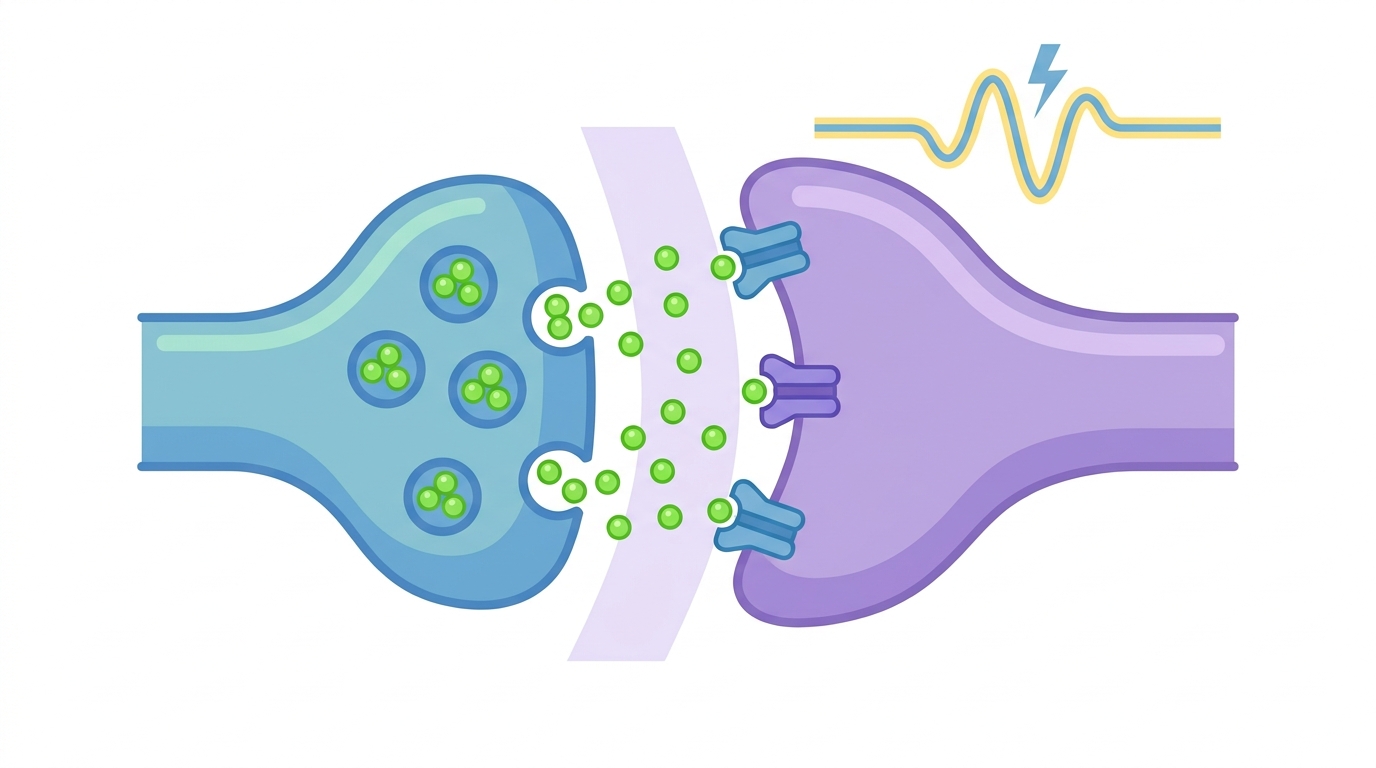
Neurotransmitters like glutamate are produced by nerve cells themselves. They are stored in tiny sacs called synaptic vesicles at the axon terminal of the nerve cell. Think of these as little bubbles. A single bubble can contain thousands of these neurotransmitter molecules!
Now, when a message or signal travels along a nerve cell, the electrical nature of that signal causes those little vesicles filled with glutamate to open up and release the glutamate into a little fluid-filled gap called a synapse between two nerve cells. It's like a bridge. On the other side of this gap is the next nerve cell. Now this glutamate has to go and bind to the special receptors on the other nerve cell that receive the message. It's like a key fitting into a lock. Once it's connected, the glutamate causes some change or action in that next nerve cell. That's when the message continues to travel from nerve cell to nerve cell.
Unlike most other neurotransmitters, glutamate can bind to four different receptors ! Think of it as opening four locks with one master key. This ability allows glutamate to have a wide range of effects throughout the brain and communicate with other nerve cells. Glutamate is responsible for more than 90% of the excitatory activity in the human brain. Can you imagine how important that is?
Inside our brains, nerve cells come together to form small circuits. These small circuits help with small tasks like recalling memories. And, larger, more extensive networks help with big, complex tasks like seeing, hearing, and moving. Glutamate is the main neurotransmitter that carries chemical messages through these circuits and networks. The way glutamate acts at the synapse between nerve cells strengthens or weakens the communication signal between these cells. It directly affects how the relevant task is performed. If glutamate is not released at the right time, in the right places, and in the right amount, communication is impaired. Similarly, if glutamate becomes too high, it can damage nerve cells and damage the communication network itself.
What service does glutamate provide to our body?
Here are some of the important functions that glutamate performs in our body:
- Learning and memory:As we mentioned earlier, because it can interact with four different receptors, glutamate has a greater chance of successfully and quickly transmitting messages between nerve cells. This rapid signal exchange and information processing is extremely important for learning and memory. Not only that, but glutamate also allows nerve cells to connect related information to each other. This is the basis of memory. Think about it, when you learn something new, new pathways are formed in the brain.
- An energy source for brain cells: When glucose, our body's main energy source, is low, glutamate can provide energy to brain cells. It's like a backup power supply.
- A chemical messenger: This is its main job. Glutamate helps send chemical messages between nerve cells.
- Sleep-wake cycle management: According to animal studies, glutamate levels are high when we are awake and during the Rapid Eye Movement'' (REM) phase of sleep. Healthy sleep is essential for a healthy life.
- A pain signal: There is a link between increased levels of glutamate and increased levels of pain perception. This means that when we are injured, it also helps to communicate that pain to the brain.
How does glutamate increase in our brain?
Sometimes, the amount of glutamate in our brain can become too high. There can be several reasons for this:
- Excessive release of glutamate from nerve cells.
- Glutamate is released directly from glial cells in the brain, adding to the total amount of glutamate in the brain.
- Excess glutamate remains in the small gap between nerve cells (the synapse). Then, many glutamate receptors remain active, and nerve cells can continue to be stimulated.
- The receptors in nerve cells become overly sensitive to glutamate. This means that even small amounts of glutamate molecules are produced to stimulate them.
What happens if glutamate increases? This is dangerous!
If the amount of glutamate in the brain increases too much, nerve cells can become overstimulated. This overstimulation can damage or even kill brain cells . In this case, glutamate is called an excitotoxin . That is, it acts as a stimulant and a poison at the same time.
Increased levels of glutamate in the brain have been linked to a number of medical conditions, including:
- Amyotrophic Lateral Sclerosis (Amyotrophic Lateral Sclerosis - Lou Gehrig's disease):In this case, the muscles gradually weaken.
- Multiple Sclerosis: A disease that affects the nervous system.
- Alzheimer's disease: You may have heard of it, a common disease that causes memory loss.
- Parkinson's disease: Affects body movements, symptoms such as tremors in the limbs may be seen.
- Huntington's disease: An inherited disease that destroys brain cells.
- Stroke: A condition caused by an interruption of blood supply to the brain.
- Fibromyalgia: Causes pain and fatigue throughout the body.
- Chronic fatigue syndrome: Long-term extreme fatigue.
There are also mental health problems thought to be caused by problems with either the production or use of glutamate:
- Mood and anxiety disorders .
- Autism .
- Depression .
- Obsessive-compulsive disorder (OCD) is a disorder characterized by unwanted thoughts and actions . Schizophrenia is emotional .
Important: While glutamate imbalance may be one cause of these conditions, these are complex conditions that can have many other causes. Only a doctor can make an accurate diagnosis.
So what happens if glutamate decreases?
As well as increasing glutamate, decreasing glutamate levels in the brain is also a problem. It is thought that this can lead to the following:
- Trouble concentrating : Difficulty concentrating on work or studying.
- Mental exhaustion : The brain feels very tired.
- Insomnia : Difficulty falling asleep at night.
- Low energy : Feeling like nothing is there.
Finally, what to remember (Take-Home Message)
So, you probably now understand how important and indispensable neurotransmitter glutamate is for our brain and central nervous system. Glutamate plays a major role in the proper functioning of our brain, especially in shaping things like learning and memory.
But the most important thing is that glutamate must be present at the right time, in the right places, and in the right concentration.If glutamate is present in the brain, in the wrong place, in too high a concentration, for too long, it can damage or even kill brain cells. Some of the neurodegenerative diseases we've discussed, such as Parkinson's disease, Alzheimer's disease, and Huntington's disease, are linked to this overstimulation of nerve cells. Problems with the production or use of glutamate can also be linked to mental health problems, such as autism, depression, and schizophrenia.
Therefore, it is very important to be aware of this amazing chemical messenger in our body. If you have any problems or doubts regarding this, it is best to seek medical advice. Because keeping all of this in balance is the most important thing for a healthy life.
Doctor's Note
Glutamate is the main excitatory neurotransmitter in the human brain and central nervous system. It is essential for learning, memory and cognitive function of the brain. However, excessive levels of glutamate in the brain can lead to excitotoxicity, which is associated with epilepsy or paralysis. Therefore, maintaining the proper chemical balance of the brain is extremely important for health.


💬 Comments (0)
No comments yet. Be the first to share your thoughts here.
Add Your Comment