
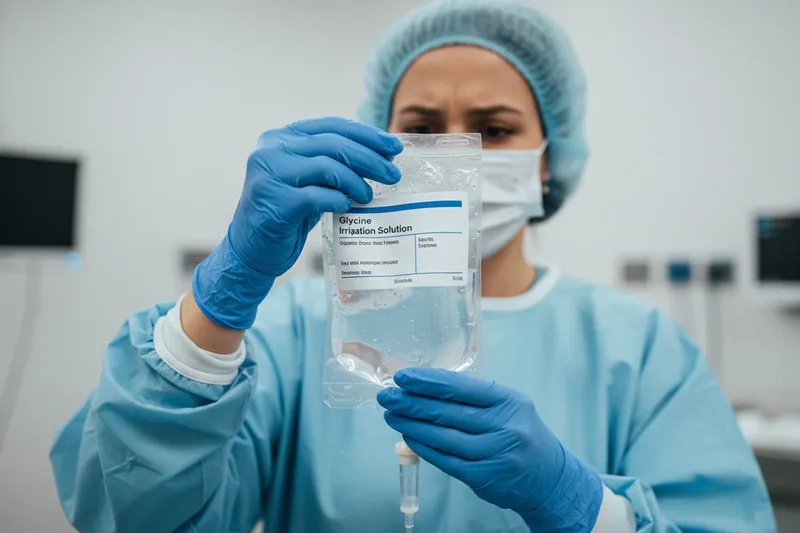
Have you ever had surgery, that is, an operation? Or have you seen or heard someone do it? When performing surgery, it is essential for the doctors to clearly see the area where the surgery is being performed, and to keep the area clean. Today, we are going to talk about a special liquid that can be used to help in such cases. Its name is Glycine Irrigation Solution.
Simply put, what is this Glycine liquid?
This isn't really a medicine you drink or inject for a disease. It's a special liquid that's used to clean (irrigate) and keep the area clear during surgery. To be precise, it does several key things.
- Providing a clear view: The surgical site is filled with this liquid and kept slightly dilated. This allows the doctor to see the organs and tissues inside very clearly, just like seeing the other side of a glass filled with water.
- Keeping the area clean: This liquid helps to wash away small pieces of tissue and blood that are removed during surgery, keeping the area clean.
- Reducing tissue damage: Keeping the area moist with a liquid like this, rather than dry, also minimizes the potential damage to delicate tissues.
The important thing is, this is not a medicine you can take home. It is only used in a hospital or clinic, during surgery, by a trained medical professional.
Things your doctor should know about you before using this liquid
Before undergoing any medical treatment, it is very important to give your doctor a complete explanation of your health condition. Especially before undergoing any surgery that involves the use of this `(Glycine)` liquid, be sure to inform your medical team if you have any of the following conditions:
| Health condition or problem | Why is it important to inform the doctor ? |
|---|---|
| Heart disease | Since extra fluid can enter the body during surgery, it can affect the functioning of the heart. Therefore, special attention should be paid to people with heart disease. |
| Kidney disease | The kidneys control the balance of fluids and salts in the body. If there is a problem with the kidneys, this fluid balance can be disrupted. |
| Low sodium level in the blood | Using this liquid can sometimes cause the sodium level in the blood to drop even lower, which can be dangerous for someone who is already low on sodium. |
| Lung disease | Increased fluid in the body can affect some lung conditions. |
| Allergies | If you have any allergies to Glycine, other medications, foods, dyes, or preservatives, it is very important to inform us in advance. |
| Pregnancy or expecting a child | Please inform your doctor of this, as extra care should be taken before undergoing any treatment during pregnancy. |
| Breastfeeding | If you are a breastfeeding mother, it is also important to inform the medical team. |
What are the possible side effects of this?
As with any medical procedure, there are some possible side effects when using this liquid. But remember, you are under the full supervision of doctors and nurses. So if any problems arise, they will take the necessary measures right away.
| Type of side effect | Symptoms you may experience |
|---|---|
| Side effects that should be reported to your medical team immediately | |
| Allergic reactions | Skin rash, itching, swelling of the face, lips, tongue or throat. |
| Heart failure | Difficulty breathing, swelling of the ankles, feet or hands, sudden weight gain, unusual fatigue. |
| Low sodium level in the blood | Muscle weakness, fatigue, dizziness, headache, confusion. |
| Side effects that are usually not serious, but should be reported if they persist | |
| Dizziness or fainting | Feeling dizzy or having blue eyes. |
| Nausea | Feeling like vomiting. |
Does this interact with other medications? (Drug Interactions)
Generally, this Glycine solution has not been reported to cause major problems with other medications, because it is a topical solution rather than a drug that works throughout the body.
However, for your best safety , it is wise to inform your doctor about any medications you are taking - including prescription medications, over-the-counter medications, vitamins, herbal remedies, and traditional medicines - before surgery, as well as if you smoke or drink alcohol.
Could it be an overdose?
This is not something you can control, but something that is completely supervised by the medical team, so the chance of an 'overdose' is very low. They will monitor your body's functions (salt levels, heart rate, etc.) throughout the surgery. If you somehow get too much fluid in your body, they will be ready to treat it. So you don't need to worry about it.
In an emergency, that is, if there is a suspicion of poisoning, the best thing to do is to immediately call the National Poisons Information Centre at the Colombo National Hospital . It is also very important to go to the Emergency Treatment Unit (ETU) of the nearest hospital.
Take-Home Message
- Glycine solution is not a medicine you take for a disease. It is a special liquid that doctors use to keep the surgical area clean and clear during surgery.
- This is only given and used in a hospital or clinical setting, by a trained medical team. You will not be able to take it home and use it.
- Before any surgery, it is imperative to tell your doctor about all health conditions you have, such as heart disease, kidney disease, and allergies.
- If you experience any discomfort or unusual symptoms (such as itching or difficulty breathing) during treatment, tell your doctor or nurse immediately. Don't worry, you will be monitored closely.




💬 Comments (0)
No comments yet. Be the first to share your thoughts here.
Add Your Comment