
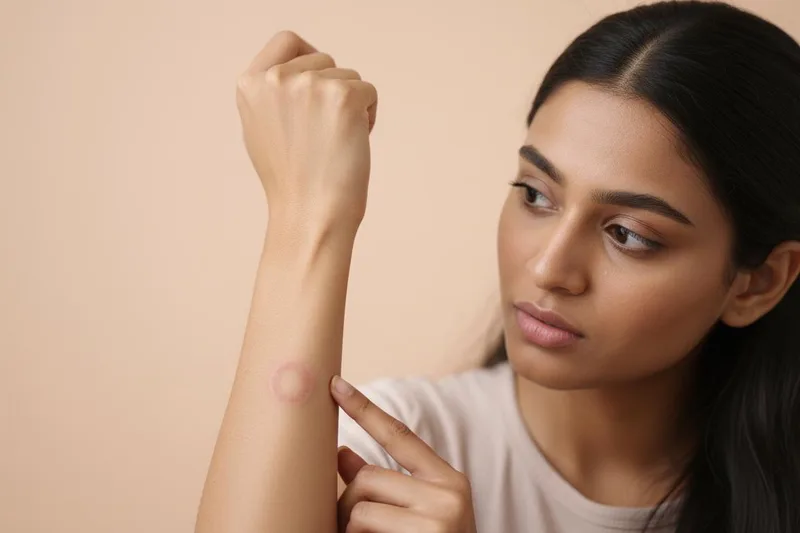
Have you ever noticed a round, raised rash on your arm, leg, or anywhere on your body? Sometimes it doesn't hurt or itch. But when you see it, you wonder, "What is this?" Most of the time, a rash like this could be a condition called `Granuloma Annulare`, which we're talking about today. Don't worry, it's not dangerous. Let's talk about everything in simple terms.
Simply put, what is Granuloma Annulare?
Granuloma Annulare is a benign, non-cancerous, but sometimes chronic skin condition. It is caused by a small amount of inflammation under the skin. This can cause a circular, discolored rash on the skin. Sometimes, it can also appear as small bumps under the skin. These are most commonly seen on the hands, feet, elbows, and forearms .
The most important thing is that Granuloma Annulare is not a contagious disease. This means that it cannot be spread from one person to another through contact.
What are the main types of Granuloma Annulare?
There are about five main types of this condition. Sometimes a person can have more than one of these types at the same time. Let's try to make them easier to identify.
| Type name | What happens in that? |
|---|---|
| Localized Granuloma Annulare | This is the most common type. It causes a circular rash that is limited to one area of the body. |
| Generalized (Disseminated) Granuloma Annulare | Here, small bumps spread over a large area of the body. For example, the entire forehead. |
| Subcutaneous Granuloma Annulare | This causes bumps to form under the skin. A rash may not be visible on top. |
| Perforating Granuloma Annulare | Painful lumps appear on the hands and fingers. Sometimes these may ooze a liquid-like discharge. |
| Patch Granuloma Annulare | A flat, spot-like rash appears on the skin surface. These are not visible as they are raised above the skin. |
Who is affected the most by this situation?
Although Granuloma Annulare can occur at any age, it is most common in children and young adults . It is also twice as likely to occur in women than in men.
Additionally, people with certain medical conditions are at a slightly higher risk of developing this condition.
- Diabetes: People with type 1 diabetes (insulin-dependent diabetes) are particularly at risk.
- Thyroid disease: This can also be seen in people with conditions such as thyroiditis and hypothyroidism.
Therefore, if your doctor tells you that you have Granuloma Annulare, especially if it is the generalized type, it is very important to talk to him about getting tested for other conditions, such as diabetes.
What effects does this have on the body?
Physically, after the rash has gone, the skin may darken in those areas (`Hyperpigmentation`) , especially in those with darker skin tones. However, scars are usually not left behind.
In addition, it can also have a psychological impact. When a rash like this is present in a visible area of the body for a long time, it can cause discomfort, anxiety, or stress. That's normal.
What is the difference between Granuloma Annulare and Ringworm?
Many people mistake the rash of `Granuloma Annulare` for `Ringworm` because both have a circular appearance. However, the two are completely different.
| Characteristic | Granuloma Annulare | Ringworm |
|---|---|---|
| Reason | The exact cause is unknown. It is thought to be an immune system process. | Caused by a fungal infection. |
| Is it contagious? | No. It is not transmitted from one person to another. | Yes. It spreads very quickly. It can be spread through touch and clothing. |
| Do you scratch? | It usually does not itch or hurt (perforating type may be painful). | Scratching hard. |
| Appearance | The skin is smooth. The edge of the circle is clear. It doesn't peel off like a coral. | The edge of the circle is red and has coral. The middle is clear. |
What is the reason for this situation?
In fact, doctors still don't know the exact cause of Granuloma Annulare. But the main idea is that it occurs when our body's immune system reacts inappropriately to an injury or other stimulus on the skin.
In addition, it is thought that this condition may be caused by the following:
- Insect bites.
- Some medications, for example `Allopurinol`.
- Some medical conditions, like HIV and Hepatitis C.
- For some people, this can also occur due to environmental factors, such as prolonged exposure to the sun.
Does stress affect this?
Yes, some research has found that long-term stress can also be a cause of Granuloma Annulare. Reducing your stress levels can help control this condition.
- Take a deep breath and count to 10.
- Exercise daily.
- Control caffeine and alcohol.
- Get 8 hours of good sleep a day.
- Eat healthy foods.
- Try to think positively.
- Talk about your problems with a trusted friend or family member.
How does a doctor recognize this?
When you go to see a doctor, the first thing he or she will do is examine your skin carefully. You can often tell if it is Granuloma Annulare by the appearance of the rash.
However, if you need to confirm the diagnosis, your doctor may recommend a skin biopsy . This involves taking a small piece of skin and examining it under a microscope to determine exactly what is causing the rash.
What are the treatments for this?
The good news is that for most people, Granuloma Annulare will clear up on its own without any treatment . It usually goes away completely within two years. However, for some people, the rash may recur at a later date.
But if the rash is widespread or the bumps under the skin are large, your doctor may refer you for treatment. The main goal of treatment is to control the itching or pain and help the rash heal quickly.
There are several treatment options:
- Medications: Medications that reduce skin inflammation can be used. Creams or ointments like `Corticosteroids` and `Tacrolimus` can be applied to the skin. Sometimes these are also given as injections. Pills like `Hydroxychloroquine`, which is used for malaria, are also sometimes used.
- PUVA therapy: This is a special type of light therapy. Here, the skin is exposed to ultraviolet A (Ultraviolet A) light, followed by a drug called Psoralen, which makes the skin sensitive to light.
- Cryotherapy: Using a special device, the area of the rash is frozen. This means that the cells are destroyed by making them very cold.
- Laser Therapy: The rash is treated with a special laser beam.
- Vitamin E tablets: These may be recommended in cases that do not respond to other treatments.
Granuloma Annulare can be difficult to treat for some people. You may need to try several different treatments until you find the one that works best for you.
Take-Home Message
- Granuloma Annulare is not a dangerous or harmful condition like cancer.
- This is not contagious from one person to another, so don't worry about your family.
- In most cases, it resolves on its own within two years, without any treatment.
- This rash is not ringworm. Ringworm is a fungal infection, but this is different.
- Sometimes this condition can be related to diabetes or thyroid disease, so it's important to see a doctor for an accurate diagnosis.
- If you are feeling uncomfortable about the rash, talk to your doctor about that as well.


💬 Comments (0)
No comments yet. Be the first to share your thoughts here.
Add Your Comment