
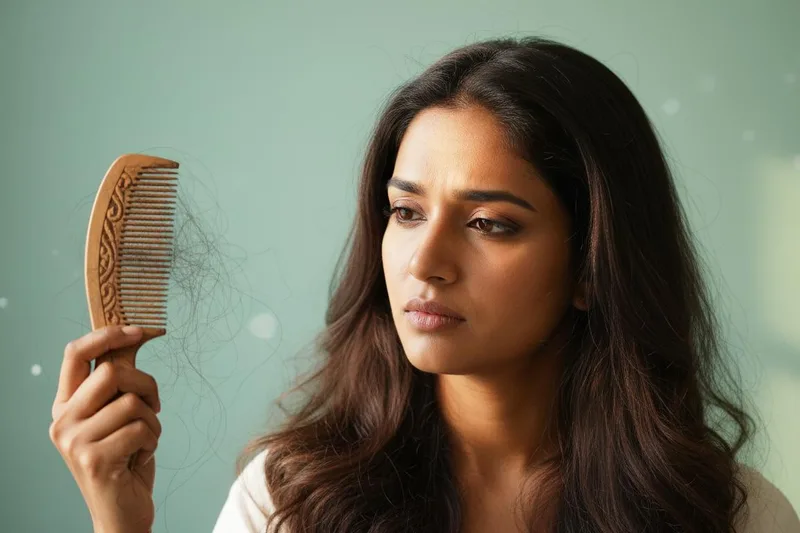
Have you ever noticed the amount of hair that gets stuck in your comb when you comb your hair, or the amount of hair that accumulates on the bathroom floor when you shower, and thought, "Oh, is my hair going too?"? Maybe your hair has become thinner than it used to be, and it feels like it's less manageable. In fact, this is a problem that many women have and that worries them. So today, let's learn exactly about hair loss in women, that is, `(Hair Loss)`.
What is hair loss in women?
Simply put, hair loss in women is the unexpected loss of more hair than normal. On average, we all lose about 50 to 100 hairs a day. It's a very natural process. Think of it like old leaves falling out, as some hairs fall out, new hairs grow in their place. This is the natural balance.
However, if this balance is disrupted, meaning that new hairs are not growing at the same rate as those that are falling out, then we face a condition called hair loss. In medical terms, this is called ``Alopecia''.
We have hair almost everywhere on our bodies, right? Except for places like our palms, soles, lips, and eyelids. Some of them are very fine, light-colored, and short. We call them `(Vellus hair)`. The other type is `(Terminal hair)`. They are thick, dark-colored, and long hairs. We have `(Terminal hair)` on our heads.
How does the hair growth cycle happen?
Our hair doesn't just grow like a tree. It has a pattern, a cycle. There are three main stages in this cycle:
1. Anagen phase: This is the period when the hair follicles are actively growing. This period can last from two to eight years. Typically, 85% to 90% of the hair follicles on our heads are in this phase.
2. Catagen phase: This is when the hair follicle shrinks. This takes about two to three weeks.
3. Telogen phase: This lasts for about two to four months. At the end of this phase, the hair follicle falls out.
Just think, our eyelashes, like the hair on our arms and legs, have a very short ``Anagen phase``, about a month. But the hair on our head can stay in this growth phase for six or seven years, maybe even longer.
What are the main types of hair loss in women?
We can identify three main types of hair loss in women:
- Androgenetic alopecia / Female Pattern Hair Loss (FPHL): This is the most common type of baldness. It is characterized by thinning of the hair on the top and sides of the head.
- Anagen effluvium: This is caused by certain medications, such as chemotherapy for cancer, which damage growing hair follicles and cause hair loss.
- Telogen effluvium: This is when a large number of hair follicles suddenly enter the resting phase, or Telogen phase, and are shed. This condition can occur during times of great stress, severe illness, after childbirth, or major surgery.
How common is hair loss among women?
Many people think that hair loss is something that only affects men. But did you know that studies have shown that more than 50% of women will experience hair loss at some point in their lives? In the United States alone, about 30 million women suffer from Female Pattern Hair Loss (FPHL). So, you are not alone.
What are the symptoms of hair loss?
How can you tell if you're losing more hair than normal? Here are some signs to look out for:
- An increase in the amount of hair that falls out daily (e.g. on the comb, pillowcase, bathroom floor)
- Hair thinning in some areas, scalp becoming visible, especially the parting line widening on the top of the head.
- Increased visibility of scalp skin behind the hair.
- When I put my hair together and tie it , I end up with a smaller ball than before.
- Feeling like your hair is breaking through the branches.
What are the causes of hair loss in women?
Why does this happen? There could actually be many reasons for this. Let's look at some of the main ones:
- Damage to hair follicles: Due to frequent `(chemical)` treatments (straightening, perming, coloring), and using high temperatures.
- Changes in eating habits: Sudden weight loss, lack of balanced nutrition.
- Stress: This is a major cause that affects many people.
- Treatments for diseases such as cancer: Treatments such as `(Chemotherapy)` or `(Radiation therapy)`.
- Underlying health conditions: Thyroid problems, anemia (iron deficiency), vitamin deficiencies (especially vitamin D, B vitamins, zinc).
- Hormonal changes: Hormonal levels change during pregnancy, postpartum, menopause, etc. Stopping birth control pills can also sometimes have an effect.
- Certain medications and supplements: Medications for high blood pressure, medications for gout, and high doses of vitamin A.
- Hereditary predisposition (genetic influence): If someone in your family has this condition, you are more likely to have it too.
What is the connection between hair loss and menopause?
Menopause is a time of great change in a woman's life. During this time, there are major changes in the body's hormone levels. This can directly affect your hair. How?
- Hair may start to grow in places where there was no hair before (e.g. on the face).
- The hair on your head may start to thin.
These changes occur as the levels of the hormones estrogen and progesterone decrease with menopause. In addition, the hair follicles shrink and the hair strands begin to thin and become thinner.
What are the risk factors for hair loss?
Female pattern hair loss can affect anyone, at any age. However, there are some situations where this risk is even higher:
- After the age of 40.
- If someone in the family has this condition (genetic influence).
- After pregnancy.
- After treatments such as chemotherapy or radiation therapy.
- With menopause.
How does a doctor diagnose hair loss?
If you think your hair loss is a problem, the best thing to do is to see a doctor, especially a dermatologist. He or she will examine you thoroughly and ask about any changes in your hair growth, your family history, the medications you take, and your lifestyle.
Then, if necessary, some tests can be done.
What tests are used to diagnose hair loss?
- Hair Pull Test: The doctor will grab a small section of your hair and pull it gently. They will then check how many hairs come out of your hand.
- Scalp examination under a microscope: A close look at the condition of the scalp and hair follicles.
- Blood tests: These check vitamin and mineral levels (such as vitamin D, B vitamins, zinc, and iron) and hormone levels (especially thyroid hormones).
- Scalp biopsy: This involves taking a very small piece of skin from the scalp and examining it under a microscope. This is not done for everyone, but only if necessary.
What kind of questions might a doctor ask you?
A doctor may ask you things like:
- What products do you use on your hair? (Such as shampoo, conditioner, gel, spray)
- What styles do you do with your hair? (Like do you tie it up tightly, do you heat it often)
- Do you have a hair pulling habit (Trichotillomania)?
- Does anyone in your family have a hair loss problem?
- Are you under a lot of stress in your life these days?
- What medications and vitamins do you take daily?
- Have you ever had hair like this before?
- What is in your diet in excess?
- How long have you had this hair problem?
- Has your hair loss increased?
- Have you noticed that hair is growing on your eyebrows and other parts of your body besides your head?
- Does anything cause hair loss to increase or decrease?
- Is this an ongoing problem, or does it come and go from time to time?
- Has the way your hair grows changed?
- Is your hair breaking more than before?
It is with your answers to questions like these that a doctor can accurately understand your condition and decide on the most appropriate treatment.
How to treat hair loss in women?
The best thing to do is to find the exact cause of your hair loss and treat it accordingly. Treatments vary depending on the cause. They may include:
- Reducing stress: Seek advice from a mental health counselor if necessary.
- Avoiding chemical treatments and products that are harmful to the hair.
- If you have a vitamin or mineral deficiency, take supplements (only on medical advice).
- Switching to hair styling methods that don't damage the hair follicles.
- Use of medications.
- Managing underlying health conditions (e.g., treating thyroid problems)
In addition, a doctor may recommend light therapy. For example, the HairMax Lasercomb® is a low-light laser comb. This is an FDA-approved device for treating FPHL. There are also the Theradome LH80 PRO® helmet and other low-light laser helmets and caps.
Important: If your hair loss is caused by stress or hormonal changes, such as pregnancy, special treatment may not be necessary. The hair loss may stop after a while.
Other treatments you can consider include:
- Scalp Microneedling: This can be done with or without the medication Minoxidil.
- Protein-Rich Plasma (PRP) injections: This is said to stimulate hair growth.
- Hair transplant surgery.
It is very important to talk to a doctor before starting any of these treatments. Some treatments may not be suitable for those who are pregnant, planning to become pregnant, or who are going through menopause.
What are the medications for hair loss?
A doctor may recommend using minoxidil (also known as Rogaine®). This is a medication approved to treat the condition (FPHL). You can buy a 2% or 5% solution at a pharmacy. However, you must follow the instructions exactly and use it consistently. Do not use this medication if you are pregnant, trying to become pregnant, or breastfeeding.
Other types of medications include:
- Spironolactone and other anti-androgens.
- Finasteride and other alpha-reductase enzyme inhibitors.
- Estrogens.
- Prostaglandin analogs.
- Steroids (These are usually given in special cases, under medical supervision)
Does Minoxidil have side effects?
Yes, Minoxidil can cause some discomfort to your scalp. For example, dry scalp, flaking, itching and/or redness. If this happens, be sure to see your dermatologist.
Also, when using Minoxidil, you may notice hair growth in areas other than the scalp (e.g. cheeks, forehead). Therefore, wash your face thoroughly after applying the medication, and be careful not to get the medication on other areas when applying it.
Who treats hair loss?
Hair loss in women is usually treated by a dermatologist.
Can hair loss in women be prevented?
In fact, it is not possible to prevent all types of hair loss. For example, it is difficult to prevent things that happen due to genetic factors. However, you can prevent damage caused by ``(chemical)`` hair treatments by not doing them. Also, eating a nutritious diet, eating foods that provide the body with the necessary vitamins, minerals and proteins, and perhaps taking daily vitamin supplements (on medical advice) can control hair loss to some extent.
What is the prognosis for hair loss?
The outcome depends on the type of hair loss you have and its severity. Some types of hair loss are permanent, especially if the hair follicles are damaged. But not all are. For example, conditions like `(Anagen effluvium)` and `(Telogen effluvium)` can stop over time. Hair loss usually improves when the underlying health conditions are controlled. Also, if `(Alopecia)` is treated early, it can slow down the rate of hair thinning and stimulate regrowth. You can learn more about your condition from a doctor.
Some tips to deal with hair loss
Losing hair can be a stressful experience, but there are a few things you can do to help you cope and feel a little more comfortable:
- Changing hair color: When you apply hair dye to your hair, it can make your hair appear thicker because the volume of the hair shafts increases.
- Scalp massage: While washing your hair, gently massage your scalp with your fingers. This stimulates blood flow to the scalp and hair follicles.
- Changing your hairstyle: Cutting your hair short, adding layers, or getting a new style can boost your confidence and help cover up areas where you're losing hair.
- Using different types of shampoo and hair products: Choose a shampoo that is free of sulfate detergents and adds volume to your hair.
When should I see a doctor?
As soon as you notice that you are losing hair, see a dermatologist as soon as possible. The sooner treatment begins, the more likely it is to be successful.
What questions should I ask my doctor?
You can ask your doctor questions like these:
- What is causing my hair to fall out?
- How many strands of hair do I lose per day?
- What type of hair loss do I have?
- Is my hair loss permanent?
- What is the best treatment for me?
Although hair loss is not life-threatening, it is a very emotional experience. Changes in our appearance can affect our self-esteem and social life. Some people find relief from the discomfort caused by this by talking to a mental health counselor . Others may find relief by changing their hairstyle or wearing a wig.
Take-Home Message from Today's Story
So, here are the most important things you need to remember about the female hair loss we talked about today:
- Hair loss is a common condition among women. You are not alone.
- There can be many reasons: genetics, hormones, stress, nutritional deficiencies, certain diseases, and medications.
- It is very important to seek medical advice immediately. See a dermatologist.
- There are different treatments depending on the cause. Talk to your doctor to choose the one that suits you best.
- This condition can be controlled to some extent with simple lifestyle changes and proper care.
We hope you find this information helpful. If you have a similar problem, please seek medical advice.
` Women's hair loss, hair loss, alopecia, hair thinning, women's health, skin diseases, hair treatment




💬 Comments (0)
No comments yet. Be the first to share your thoughts here.
Add Your Comment