

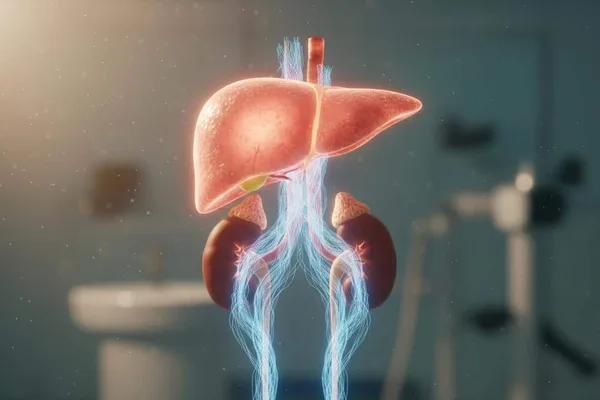
Have you ever thought that a serious problem with your liver could cause both of your perfectly healthy kidneys to stop working at once? It's a scary thought, isn't it? Today we're going to talk about a serious, life-threatening condition that can occur with liver failure. This is what doctors call Hepatorenal Syndrome (HRS) . Let's take a look at what it is, why it happens, and what else we can do.
What is Hepatorenal Syndrome?
Simply put, hepatorenal syndrome (HRS) is a condition in which your liver is not working properly, a very serious complication that occurs in the final stages of liver failure. What happens in this case is that your kidneys suddenly lose their function due to liver problems. What’s special is that this is considered prerenal acute kidney failure . This means that you can have this condition even if you don’t have any previous kidney disease and there are no physical changes or damage to your kidneys. Your kidneys may be perfectly healthy, but because of the liver problem, the blood supply to them is disrupted, and they can’t do their job.
Think of it like a water pump that is working fine, but if the water pipe to the water tank is blocked, the water will not come out. The kidneys are fine, but problems with the liver cause the blood vessels that carry blood to the kidneys to become blocked and narrow. Then, the kidneys do not get the blood they need, and their function gradually decreases. This is considered an emergency , and in most cases, the only permanent treatment for this is a liver transplant .
Who is most affected by this situation?
This condition, called hepatorenal syndrome (HRS), mainly affects people with severe liver disease . In particular, people with chronic, progressive liver disease , whose liver has been gradually weakening over time, are at the highest risk for this condition. Did you know that due to such long-term liver disease, the liver tissue becomes scarred and the liver becomes hard. We call this cirrhosis . Due to this condition, the blood supply to the liver changes, and over time, the liver stops working.
Also, HRS can occur in acute liver failure, which occurs suddenly for some reason. Studies have shown that about 40% of people with end-stage liver failure develop HRS. Although it can occur at any age and regardless of gender, it is usually more common in people in their second half of life. It also occurs in about 10% of people with chronic or acute liver failure who are hospitalized. Although there are more than one cause of kidney failure due to liver disease, HRS is unique in that it occurs in people who have no previous kidney disease.
How does cirrhosis cause hepatorenal syndrome?
This is a bit of a complicated issue. There are still differing opinions among researchers about exactly how liver disease causes hepatorenal syndrome (HRS), that is, its pathophysiology .
How does this actually happen? (Pathophysiology)
As we know, kidney failure occurs when the blood vessels in the kidneys become narrowed, blocked, and the blood flow to them is reduced. Researchers believe that this narrowing of the blood vessels is caused by a combination of factors associated with liver disease and liver failure. The main cause of this is portal hypertension .
Portal hypertension is a condition in which the blood pressure in the portal vein, the main vein that runs through your liver, and the veins that connect to it and extend throughout your digestive system, increases. The most common cause of this is cirrhosis . Cirrhosis can also cause a condition called cirrhotic cardiomyopathy , which causes some of the arteries in your body to become abnormally wide. This complex blood flow change causes some blood vessels to widen while others (especially those in your kidneys) narrow. Think of it like a traffic jam on one side of a road, which affects the other sides as well.
What are the precipitating factors that exacerbate this situation?
There are other things that are associated with liver disease that can be a "trigger" or precipitating factor for HRS. The most common of these is Spontaneous Bacterial Peritonitis (SBP) . This is a bacterial infection of the lining of your abdomen (peritoneum). SBP is a complication of ascites , which is a buildup of fluid in the abdomen. Ascites is caused by fluid leaking from the veins in the abdomen due to portal hypertension.
Imagine, if your abdomen is filled with water (ascites), germs can easily enter there and cause an infection. That's what this spontaneous bacterial peritonitis (SBP) is called.
Also, portal hypertension can cause your veins to burst and bleed into your abdomen. Acute blood loss from gastrointestinal bleeding is another contributing factor. Not only that, but excessive use of diuretics , or "water pills," can also be a cause. Diuretics work by removing excess fluid from the body. People with advanced liver disease may take these water pills for ascites or edema , which is swelling in the body.
What are the symptoms?
People with hepatorenal syndrome (HRS) usually first experience a vague, general feeling of unwellness. Symptoms include:
- Fatigue
- Nausea
- Stomach ache
- Bad taste in the mouth
In addition, they may also have symptoms of advanced liver disease or liver failure. These include:
- Jaundice (yellowing of the whites of the eyes)
- Easy bruising and bleeding
- Light-colored stools and dark-colored urine
- Abdominal swelling (due to ascites, an enlarged liver or spleen)
- Itchy skin
- Confusion, memory loss, or drowsiness (Hepatic Encephalopathy)
When kidney failure becomes severe, you may notice that the amount of urine you produce has decreased significantly .
How do you recognize this?
Hepatorenal syndrome (HRS) is a type of kidney failure that occurs in the presence of severe liver disease and no other cause of kidney failure. So, doctors diagnose this by first confirming liver disease and kidney failure, and then ruling out other possible causes of kidney failure. To do this, they use various imaging tests , such as scans, blood tests, and urine tests, to check how your liver and kidneys are working.
How is it treated?
Although HRS is a very serious condition due to kidney failure, the root of the problem lies in the liver . Hepatorenal syndrome (HRS) is classified as a "prerenal" form of acute kidney failure because your kidneys are otherwise healthy. In fact, if your kidneys are taken and transplanted into someone else's body, they will work just fine. Similarly, if your liver function returns to normal, there is a good chance that your kidneys will start working again.
Some people with acute liver failure may recover both their liver and kidney function. But everyone else will need a liver transplant . They may need a liver transplant at some point anyway, but HRS makes the need even more urgent. However, not everyone qualifies for a liver transplant, and even if they do, they have to wait until they receive one.
At a time like this, prompt treatment and proper management are the most important things.
In the meantime, your doctor or nurse will try to preserve your kidney function as much as possible and reduce the symptoms and side effects of this condition. These steps can improve your overall health and help prepare you for a liver transplant. They can also help improve the outcome of a liver transplant if you do have one. However, these are not cures . These treatments may include:
- IV fluids , which are things like saline, are given to correct electrolyte imbalances in the body and help blood flow to the kidneys.
- Stopping certain medications, such as diuretics (water pills).
- Giving antibiotics for associated infections.
- Paracentesis is performed to remove excess fluid accumulated due to ascites.
- Giving medications called vasoconstrictors . These work by narrowing your blood vessels that are abnormally wide and increasing blood flow to the kidneys.
- Hemodialysis , which is blood dialysis, is a treatment to help your stressed kidneys.
Can it be prevented?
The best way to prevent hepatorenal syndrome (HRS) is to manage liver disease before it progresses to cirrhosis . Chronic liver disease is a condition that develops slowly over many years. People who know they have the condition can control and sometimes reverse the progression of the disease by doing things like cutting down on alcohol, losing weight, and improving their diet. However, because many people do not show symptoms, it may not be detected without a routine medical examination.
If you already have cirrhosis, there is no way to prevent or predict HRS. However, you can avoid the most common "trigger" for it, called spontaneous bacterial peritonitis (SBP) . SBP is the cause of about 25% of HRS cases in people with cirrhosis. So, if your doctor thinks you are at high risk for SBP, taking antibiotics as a preventative measure can reduce this trigger and reduce your chances of developing HRS.
Can this be cured? Is it life-threatening?
Without a liver transplant, many people are in a very serious condition. If HRS suddenly worsens and a transplant is not available, the average survival time is only two weeks . With chronic HRS, the average survival time without a transplant is three to six months . Depending on how severe the liver failure is, the condition can get worse quickly. Also, if the condition gets worse quickly, you may become too ill to undergo a transplant, which can be complicated.
However, if you get a liver transplant, your condition will improve significantly . People with HRS have a 60% chance of surviving three years after a liver transplant. This is slightly lower than the three-year survival rate for people who usually get a liver transplant (75%). Most people's kidney function will return to normal within a few weeks. A very small number (about 5%) may need to continue dialysis .
Whether you are a person with slowly deteriorating end-stage liver failure or a sudden onset of hepatorenal syndrome (HRS) that hastened your time, being on the liver donor waiting list is not a good idea. Because there are not enough donor livers available for people on that list. However, if you can find a living liver donor , you may not need to be on the list, and your overall health outcomes may improve.
Living donors are healthy volunteers, usually your loved ones, who are a match for your blood type and body size. Even a small piece of a liver taken from another living person can grow back into a complete liver in both you and the donor. Also, living livers are likely to be in better condition than livers taken from deceased donors. Surgeons make every effort to make the surgery on these heroic living donors as minimally invasive as possible.
Finally, things to remember
So, you probably now understand that hepatorenal syndrome is a serious condition that requires attention because it affects the kidneys due to liver problems.
- Liver health is very important: If you have any liver disease, it is very important to manage it properly, especially to prevent conditions like cirrhosis.
- Pay attention to symptoms: If you have symptoms related to liver disease or a general feeling of unwellness, see a doctor immediately.
- Think about your kidneys: When you have liver problems, you also need to take care of your kidneys. If you have symptoms like decreased urination, tell your doctor.
- There is treatment: Although HRS is a serious condition, treatments like liver transplants can save lives. So don't give up hope.
- Lifestyle is important: Things like a healthy lifestyle, a balanced diet, and avoiding alcohol help keep the liver healthy.
I hope this information is helpful to you. If you or someone you know is experiencing this type of problem, the best thing to do is to seek medical advice immediately.
` Hepatorenal syndrome, liver disease, kidney failure, cirrhosis, liver transplant, portal hypertension, ascites




💬 Comments (0)
No comments yet. Be the first to share your thoughts here.
Add Your Comment